
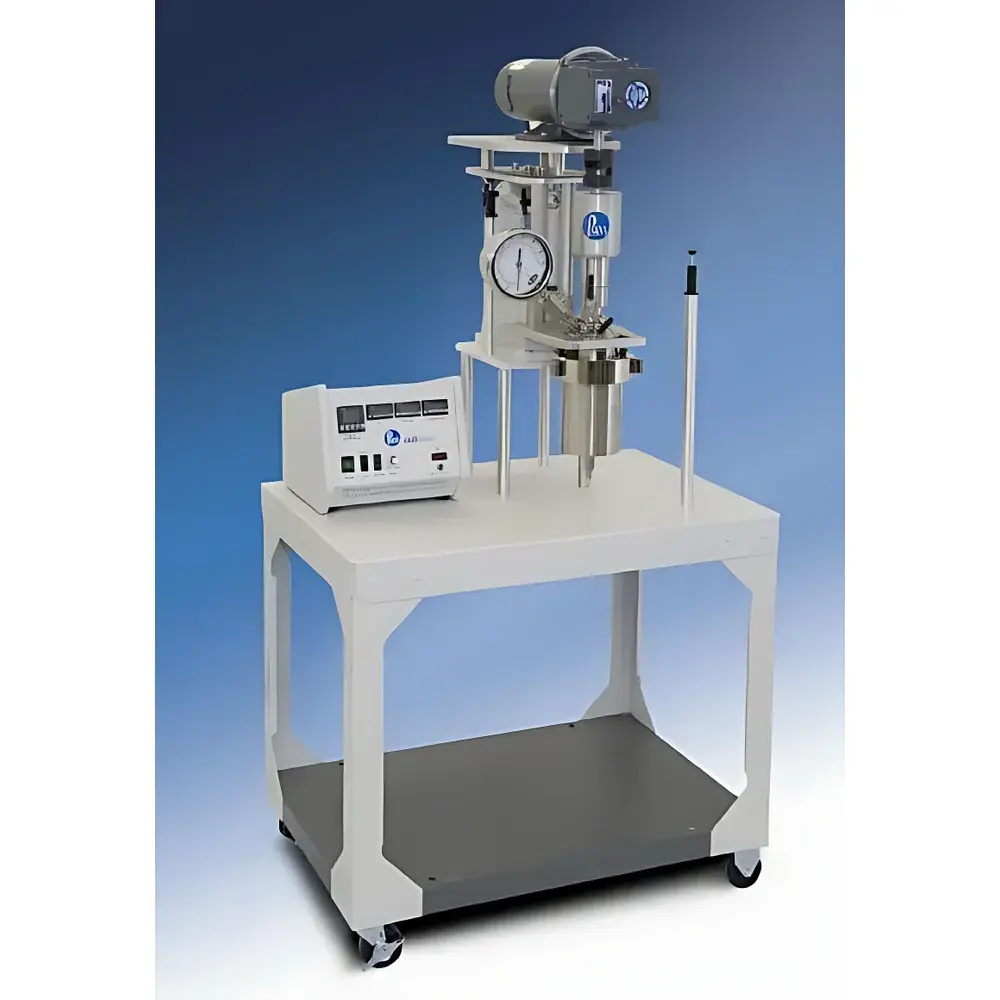
Parr Horizontal Stirred Reactor Model 4848
| Origin | USA |
|---|---|
| Manufacturer Type | Authorized Distributor |
| Origin Category | Imported |
| Model | Horizontal Stirred Reactor |
| Pricing | Upon Request |
Overview
The Parr Horizontal Stirred Reactor Model 4848 is an engineered solution for heterogeneous, high-viscosity, and fibrous reaction systems where conventional vertical reactors exhibit insufficient mixing efficiency. Designed around Couette-type shear dynamics and horizontal-axis rotational mechanics, this reactor enables uniform suspension, heat transfer, and mass transfer in challenging feedstocks—such as lignocellulosic biomass (e.g., straw, grasses), polymer melts, slurries, and catalyst-laden suspensions. Unlike vertically oriented stirred vessels, its horizontal orientation minimizes particle settling, reduces vortex formation, and ensures consistent torque delivery across the entire working volume. The system integrates a precision-engineered 1 L stainless steel (316 SS) pressure vessel rated to 1900 psi (131 bar) and 350 °C, compliant with ASME BPVC Section VIII Div. 1 design standards for laboratory-scale pressure equipment.
Key Features
- Horizontal orientation with dual-axis positioning: vertical for charging/loading and horizontal for active stirring—enabling safe, residue-free introduction of bulky or fibrous solids.
- High-torque DC motor (rated continuous output ≥ 2.5 N·m) coupled to a dual-layer anchor impeller geometry—optimized for scraping, axial pumping, and radial dispersion in non-Newtonian media.
- Modular heating via flexible silicone rubber heating jacket with PID-controlled surface temperature regulation up to 350 °C; thermal uniformity maintained within ±2 °C across the vessel wall under steady-state conditions.
- Parr 4848 multi-parameter controller featuring real-time digital display and closed-loop control of temperature (±0.5 °C accuracy), pressure (0–1900 psi, ±0.5% FS), and stir speed (0–300 rpm, resolution 1 rpm).
- Quick-release flange with dual O-ring sealing (Viton® primary + graphite backup) and integrated rupture disc protection per ASME PRT-1 requirements.
- Tilt-and-pour discharge mechanism with 0–90° adjustable inclination angle, enabling gravity-assisted emptying without disassembly or secondary pumping.
Sample Compatibility & Compliance
This reactor supports a broad range of sample types—including abrasive slurries, thermally sensitive biopolymers, corrosive reagents (pH 0–14), and solid-loaded suspensions up to 60 wt% solids content. All wetted parts conform to ASTM A276 for 316 stainless steel. Pressure and temperature control functions are validated per ISO/IEC 17025 calibration traceability protocols. The controller firmware supports audit trail logging and user access levels aligned with FDA 21 CFR Part 11 requirements when operated in GLP/GMP-compliant environments. Optional HART-enabled transmitters and Ethernet/IP connectivity allow integration into centralized lab automation platforms.
Software & Data Management
The Parr 4848 controller includes embedded data logging (up to 10,000 timestamped records) with USB export capability (CSV format). Optional ParrView™ PC software provides graphical trending, alarm configuration, recipe-based parameter sequencing, and automated report generation compliant with ISO 9001 documentation standards. All logged parameters—including setpoints, actuals, ramp rates, and fault codes—are time-stamped with microsecond resolution and stored with immutable metadata (operator ID, session ID, instrument serial number). Data integrity safeguards include write-once storage mode and SHA-256 hash verification for exported files.
Applications
- Biomass pretreatment studies (e.g., dilute acid hydrolysis, alkaline oxidation) requiring uniform fiber dispersion and thermal homogeneity.
- Heterogeneous catalytic hydrogenation of fatty acids and triglycerides under elevated H₂ pressure.
- Thermoset resin synthesis and curing kinetics evaluation with high-solids loading.
- Slurry-phase Fischer–Tropsch screening and catalyst deactivation profiling.
- Hydrothermal carbonization (HTC) and solvothermal nanomaterial synthesis where sedimentation must be suppressed during reaction hold times.
FAQ
What is the maximum allowable working pressure and temperature for this reactor?
The vessel is rated for 1900 psi (131 bar) and 350 °C, verified per ASME BPVC Section VIII Div. 1 certification.
Can the reactor handle abrasive or fibrous feedstocks without impeller wear or clogging?
Yes—the dual-layer anchor impeller is machined from hardened 316 SS and features generous tip clearance (≥3 mm); horizontal orientation prevents bridging and facilitates self-cleaning during rotation.
Is third-party calibration documentation available for regulatory submissions?
Yes—NIST-traceable calibration certificates for temperature, pressure, and speed sensors are provided upon request and meet ISO/IEC 17025 reporting requirements.
Does the system support remote monitoring or integration with LIMS?
Via optional Ethernet/IP or Modbus TCP interface modules; full OPC UA compatibility is supported through ParrView™ Enterprise Edition.
How is cleaning and maintenance performed between runs with viscous residues?
The horizontal orientation allows full 360° rotation for solvent rinsing; flange-mounted sight glass and drain port facilitate visual inspection and residue removal without internal tooling.



