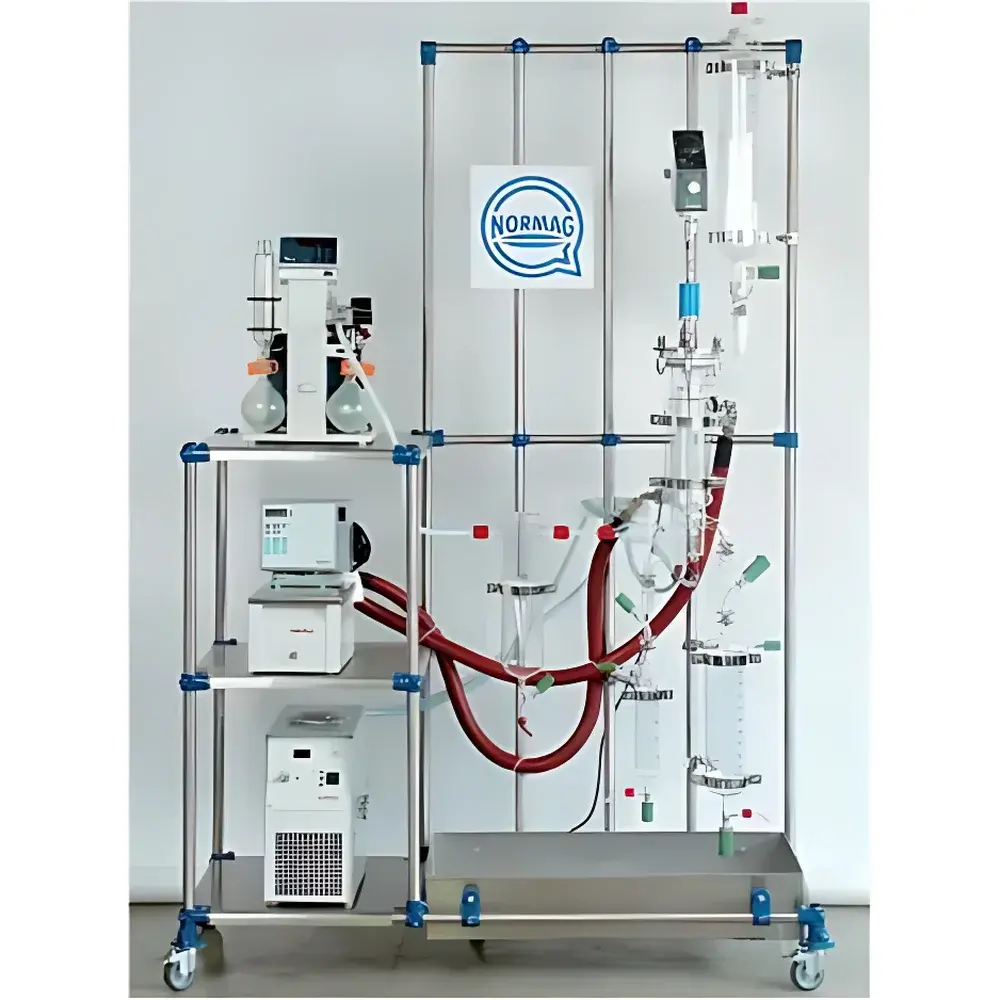
Normag DSV80 Short-Path Distillation System
| Brand | NORMAG |
|---|---|
| Origin | Germany |
| Model | DSV80 |
| Operating Pressure Range | 760 mbar to 10⁻³ mbar |
| Max. Heating Temperature | 250 °C |
| Feed Rate | 0.3–1 kg/h |
| Evaporator Type | Thin-Film & Falling-Film Configurable |
| Vacuum Compatibility | High-vacuum (≤10⁻³ mbar) |
| Application Scope | Thermally labile, high-viscosity, and heat-sensitive compounds |
Overview
The Normag DSV80 Short-Path Distillation System is an engineered solution for the gentle, high-efficiency separation and purification of thermally sensitive, high-boiling, or viscous substances under controlled high-vacuum conditions. Based on short-path distillation principles—where molecular mean free path exceeds the distance between evaporator surface and condenser—the DSV80 enables phase separation with minimal thermal stress. Unlike conventional batch distillation, this system operates with residence times typically under 10 seconds in the heated zone, significantly reducing decomposition, polymerization, or oxidative side reactions. Its dual-mode evaporator architecture supports both thin-film and falling-film configurations, allowing method flexibility across a broad spectrum of feedstock rheologies—from low-viscosity liquids (e.g., essential oils, solvents) to highly viscous materials (e.g., polymeric residues, crude bio-oils, or vitamin concentrates). Designed and manufactured in Germany, the DSV80 complies with fundamental engineering standards for vacuum integrity, thermal stability, and material compatibility (316L stainless steel wetted parts, borosilicate glass viewports, PTFE-sealed joints), ensuring long-term operational reliability in regulated laboratory and pilot-scale environments.
Key Features
- Modular evaporator design supporting interchangeable thin-film and falling-film modes—optimized for either high-shear, uniform film formation (thin-film) or low-pressure-drop, low-holdup operation (falling-film).
- Integrated high-vacuum capability down to 10⁻³ mbar, achieved via compatible vacuum pump interface (e.g., two-stage rotary vane or dry scroll pumps) and helium-leak-tested sealing architecture.
- Precision temperature control (±1 °C) over the entire evaporation zone, with independent heating zones for evaporator body and condenser jacket to maintain optimal ΔT gradients.
- Low liquid holdup (<5 mL in falling-film mode; <10 mL in thin-film mode), minimizing cross-contamination and enabling rapid method switching during multi-component fractionation.
- Robust mechanical construction: all-glass vacuum path (DIN-standard ground joints), corrosion-resistant 316L stainless steel frame, and vibration-damped base plate for stable long-duration runs.
- Optional integrated cold trap and pressure transducer with digital readout (0–1000 mbar range, ±0.5% FS accuracy) for real-time process monitoring and documentation.
Sample Compatibility & Compliance
The DSV80 accommodates feedstocks with viscosities up to 50,000 cP at processing temperature and solid contents up to 15 wt%, making it suitable for applications involving crude extracts, hydrogenated fats, epoxy resins, pharmaceutical intermediates, and natural product isolates. It meets fundamental requirements for Good Laboratory Practice (GLP) workflows: traceable temperature and pressure logging (when paired with external data acquisition), non-reactive wetted surfaces compliant with USP Class VI and FDA 21 CFR 177.1520, and mechanical design aligned with ISO 2852 (sanitary clamp connections) and PED 2014/68/EU (for optional pressurized condenser variants). While not intrinsically certified for GMP manufacturing, its reproducible performance, cleanability, and documentation readiness support qualification protocols per ASTM D2892 (petroleum fractionation) and ISO 6618 (short-path distillation of edible oils).
Software & Data Management
The DSV80 operates as a stand-alone instrument without proprietary software dependency. All critical parameters—evaporator temperature, condenser temperature, vacuum level, and feed rate—are monitored via analog or 4–20 mA outputs, enabling seamless integration into existing SCADA or LIMS platforms. Optional digital controllers (e.g., Watlow F4T or Eurotherm 3500 series) provide PID-regulated heating, programmable ramp/soak profiles, and audit-trail-capable event logging compliant with FDA 21 CFR Part 11 when configured with user-access controls and electronic signature functionality. Raw sensor data can be exported in CSV format for post-run analysis in MATLAB, Python, or industry-standard chromatography/data review software.
Applications
- Purification of omega-3 fatty acid ethyl esters from fish oil hydrolysates without cis-trans isomerization.
- Deacidification and deodorization of vegetable oil distillates (e.g., rice bran oil, sunflower sterol concentrates).
- Recovery of heat-labile active pharmaceutical ingredients (APIs) from reaction mixtures containing residual catalysts or solvents.
- Concentration of fragrance volatiles from botanical extracts while preserving delicate top notes.
- Removal of monomers and volatiles from silicone prepolymers prior to final curing.
- Lab-scale simulation of industrial wiped-film evaporation processes for scale-up studies in petrochemical and biorefinery R&D.
FAQ
What vacuum level is required for optimal operation of the DSV80?
The system is rated for continuous operation down to 10⁻³ mbar; however, optimal separation efficiency for most thermolabile compounds is achieved between 10⁻² and 10⁻³ mbar, depending on molecular weight and vapor pressure.
Can the DSV80 handle feedstocks containing suspended solids?
Yes—up to 15 wt% solids are compatible in falling-film mode, provided particles are non-abrasive and do not exceed 100 µm in diameter to avoid nozzle clogging or film disruption.
Is the DSV80 suitable for continuous operation over 8+ hours?
With proper cooling water flow, vacuum maintenance, and feed pump calibration, the DSV80 supports uninterrupted runs exceeding 12 hours; routine inspection of wiper blade wear (in thin-film mode) and condenser frost accumulation is recommended every 4–6 hours.
Does Normag provide validation documentation (IQ/OQ)?
Normag supplies factory test reports (leak test, temperature uniformity, vacuum decay) and dimensional compliance certificates; full IQ/OQ protocol development and execution must be performed by the end user or qualified third-party service provider per local regulatory expectations.
What maintenance intervals are recommended for long-term reliability?
Vacuum seals should be inspected quarterly; wiper blades (thin-film mode) replaced every 500 operating hours; and condenser surfaces cleaned after each batch when processing high-residue feeds to prevent thermal insulating deposits.