
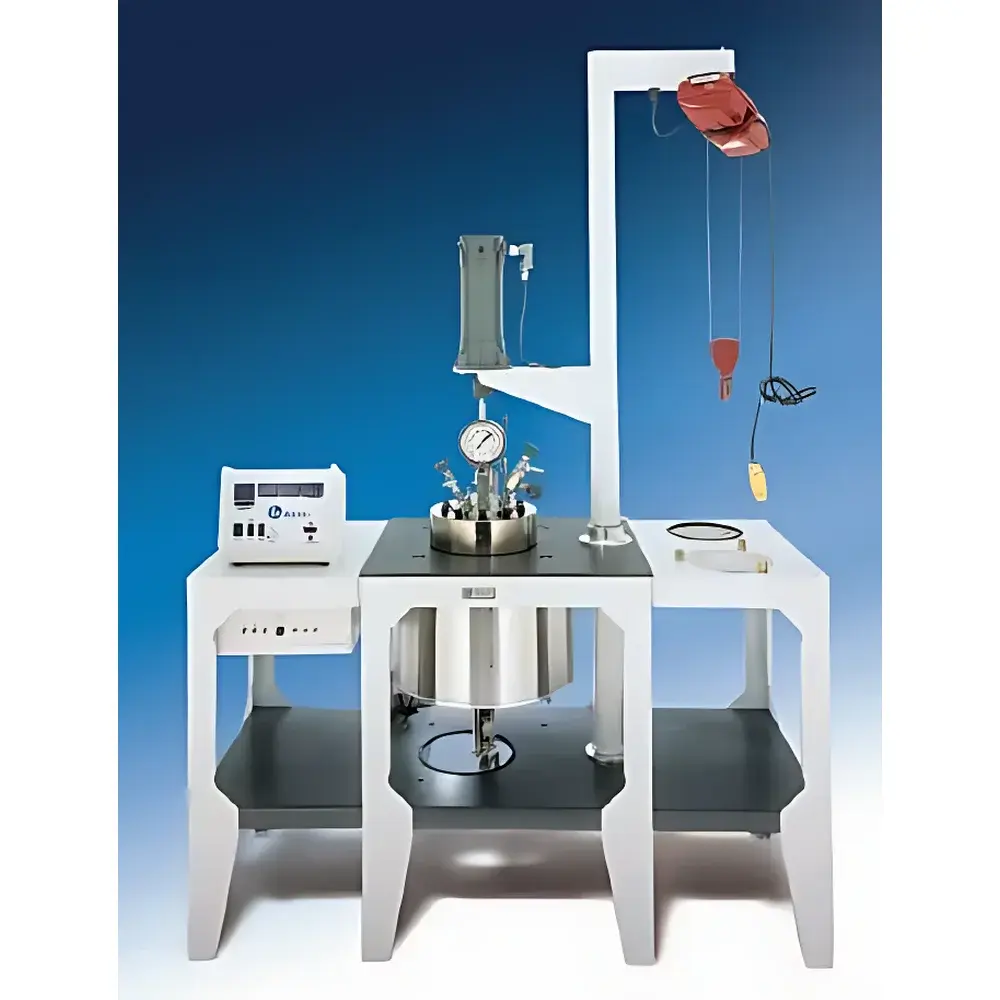
Parr 4555 Series High-Pressure Laboratory Reactor
| Brand | Parr |
|---|---|
| Origin | USA |
| Manufacturer Authorization | Authorized Distributor |
| Import Status | Imported |
| Model | 4555 Series |
| Price Range | USD $130,000–$260,000 (FOB) |
| Usable Volume | 10 L to 18.75 L |
| Maximum Operating Pressure | 130 atm (13.2 MPa) |
| Maximum Operating Temperature | 350 °C |
| Construction Materials | 316 Stainless Steel, Hastelloy C-276, Hastelloy C-2000 |
| Vacuum Capability | Not rated for vacuum service |
| Certification | ASME Section VIII Div. 1, UL/cUL Listed (uV), ISO 9001:2015, CSA C22.2 No. 61010-1, CE Marked |
Overview
The Parr 4555 Series High-Pressure Laboratory Reactor is a floor-standing, jacketed autoclave engineered for rigorous batch synthesis and kinetic studies under elevated temperature and pressure conditions. Designed and manufactured by Parr Instrument Company—a U.S.-based leader in high-pressure process equipment since 1916—the 4555 series implements a robust stirred-tank architecture based on proven Couette-flow agitation principles and precision-machined sealing systems. It operates on the fundamental principle of controlled exothermic or endothermic reaction containment, where thermal energy transfer occurs via external heating/cooling jackets (typically using steam, thermal oil, or electric cartridge heaters) and internal mechanical stirring. This configuration enables reproducible control over reaction thermodynamics, mass transfer rates, and phase behavior—critical parameters in catalytic hydrogenation, polymerization, hydrothermal synthesis, supercritical fluid processing, and pharmaceutical intermediate development. The reactor’s structural integrity is validated per ASME Section VIII Division 1 code requirements, with full traceability of material certifications (MTRs), non-destructive examination (NDE) records, and pressure test documentation included with each unit.
Key Features
- Modular design supporting interchangeable vessel liners and agitator configurations—including gas-inducing impellers, anchor-type scrapers, and dual-speed magnetic drive systems (standard 0–300 rpm, optional 0–600 rpm)
- Integrated safety architecture featuring redundant pressure monitoring (dual transducers + mechanical relief valve set at 110% MAWP), automatic temperature cutoff at 370 °C, and real-time torque feedback for viscosity-sensitive reactions
- High-integrity sealing system utilizing dual O-ring grooves with pressure-assisted backup seals; compatible with aggressive media including H₂, NH₃, Cl₂, and HF under specified material selection
- Jacketed vessel with uniform thermal distribution (±1.5 °C across 10 L volume at steady state); optional PID-controlled external circulator interface for sub-ambient operation down to –40 °C
- Standard instrumentation package includes 4–20 mA outputs for pressure, temperature, stirrer speed, and jacket temperature—fully compatible with third-party DCS/SCADA systems
Sample Compatibility & Compliance
The 4555 reactor accommodates heterogeneous, multiphase, and corrosive reaction mixtures—including slurries, gaseous reagents, viscous polymers, and halogenated solvents—when constructed with appropriate alloy selections (e.g., Hastelloy C-276 for chloride-rich environments). All vessels undergo hydrostatic testing at 1.3× MAWP prior to shipment, with test reports issued per ASME BPVC requirements. Regulatory compliance extends to ISO 9001:2015 quality management, UL/cUL safety listing for North America, CSA certification for industrial equipment, and CE marking for EU markets. While not intrinsically rated for explosive atmospheres (ATEX), optional explosion-proof motor packages and purge-ready enclosures are available upon request. The system supports GLP-compliant operation when paired with validated data acquisition software meeting FDA 21 CFR Part 11 requirements.
Software & Data Management
Parr’s optional Reactor Control Software (RCS v5.2) provides closed-loop automation for ramp-hold profiles, multi-step pressure sequencing, and event-triggered sampling logic. All process variables are timestamped with microsecond resolution and stored in encrypted .csv and SQL-compatible formats. Audit trails include user login history, parameter modification logs, and electronic signatures—fully traceable for regulatory submissions. Data export supports ASTM E2500-17 formatting conventions and integrates natively with LabArchives ELN and Thermo Fisher SampleManager LIMS platforms. Optional OPC UA server module enables bidirectional communication with enterprise MES systems.
Applications
- Catalytic hydrogenation of unsaturated organic compounds under 50–130 atm H₂
- Hydrothermal synthesis of metal–organic frameworks (MOFs) and nanocrystalline oxides at 200–350 °C
- Supercritical CO₂ extraction kinetics and phase-equilibrium mapping
- Batch polymerization of polyesters, polyethers, and polyurethanes with precise stoichiometric control
- Corrosion testing of alloys in simulated geothermal brines (pH 2–12, T ≤ 300 °C)
- Ammonia-based nitridation of transition metals for battery cathode precursor development
FAQ
What materials are standard for the 4555 reactor vessel body?
Standard construction uses ASTM A240 Type 316 stainless steel; Hastelloy C-276 and C-2000 are available as optional liner or monolithic vessel materials.
Is vacuum operation supported?
No—the 4555 series is designed exclusively for positive-pressure service; vacuum-rated models (e.g., Parr 4840 series) require separate specification.
Can the reactor be integrated into an existing plant control system?
Yes—4–20 mA analog I/O, Modbus RTU/TCP, and optional Profibus DP interfaces support seamless integration with DCS or PLC infrastructure.
What documentation is provided for regulatory validation?
Each unit ships with ASME Data Report (Form U-1), Material Test Reports (ASTM A240/A479), NDE reports (RT/UT), calibration certificates for all transmitters, and FAT/SAT protocols.
Does Parr offer installation and commissioning support outside the U.S.?
Yes—global technical service includes remote pre-commissioning checks, on-site startup assistance, and IQ/OQ protocol development aligned with ISO/IEC 17025 and GMP Annex 15 guidelines.



