
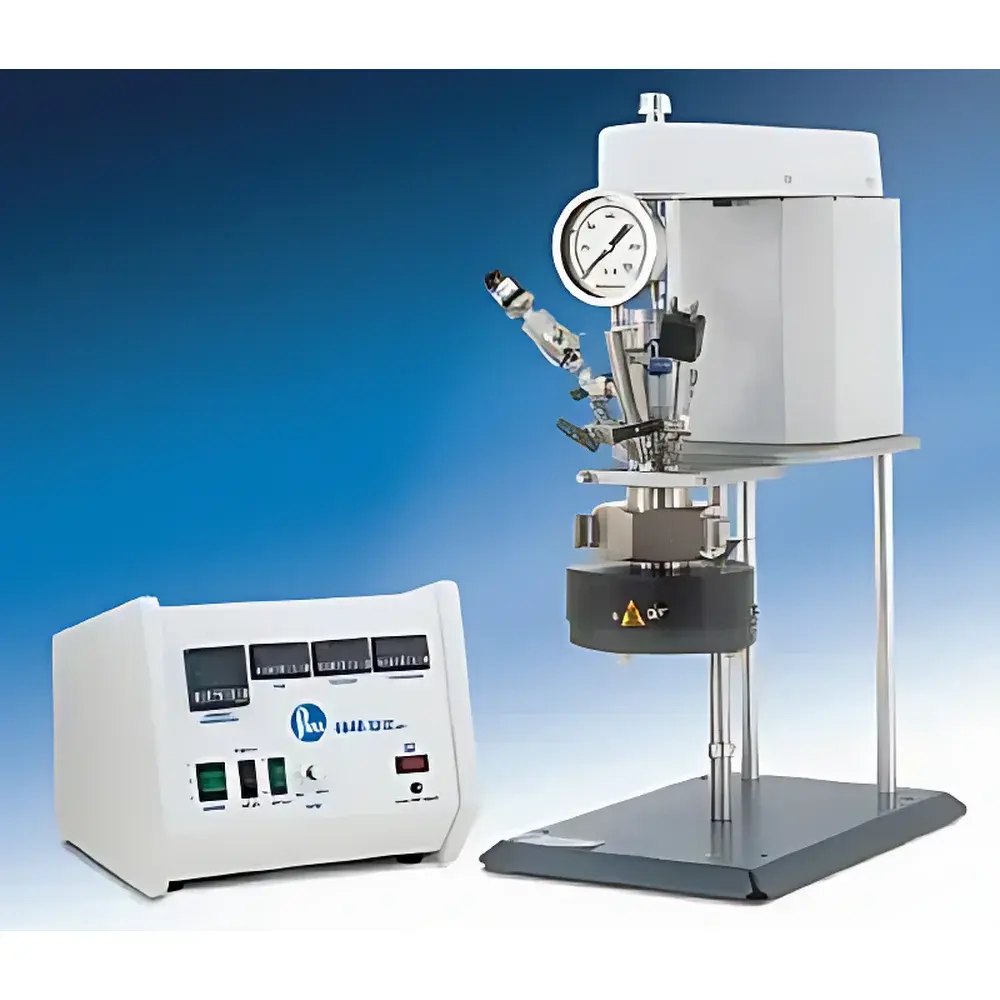
Parr 4590 Series Laboratory High-Pressure Reactor
| Brand | Parr |
|---|---|
| Origin | USA |
| Model | 4590 Series |
| Working Pressure | Up to 575 bar |
| Maximum Temperature | Up to 600 °C |
| Vessel Volume Options | 25 mL – 18.75 L |
| Construction Materials | ASTM-certified alloys (e.g., 316 SS, Hastelloy C-276, Inconel 600, Titanium Grade 2, Zirconium), borosilicate glass, or PTFE-lined configurations |
| Stirring Options | Magnetic drive (0–1800 rpm), gear-driven, pneumatic, or explosion-proof motorized agitators |
| Heating Methods | Electric heating mantle, aluminum block heater, steam/oil jacket |
| Closure Types | Clamp-style (open-loop) or threaded (screw-cap) head design |
| Certifications | ASME Section VIII Div. 1, CSA, CE, ISO 9001, uV Listed |
Overview
The Parr 4590 Series Laboratory High-Pressure Reactor is a precision-engineered batch reactor system designed for controlled chemical synthesis, catalytic studies, hydrogenation, oxidation, polymerization, and materials processing under rigorously defined thermodynamic conditions. Built upon over a century of high-pressure vessel engineering heritage, the 4590 platform implements fundamental principles of pressure containment integrity, thermal uniformity, and mass transfer optimization. Its core architecture adheres to ASME Section VIII Division 1 requirements for pressure-retaining components, ensuring mechanical reliability across extended operational cycles. The reactor operates on a sealed-vessel principle—where reactants are introduced into a rigid, corrosion-resistant chamber, sealed via either clamp- or screw-type closures, then subjected to elevated temperature and pressure while maintaining stoichiometric control and gas-phase equilibrium. This enables reproducible kinetic profiling, phase behavior analysis, and reaction calorimetry in both academic research and industrial process development environments.
Key Features
- Modular pressure rating selection: Standard configurations support maximum working pressures of 115, 130, 207, 210, 350, 420, or 575 bar—each validated per ASME hydrostatic test protocols.
- Temperature capability up to 600 °C, achieved through calibrated electric mantles, aluminum heating blocks, or external steam/oil jacket systems with integrated PID-controlled feedback loops.
- Agitation flexibility: High-torque magnetic coupling (0–1800 rpm, hermetically sealed), heavy-duty gear-driven shafts, pneumatic stirrers, and intrinsically safe explosion-proof motors accommodate viscous, heterogeneous, or hazardous reaction media.
- Material compatibility: Vessels fabricated from ASTM-certified alloys—including 316 stainless steel, Alloy 20Cb-3, Inconel 600/718, Hastelloy B-2/C-276/C-2000, commercially pure titanium (Grade 2), zirconium, nickel 200—and optional borosilicate glass liners or PTFE coatings for aggressive chemistries.
- Configurable vessel volume range: From micro-scale 25 mL reactors for catalyst screening to 18.75 L (5-gallon) units for pilot-scale feasibility testing.
- Dual closure architecture: Clamp-style open-loop heads allow rapid access for solid loading; screw-cap designs provide enhanced sealing integrity for ultra-high-pressure applications (>350 bar).
Sample Compatibility & Compliance
The 4590 Series supports a broad spectrum of sample types—including corrosive acids (e.g., HF, HCl), halogenated solvents, supercritical fluids (CO₂, NH₃), pyrophoric reagents, and heterogeneous slurries—without compromising structural integrity or measurement fidelity. All pressure-containing components undergo full material traceability, non-destructive examination (NDE), and hydrostatic proof testing prior to shipment. Regulatory compliance includes ASME U-Stamp certification, CSA B51 registration, CE marking per PED 2014/68/EU, ISO 9001:2015 quality management, and UL/CSA recognition for electrical safety. For GxP-regulated laboratories, optional features include audit-trail-enabled digital controllers compliant with FDA 21 CFR Part 11 requirements when paired with Parr’s iControl software suite.
Software & Data Management
Parr’s iControl™ software provides real-time acquisition and logging of pressure, temperature, stirring speed, torque, and gas flow (when interfaced with mass flow controllers). Data is timestamped, encrypted, and exportable in CSV or XML formats for integration into LIMS or ELN platforms. The system supports automated ramp-hold sequences, programmable safety interlocks (e.g., pressure cutoff at 90% MWP), and remote monitoring via Ethernet/WiFi. Optional validation packages include IQ/OQ documentation templates aligned with ASTM E2500 and ISO/IEC 17025 guidelines, facilitating GLP and GMP audit readiness.
Applications
- Catalytic hydrogenation and hydrotreating studies under industrially relevant H₂ partial pressures
- Hydrothermal synthesis of metal oxides, MOFs, and nanomaterials
- Supercritical fluid extraction and reaction kinetics in CO₂ media
- Thermal stability assessment of energetic materials and battery electrolytes
- Corrosion testing of alloy candidates in simulated refinery or geothermal environments
- Process intensification evaluation for continuous-flow precursor synthesis scaled from batch data
FAQ
What pressure and temperature ratings are standard for the 4590 Series?
Standard configurations span 115–575 bar maximum working pressure and 225–600 °C maximum operating temperature—selected at time of order based on application-specific hazard analysis.
Can the reactor be used for exothermic reactions requiring precise thermal control?
Yes—integrated cooling coils (optional), external chiller interfaces, and dual-zone heating/cooling jackets enable dynamic temperature modulation with ±1 °C stability over extended durations.
Is third-party calibration and certification available?
Parr offers NIST-traceable calibration services for transducers and thermocouples, along with ASME-stamped inspection reports issued by authorized inspectors (AI) certified to NB-23.
How is maintenance and long-term reliability ensured?
All reactors include scheduled preventive maintenance checklists, torque verification protocols for closure hardware, and lifetime material fatigue modeling reports derived from cyclic pressure testing data.
Are custom geometries or sensor integrations supported?
Yes—Parr’s engineering team collaborates on bespoke configurations including internal thermocouple wells, optical viewports, pH/redox probes, and inline Raman spectroscopy feedthroughs.



