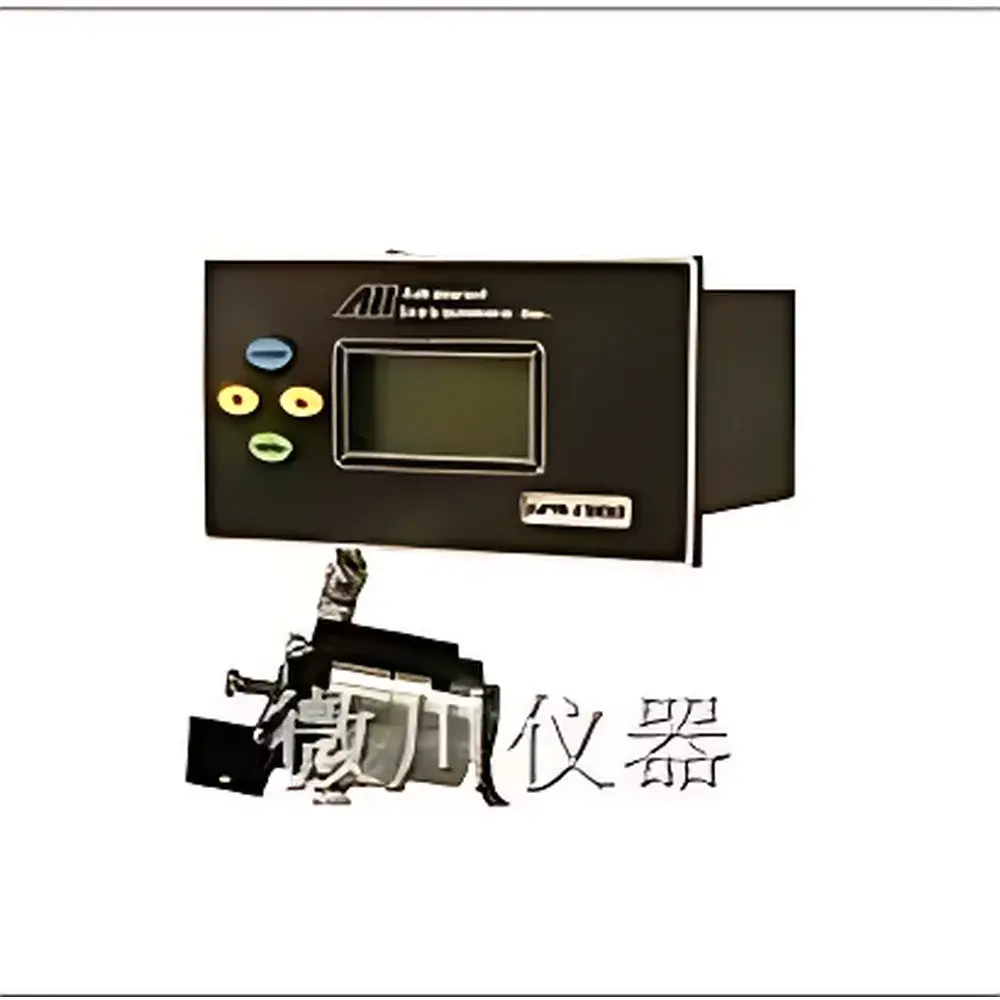
AII GPR-1900 Online Oxygen Analyzer
| Brand | AII |
|---|---|
| Origin | USA |
| Model | GPR-1900 |
| Sensor | GPR-12-333 |
| Measurement Principle | Electrochemical (Galvanic) |
| Accuracy | <1% of Full Scale |
| Range Options | 0–10 ppm, 0–100 ppm, 0–1000 ppm, 0–1%, 0–25% O₂ |
| Resolution | 0.001 ppm |
| Response Time (t₉₀) | <10 s |
| Operating Temperature | 5–45 °C |
| Sample Pressure | 5–30 psig (inlet), max 100 psig |
| Sample Flow Rate | 0.5–1.5 L/min (recommended: 1 L/min) |
| Output Signals | Isolated 4–20 mA and 0–1 V analog |
| Power Supply | 19–28 VDC or 220 VAC (configurable) |
| Enclosure Dimensions | 7″ × 4″ × 4.5″ (H×W×D) |
| Weight | 8 lbs |
| Wetted Materials | 316 Stainless Steel |
| Certifications | CE, ISO 9001, Class I, Division 1, Groups A–D (with appropriate intrinsically safe barrier) |
| Sensor Lifetime | 24 months at ≤1000 ppm avg O₂, 25 °C |
| Calibration | Auto-zero & span |
| Compensation | Automatic temperature & pressure compensation |
| Display | 5″ × 2.75″ backlit LCD |
| Interface | 1/8″ compression fittings, RS-232 serial port |
| IP Rating | NEMA 4X equivalent (front panel with sealed membrane keypad) |
| Warranty | 12 months (instrument + sensor) |
Overview
The AII GPR-1900 Online Oxygen Analyzer is a precision electrochemical (galvanic cell) analyzer engineered for continuous, stable oxygen monitoring in industrial process streams where reliability, low maintenance, and regulatory compliance are critical. Unlike paramagnetic or zirconia-based analyzers, the GPR-1900 employs a proprietary long-life galvanic sensor (GPR-12-333) that operates without external power or consumable electrolytes—delivering inherent stability and drift-free performance over its rated 24-month service life under typical operating conditions (<1000 ppm average O₂, 25 °C). Its measurement principle relies on the spontaneous redox reaction between ambient oxygen and a lead anode in an aqueous alkaline electrolyte, generating a current linearly proportional to partial pressure of O₂—ensuring high reproducibility across five selectable full-scale ranges (0–10 ppm to 0–25% O₂). Designed for integration into inert gas purging systems, blanketing applications, hydrogen and helium handling, CO₂ enrichment loops, and semiconductor purge lines, the GPR-1900 meets stringent requirements for trace- to percent-level O₂ quantification in non-corrosive, dry-to-moderately humid gas matrices.
Key Features
- Self-powered galvanic sensor (GPR-12-333) with zero routine maintenance and 24-month guaranteed lifetime under specified conditions
- Automatic zero and span calibration routines, plus dedicated voltage-contact relay outputs for external auto-calibration triggers
- Five user-selectable measurement ranges via front-panel rotary switch—enabling seamless transition from sub-ppb detection to high-concentration monitoring
- Dual analog outputs: isolated 4–20 mA (HART-compatible when configured) and buffered 0–1 V, both fully temperature- and pressure-compensated
- Robust stainless steel (316 SS) wetted components compliant with ASME BPE surface finish standards for high-purity gas service
- Integrated microprocessor-controlled display (5″ × 2.75″) showing real-time O₂ concentration, sample temperature, and line pressure—with 0.001 ppm resolution on trace ranges
- Flexible power architecture supporting either 19–28 VDC (24 V nominal) or 220 VAC operation, with internal transient suppression and reverse-polarity protection
- NEMA 4X-equivalent enclosure with sealed membrane keypad and IP65-rated front panel for harsh industrial environments
Sample Compatibility & Compliance
The GPR-1900 is validated for use with inert gases (N₂, Ar), helium, hydrogen, carbon dioxide, and mixed process gases—provided condensable vapors, halogenated compounds, sulfur species, and acidic gases (e.g., HCl, SO₂, NOₓ) are absent or pre-removed via conditioning. It is not suitable for direct installation in wet, particulate-laden, or chemically aggressive streams without upstream filtration, drying, and chemical scrubbing. The analyzer complies with CE marking directives (EMC 2014/30/EU, LVD 2014/35/EU), ISO 9001:2015 quality management system certification, and may be deployed in Class I, Division 1, Groups A–D hazardous locations when installed with an approved intrinsically safe barrier (e.g., Pepperl+Fuchs KFD2-STC4-Ex1). It supports GLP/GMP-aligned operation through audit-trail-capable calibration logging (when paired with optional data acquisition software) and meets general requirements for ASTM D6299 and ISO 8573-3 for compressed gas purity verification.
Software & Data Management
While the GPR-1900 operates autonomously without host software, its RS-232 serial interface enables bidirectional communication for remote configuration, real-time data streaming, and event-triggered diagnostics. Using standard ASCII command protocols, users can read live measurements, adjust range selection, initiate manual calibrations, query sensor health status, and retrieve internal temperature/pressure logs. When integrated with SCADA or DCS platforms via Modbus RTU (via optional protocol converter), the device supports time-stamped 4–20 mA output validation and alarm state reporting. All calibration events—including date, operator ID (if entered), reference gas concentration, and post-calibration deviation—are stored in non-volatile memory and retrievable via serial dump, satisfying basic FDA 21 CFR Part 11 data integrity expectations for non-critical process monitoring.
Applications
- Inert gas blanketing control in pharmaceutical reactors and API synthesis vessels
- Oxygen ingress monitoring in nitrogen-purged transformer oil storage tanks
- Leak detection and purity assurance in helium recovery loops for MRI facilities
- Residual O₂ verification in modified atmosphere packaging (MAP) gas mixtures (CO₂/N₂ blends)
- Process safety interlock support in hydrogen-handling infrastructure (e.g., fuel cell manufacturing)
- Quality control of ultra-high-purity (UHP) argon used in semiconductor CVD and PVD tool chambers
- Validation of glovebox atmosphere integrity during battery R&D and material synthesis
FAQ
What is the recommended calibration frequency?
Calibration should be performed at installation, after any major maintenance or sensor replacement, and at intervals determined by risk assessment—typically every 3–6 months for critical applications or per internal SOPs aligned with ISO/IEC 17025.
Can the GPR-1900 measure oxygen in wet gas streams?
No. Condensation or liquid water contacting the sensor will permanently damage the galvanic cell. A coalescing filter and refrigerated dryer are mandatory upstream if moisture cannot be guaranteed below dew point −40 °C.
Is pressure compensation automatic?
Yes. The unit incorporates a built-in absolute pressure transducer and applies real-time correction using the ideal gas law; no user input required beyond initial atmospheric reference setup.
Does the analyzer support HART communication?
Not natively—but the isolated 4–20 mA output is compatible with standard HART-enabled I/O modules for digital configuration and diagnostics when integrated into modern DCS architectures.
What happens if the sensor exceeds its 24-month service life?
Output drift increases progressively; sensitivity declines; response time elongates. Continued use beyond warranty period is not recommended for compliance-critical applications—replacement is required to maintain stated accuracy and repeatability specifications.