
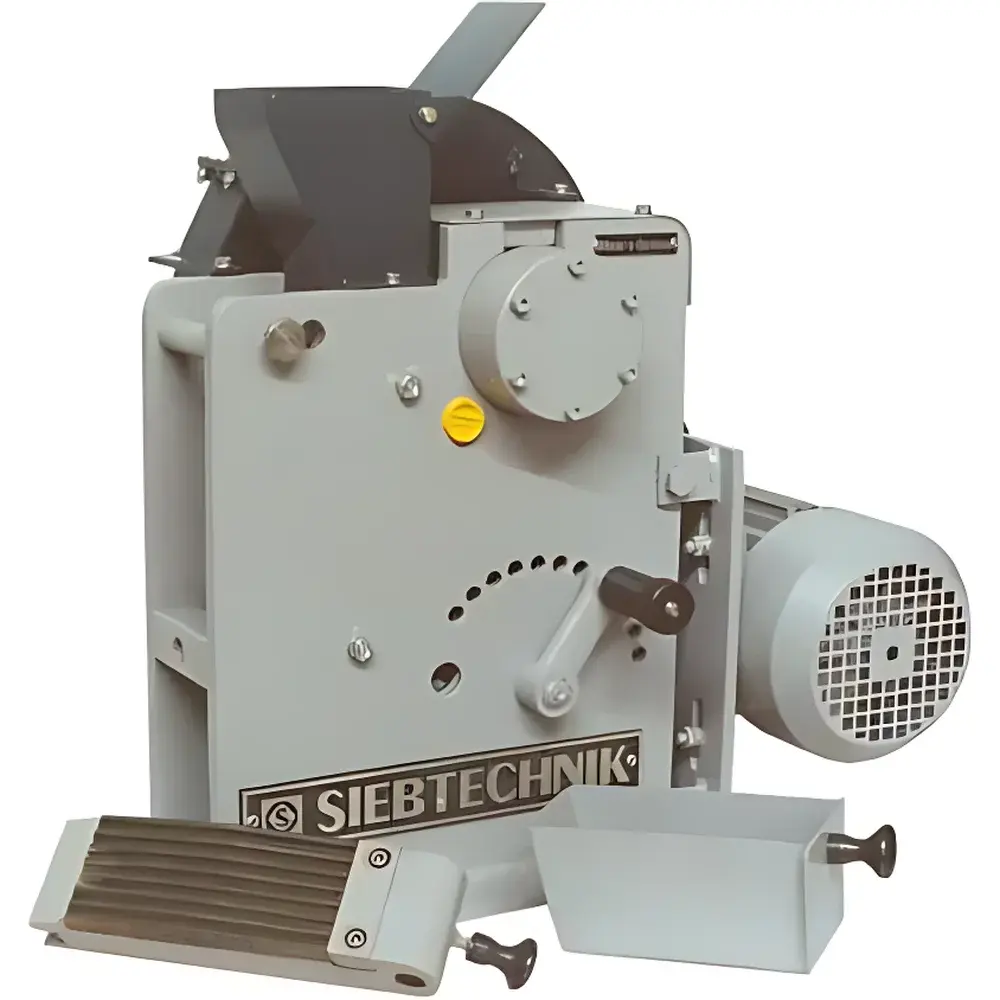
Siebtechnik EB7/6 Compact High-Throughput Jaw Crusher
| Brand | Siebtechnik |
|---|---|
| Origin | Germany |
| Model | EB7/6 Jaw Crusher |
| Max. Feed Size | 50 mm |
| Final Particle Size | < 1 mm |
| Adjustable Jaw Gap | 2–8 mm |
| Throughput | 15–90 kg/h |
| Motor Power | 750 W (3-phase) |
| Jaw Materials | Hardened Steel, Stainless Steel, Tungsten Carbide, Zirconia Oxide |
| Dimensions (w/d/h incl. base) | 296 × 495 × 590 mm |
Overview
The Siebtechnik EB7/6 Compact High-Throughput Jaw Crusher is an engineered solution for reliable, reproducible size reduction of medium-hard to hard, brittle, and non-ductile materials in laboratory and pilot-scale industrial environments. Based on the proven principle of compressive crushing—where material is subjected to controlled mechanical stress between two opposing jaw plates—the EB7/6 delivers consistent particle size distribution through a three-dimensional compound motion of the moving jaw. This kinematic design ensures uniform force application, minimizes material jamming, and enhances throughput stability across heterogeneous feed compositions. Designed and manufactured in Germany to stringent DIN and ISO quality benchmarks, the unit complies fully with CE safety directives (2006/42/EC Machinery Directive and 2014/30/EU EMC Directive), making it suitable for use in regulated quality control laboratories, geological survey facilities, mining R&D centers, and raw material processing lines where traceability, operator safety, and process repeatability are critical.
Key Features
- Compact footprint (296 × 495 × 590 mm) with high throughput capacity—up to 90 kg/h—optimized for space-constrained lab settings without compromising industrial-grade performance.
- Three-dimensional compound motion of the movable jaw eliminates bridging and blockage, significantly improving feed continuity and reducing manual intervention during extended operation.
- Interchangeable jaw plates with precision-machined groove geometry—rather than flat surfaces—enhance grinding efficiency, reduce energy dissipation, and suppress high-frequency friction noise typically associated with planar jaw configurations.
- Jaw plates feature 180° reversible mounting, effectively doubling service life and lowering long-term consumables cost per ton of processed sample.
- Manually adjustable jaw gap (2–8 mm) enables precise control over final particle size; calibrated scale allows repeatable setup across batches and operators.
- Front-access grinding chamber with tool-free jaw plate removal simplifies maintenance, enables full visual inspection, and supports thorough cleaning—critical for cross-contamination-sensitive applications such as geochemical analysis or multi-element QA/QC workflows.
- CE-certified 750 W three-phase motor with integrated thermal overload protection ensures stable torque delivery under variable load conditions and meets IEC 60034-1 insulation class standards.
Sample Compatibility & Compliance
The EB7/6 is validated for comminution of abrasive, friable, and thermally stable materials including but not limited to: ores (e.g., hematite, bauxite), coal and coke, blast furnace slag, ceramics, quartz, feldspar, basalt, granite, soil aggregates, glass cullet, and refractory bricks. It is unsuitable for fibrous, elastic, sticky, or highly moisture-sensitive samples. All wetted components—including jaw plates and feed hopper—are available in multiple wear-resistant material options (hardened steel, stainless steel 1.4404, tungsten carbide, and zirconia oxide), permitting selection based on sample chemistry and contamination requirements. The system conforms to ISO 17025:2017 documentation practices when operated within defined SOPs, and its mechanical design supports integration into GLP-compliant workflows requiring equipment qualification (IQ/OQ/PQ) and audit-ready maintenance logs.
Software & Data Management
As a mechanically actuated, non-digitalized crushing instrument, the EB7/6 operates without embedded firmware or proprietary software. Its operational parameters—jaw gap setting, run time, feed mass, and batch ID—are documented manually or via external LIMS integration using standardized metadata templates (e.g., ASTM E1447, ISO/IEC 17025 Annex A.2). Optional accessories include calibrated feed funnels with volumetric markings and certified reference material (CRM) traceable to NIST SRMs for method validation. For regulatory environments requiring electronic records, the unit may be paired with third-party digital loggers (e.g., temperature/stress sensors with 21 CFR Part 11–compliant data acquisition systems) to capture runtime metrics and environmental context.
Applications
- Preparation of homogenized sub-samples for XRF, XRD, ICP-OES, and AA spectroscopy in geological and metallurgical laboratories.
- Routine size reduction of bulk mineral samples prior to sieve analysis (ASTM D422, ISO 17892-4) or leaching protocols (EPA Method 3050B).
- QC testing of construction aggregates and refractory raw materials per EN 933-1 and ASTM C136.
- Pilot-scale comminution trials supporting scale-up studies for downstream milling, classification, or beneficiation processes.
- Fragmentation characterization of brittle materials under controlled stress conditions for mechanical property modeling (e.g., Bond Work Index estimation).
FAQ
What types of materials are incompatible with the EB7/6?
Materials exhibiting high elasticity (e.g., rubber, polymers), plastic deformation (e.g., lead, aluminum), hygroscopic behavior (e.g., certain clays), or excessive moisture content (>10% w/w) are not recommended due to risk of clogging, adhesion, or inconsistent size reduction.
Can the EB7/6 be used in inert atmosphere or glovebox environments?
Yes—the unit operates without internal electronics or cooling fluids; optional stainless steel or zirconia jaws and sealed feed hopper variants are available for controlled-atmosphere applications.
Is routine calibration required for jaw gap adjustment?
No formal calibration is mandated; however, users should verify gap accuracy annually using certified gauge blocks traceable to national metrology institutes, especially in ISO/IEC 17025-accredited labs.
How often should jaw plates be inspected for wear?
Visual inspection is recommended after every 200 operating hours or following processing of 5 metric tons of abrasive material—whichever occurs first—to ensure dimensional integrity and particle size consistency.
Does Siebtechnik provide IQ/OQ documentation packages?
Yes—validated qualification kits including test protocols, acceptance criteria, and template reports are available upon request to support GMP/GLP implementation and regulatory audits.
Related Products



