
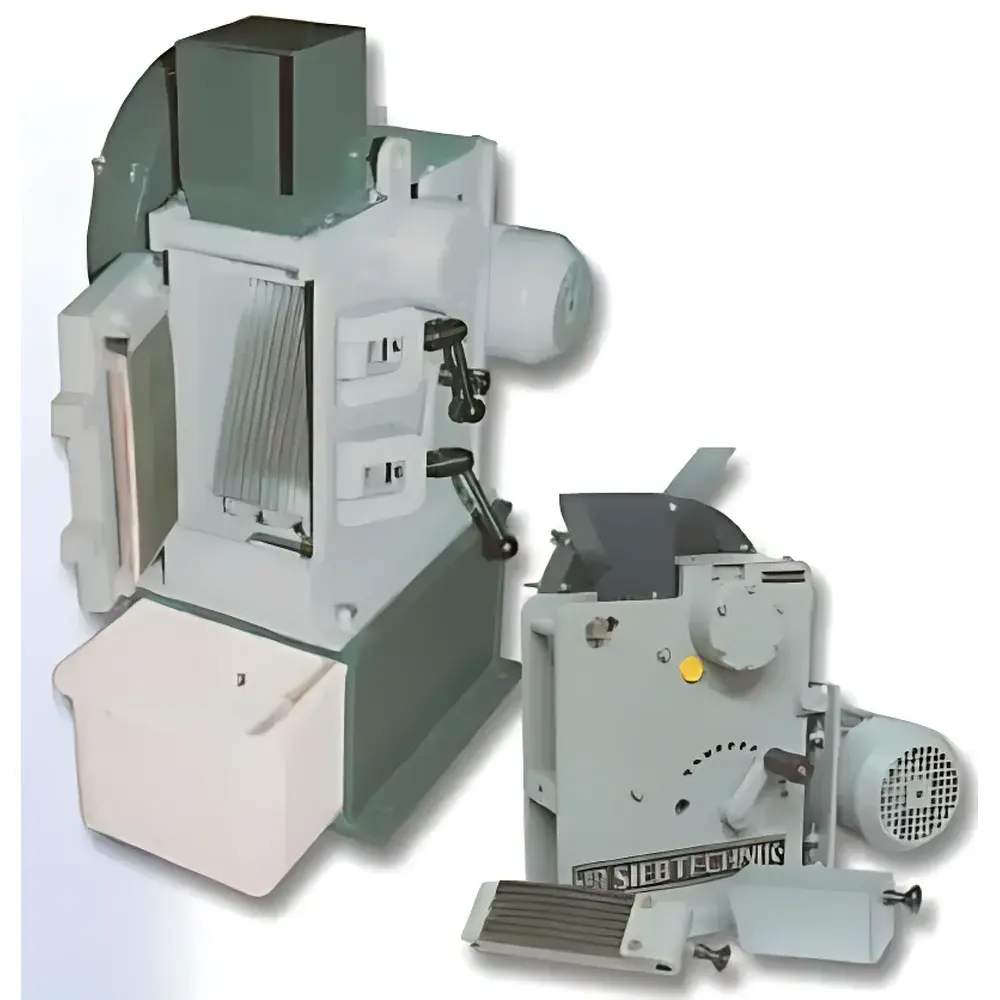
Siebtechnik EB10/8 Jaw Crusher
| Brand | Siebtechnik |
|---|---|
| Origin | Germany |
| Model | EB10/8 Jaw Crusher |
| Max. Feed Size | 70 mm (Hopper Opening: 100 mm × 80 mm) |
| Final Particle Size | < 4 mm |
| Adjustable Jaw Gap | 4–12 mm |
| Throughput | 80–350 kg/h |
| Motor Power | 1100 W, 3-Phase |
| Jaw Materials | Hardened Steel, Stainless Steel, Tungsten Carbide, Zirconia Oxide |
| Dimensions (with Base & Collection Tray) | 375 mm × 750 mm × 800 mm |
| Compliance | CE-certified, Designed to EN 61000-6-2 / EN 61000-6-4 Safety & EMC Standards |
Overview
The Siebtechnik EB10/8 Jaw Crusher is a heavy-duty, laboratory-scale primary crushing instrument engineered for consistent size reduction of medium-to-high hardness, brittle, and non-ductile materials. Based on the classic toggle-jaw principle, it operates via a fixed jaw and a dynamically oscillating jaw executing a three-dimensional compound motion—combining vertical compression, horizontal shearing, and slight rotational displacement. This kinematic design ensures uniform stress distribution across the sample bed, minimizing particle agglomeration and eliminating material jamming—a common limitation in single-axis eccentric jaw systems. The crusher is not intended for ductile, fibrous, or highly elastic substances (e.g., polymers, rubber, or moist clays), but excels with geological samples (ores, granites, basalts), industrial by-products (slag, coke, fly ash), ceramics, glass frits, quartz, and construction aggregates. Its robust cast-iron frame, precision-machined jaw carriers, and modular base assembly enable stable operation under continuous duty cycles in both analytical laboratories and pilot-scale process environments.
Key Features
- Three-dimensional jaw motion architecture prevents feed blockage and enhances particle liberation efficiency compared to conventional two-axis eccentric drives.
- Reversible jaw plates with optimized groove geometry—180° flip capability doubles service life and maintains consistent crushing performance across extended operational periods.
- Manually adjustable jaw gap (4–12 mm) enables precise control over top-size output without requiring tool changes or recalibration.
- Front-access grinding chamber with quick-release hinge mechanism allows full exposure of jaw assemblies for rapid maintenance, cleaning, and cross-contamination mitigation—critical for sequential analysis of heterogeneous geological or metallurgical samples.
- CE-compliant motor with integrated thermal overload protection and electromagnetic compatibility per EN 61000-6-2 (immunity) and EN 61000-6-4 (emission) standards.
- Standard jaw plate materials include hardened steel (for general-purpose use), stainless steel (for corrosion-sensitive matrices), tungsten carbide (for abrasive ores), and zirconia oxide (for ultra-low contamination applications in geochemical trace analysis).
Sample Compatibility & Compliance
The EB10/8 is validated for use with dry, free-flowing, brittle feedstocks having Mohs hardness ≤ 7.5 and moisture content < 2% w/w. It complies with ISO 14688-1:2018 (geotechnical investigation—identification and classification of soils), ASTM D2974 (standard test methods for moisture, ash, and organic matter in peat and other organic soils), and supports sample preparation workflows aligned with ISO/IEC 17025:2017 requirements for testing laboratories. Jaw plate material selection must be documented per GLP Annex 15 principles when used in regulated environments (e.g., mining QA/QC labs subject to MSHA or ISO 9001 audits). The unit does not require ATEX certification as it lacks internal ignition sources and is unsuitable for explosive dust atmospheres without external inertization.
Software & Data Management
The EB10/8 is a manually operated mechanical device with no embedded firmware, touchscreen interface, or digital connectivity. All operational parameters—including jaw gap setting, throughput estimation, and maintenance logs—are recorded in paper-based or LIMS-integrated lab notebooks. Users are advised to document jaw plate rotation cycles, wear inspection dates, and calibration verification (via gauge block measurement of nominal gap) in accordance with internal SOPs and ISO/IEC 17025 clause 7.7 (equipment management). No software validation (e.g., FDA 21 CFR Part 11) applies, though traceable mechanical calibration records support audit readiness.
Applications
- Geological core sample homogenization prior to XRF, ICP-MS, or fusion bead preparation.
- Coal and coke sizing for proximate analysis (ASTM D3172) and calorific value determination (ASTM D5865).
- Routine reduction of ceramic raw materials (feldspar, kaolin, alumina) to <4 mm for subsequent ball milling or laser diffraction particle size analysis.
- Preparation of construction aggregate fractions for Los Angeles abrasion testing (ASTM C131) and soundness evaluation (ASTM C88).
- Slag and fly ash comminution for leaching studies (TCLP, EPA Method 1311) and pozzolanic activity assessment.
FAQ
What safety certifications does the EB10/8 hold?
It carries CE marking per Machinery Directive 2006/42/EC and complies with EN 61000-6-2 and EN 61000-6-4 for electromagnetic compatibility.
Can the crusher handle wet or sticky samples?
No—feed material must be air-dried to <2% moisture to prevent clogging and uneven wear; slurry or cohesive soils require pre-drying or alternative comminution methods (e.g., freeze-drying followed by cryo-milling).
How often should jaw plates be rotated or replaced?
Rotation is recommended after every 200–300 kg of abrasive material (e.g., quartzite); replacement intervals depend on hardness and throughput—typically 500–1,200 kg for hardened steel, up to 3,000 kg for tungsten carbide variants.
Is routine calibration required?
Yes—jaw gap should be verified monthly using certified gauge blocks; deviation > ±0.3 mm from setpoint requires mechanical re-adjustment and log entry per ISO/IEC 17025 clause 6.4.10.
Does Siebtechnik provide jaw plate wear documentation templates?
Yes—downloadable PDF maintenance logs and SOP alignment checklists are available through authorized distributors upon request and are compatible with standard LIMS metadata fields.



