
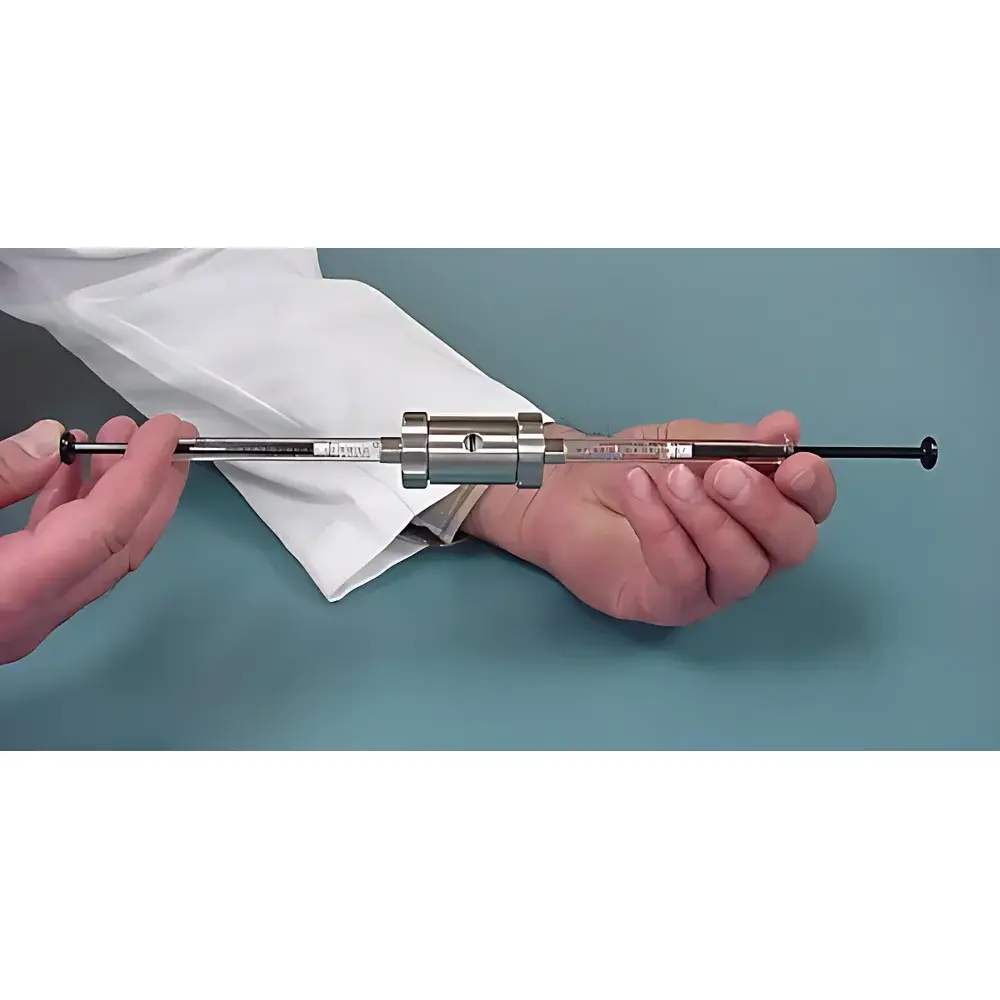
AVESTIN LiposoFast LF1 Manual Liposome Extruder
| Brand | AVESTIN |
|---|---|
| Origin | Canada |
| Model | LiposoFast LF1 |
| Actuation | Manual |
| Sample Volume per Extrusion | 1 mL (2 × 500 µL syringes) |
| Minimum Sample Volume | 0.1 mL |
| Residual Volume | 0 µL |
| Available Membrane Pore Sizes | 50, 100, 200, 400, 800, and 1000 nm |
| Optional Temperature Control | Water-bath compatible |
| Weight | <2 kg |
| Compliance | Designed for GLP-compliant lab environments |
Overview
The AVESTIN LiposoFast LF1 Manual Liposome Extruder is an engineered solution for reproducible, scalable preparation of unilamellar or oligolamellar liposomes in research and preclinical development laboratories. Based on the principle of membrane extrusion—where lipid suspensions are forced under controlled pressure through polycarbonate track-etched membranes of defined pore size—the LF1 enables precise size homogenization via sequential passage (typically 5–21 passes) to yield monodisperse vesicle populations. Unlike sonication or high-pressure homogenization, extrusion avoids thermal degradation and chemical oxidation, preserving encapsulated therapeutics, peptides, nucleic acids, or sensitive adjuvants. Its all-glass, chemically inert fluid path ensures minimal adsorption and compatibility with organic solvents, detergents, and low-pH formulations. Designed and manufactured in Canada, the LF1 adheres to ISO 9001-certified production standards and supports traceable, auditable workflows required in regulatory-grade formulation development.
Key Features
- Manual actuation with ergonomic dual-syringe configuration (2 × 500 µL borosilicate glass syringes) enabling intuitive, tactile control over extrusion force and rate.
- Zero-residual-volume design: complete sample recovery post-extrusion eliminates waste and ensures quantitative yield—critical for precious biologics or radiolabeled compounds.
- Modular extrusion module accepts standard 25 mm diameter polycarbonate membranes (Whatman Nuclepore™ or equivalent), available in six calibrated pore sizes: 50, 100, 200, 400, 800, and 1000 nm—enabling stepwise downsizing or target-size endpoint processing.
- Water-jacketed compatibility: the extrusion module can be immersed in a temperature-controlled water bath (4–40 °C), permitting extrusion of thermolabile lipids (e.g., DPPC, sphingomyelin) or temperature-sensitive payloads without phase transition disruption.
- Full disassembly capability: all wetted components—including syringe barrels, plungers, O-rings, and the extrusion housing—are autoclavable or solvent-cleanable; ultrasonic cleaning is validated for residue removal between batches.
- Portable architecture: total system mass <2 kg, with no electrical or pneumatic dependencies—ideal for glovebox use, cleanroom integration, or mobile GMP pilot labs.
Sample Compatibility & Compliance
The LF1 accommodates aqueous dispersions, ethanol-injection precursors, detergent-solubilized micellar intermediates, and even viscous glycerol-stabilized formulations. It is routinely employed in preparing liposomal doxorubicin analogs, mRNA-LNP pre-formulations, peptide-loaded stealth liposomes, and vaccine adjuvant systems (e.g., CAF01, AS01). The device meets essential requirements for Good Laboratory Practice (GLP) and early-phase Good Manufacturing Practice (GMP) environments: materials comply with USP Class VI biocompatibility standards; surface finish supports endotoxin-free processing when cleaned per SOP; and its mechanical simplicity eliminates software-related 21 CFR Part 11 validation burdens. While not a regulated medical device, the LF1 is referenced in multiple ASTM and ICH-aligned method development protocols for nanomedicine characterization (e.g., ASTM E2874–23 for liposome size distribution by extrusion).
Software & Data Management
As a fully manual, non-electronic instrument, the LF1 does not incorporate embedded firmware or digital interfaces. This design choice eliminates cybersecurity risks, firmware obsolescence, and calibration drift associated with motorized systems. Process parameters—including number of passes, membrane pore size, bath temperature, and operator ID—are documented manually in laboratory notebooks or integrated into electronic lab notebooks (ELNs) such as LabArchives or Benchling. For users requiring enhanced traceability, optional accessories (e.g., nitrogen-driven actuation kits) support external pressure transducers and data loggers compliant with FDA 21 CFR Part 11 when paired with validated acquisition software.
Applications
- Preformulation screening of lipid composition and PEGylation density effects on vesicle size stability.
- Manufacturing of reference standards for dynamic light scattering (DLS), cryo-TEM, and nanoparticle tracking analysis (NTA) method validation.
- Rapid prototyping of cationic liposomes for CRISPR-Cas9 RNP delivery optimization.
- Scale-down modeling for transition from lab-scale extrusion to industrial tangential flow filtration (TFF) or microfluidic platforms.
- Teaching laboratories: visual demonstration of membrane-based size reduction mechanics and bilayer self-assembly thermodynamics.
FAQ
Can the LF1 be used with organic solvents such as chloroform/methanol mixtures?
Yes—the glass syringes and PTFE-coated plunger seals are chemically resistant to common lipid dissolution solvents; however, polycarbonate membranes must be pre-wetted and never exposed to acetone or THF.
Is membrane reuse recommended?
No—polycarbonate membranes are single-use to prevent cross-contamination and pore deformation; AVESTIN supplies certified lot-matched membranes with certificate of conformance.
How does the LF1 compare to high-pressure extruders for scalability?
While the LF1 is strictly benchtop (≤1 mL/batch), its extrusion mechanics and shear profile are directly translatable to industrial nitrogen-driven extrusion systems; many clients report successful linear scale-up to 100× volume using identical membrane specifications and pass counts.
Does AVESTIN provide method development support?
Yes—application scientists offer free protocol consultation, including membrane selection guidance, pass-number optimization studies, and troubleshooting for aggregation or low recovery scenarios.



