
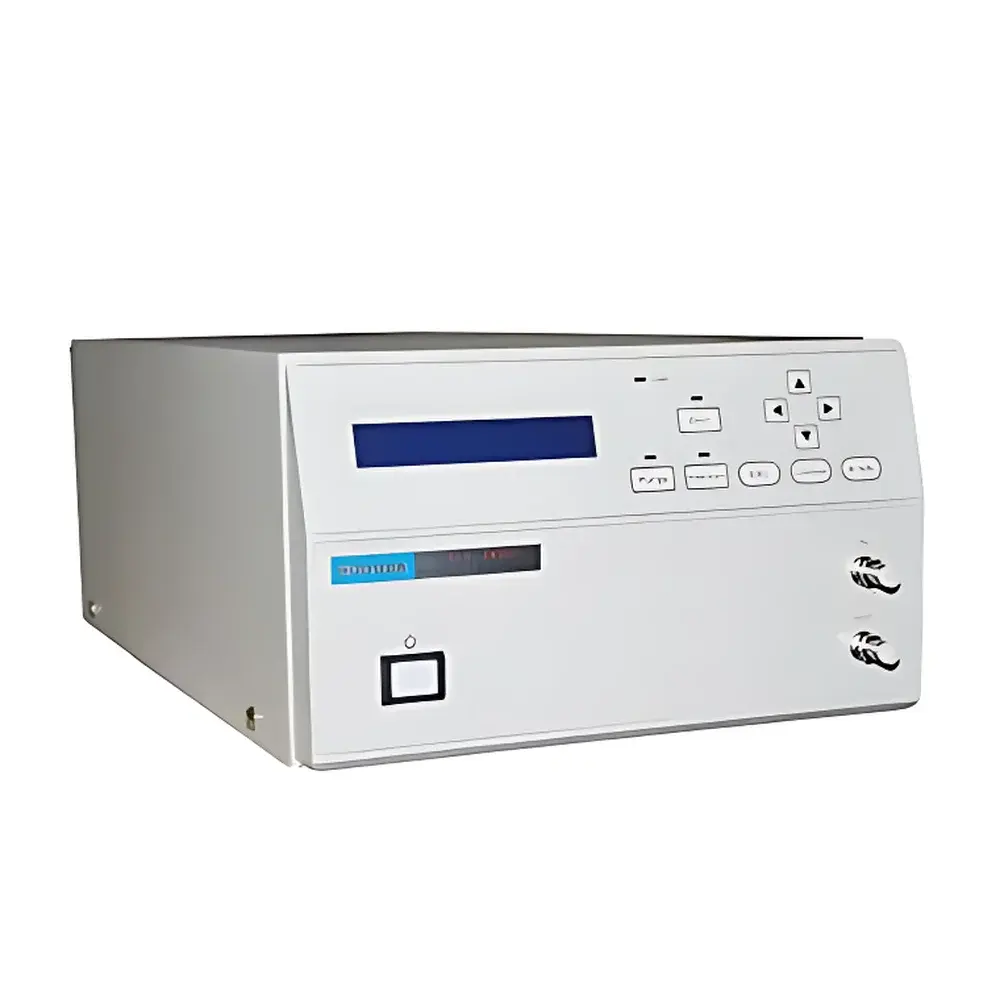
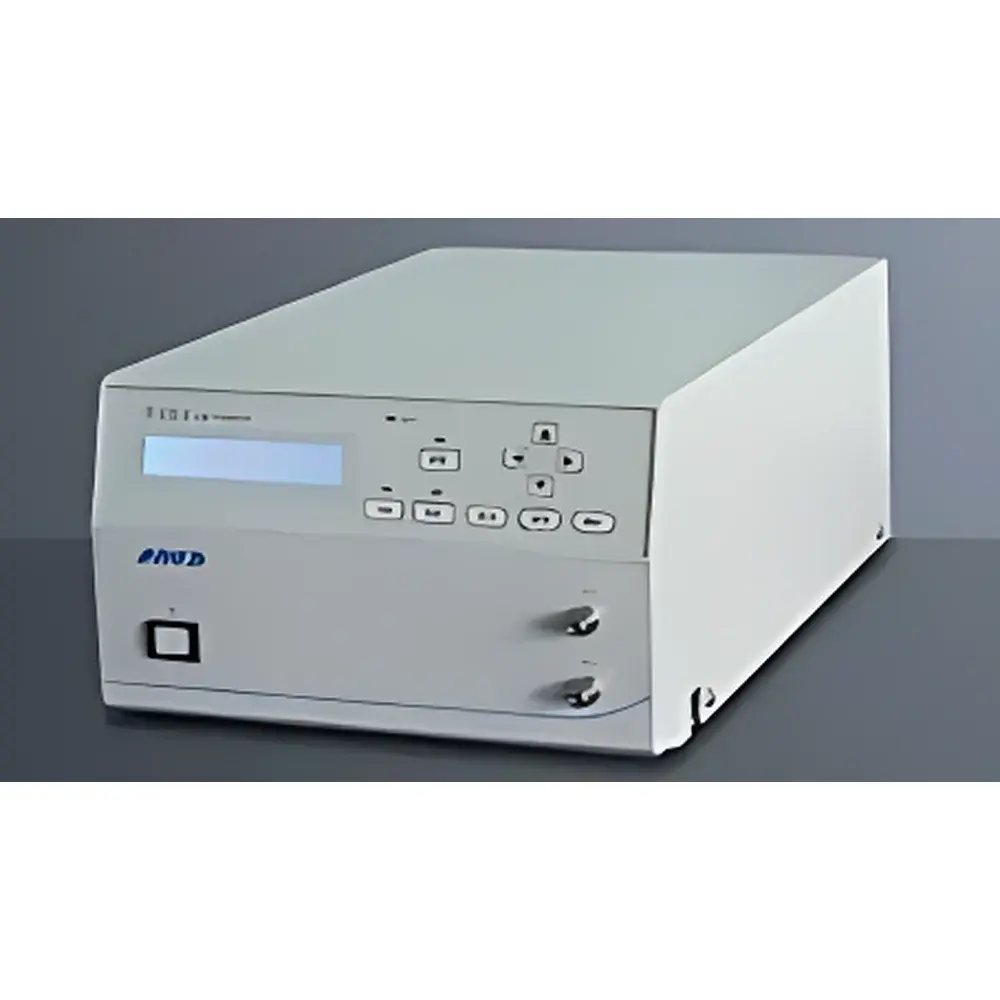
Elite RI-201H Refractive Index Detector
| Brand | Elite |
|---|---|
| Origin | Liaoning, China |
| Manufacturer Type | Direct Manufacturer |
| Region of Origin | Domestic (China) |
| Model | RI-201H |
| Price Range | USD 7,000–14,000 (FOB) |
| Compatible Instrument | HPLC Systems |
| Detector Type | Differential Refractive Index Detector |
| Noise | ≤2.5×10⁻⁹ RIU (Standard Response Time) |
| Refractive Index Range | 1.00–1.75 |
| Detection Range | 0.25–512×10⁻⁶ RIU |
| Linearity Range | 6×10⁻⁴ RIU |
| Auto-Zero Function | Optical & Electronic |
| Drift | ≤2.0×10⁻⁷ RIU/h (deionized water, 1 mL/min, purge off) |
| Response Times | 0.1, 0.25, 0.5, 1.0, 1.5, 2.0, 3.0, 6.0 s |
| Temperature Control | Off / 30–50 °C (1 °C increments) |
| Heater Element Max Temp | 77 °C |
| Flow Cell Volume | 8 μL |
| Max Flow Rate | 10 mL/min (water mobile phase) |
| Max Pressure Rating | 0.05 MPa |
| Wetted Materials | SUS316 Stainless Steel, PTFE (Teflon), Fused Silica |
| Power Supply | AC 100–240 V ±10%, 50/60 Hz, ≤150 VA |
| Dimensions (L×W×H) | 400×260×150 mm |
Overview
The Elite RI-201H Refractive Index Detector is a precision differential refractometer engineered for integration into high-performance liquid chromatography (HPLC) and gel permeation chromatography (GPC) systems. It operates on the principle of measuring minute changes in the refractive index of the eluent stream relative to a reference solvent—enabling universal, non-destructive detection of analytes lacking chromophores or fluorophores. Unlike UV-Vis or fluorescence detectors, the RI-201H delivers consistent response across carbohydrates, polymers, lipids, organic acids, and other optically transparent compounds, making it indispensable for molecular weight distribution analysis in synthetic and natural polymers, as well as quantitative sugar profiling in food, pharmaceutical, and biotechnology applications.
Key Features
- Dual-mode auto-zero capability—optical nulling via beam alignment and electronic baseline correction—ensures long-term baseline stability under variable ambient and flow conditions.
- Low-noise optical design with fused silica flow cell (8 μL volume) and temperature-stabilized detector housing, achieving ≤2.5×10⁻⁹ RIU noise at standard response (1 s).
- Configurable response time (0.1–6.0 s) allows optimization for speed-resolution trade-offs: fast response for narrow peaks in gradient HPLC; slower settings for enhanced signal-to-noise in low-concentration GPC runs.
- Independent thermal control (30–50 °C, 1 °C resolution) minimizes thermal drift without requiring external column ovens; heater element rated to 77 °C supports rapid warm-up and thermal equilibration.
- Robust wetted-path construction using SUS316 stainless steel, PTFE seals, and fused silica optics ensures chemical compatibility with common HPLC solvents (e.g., THF, chloroform, DMF, aqueous buffers) and resistance to hydrolysis or corrosion.
- Maximum pressure rating of 0.05 MPa (≈0.5 bar) and 10 mL/min flow capacity accommodate both analytical and semi-preparative GPC configurations while maintaining mechanical integrity.
Sample Compatibility & Compliance
The RI-201H is validated for use with non-volatile and semi-volatile solutes in isocratic or low-gradient mobile phases. It is widely deployed in laboratories conducting ASTM D5296 (GPC of polymers), USP (chromatography system suitability), and ISO 16000-23 (indoor air VOC analysis via derivatization + RI detection). While not intrinsically 21 CFR Part 11 compliant, its analog output (0–1 V or 0–5 V) and optional RS-232 interface support integration into validated LIMS or CDS platforms that implement audit trails, electronic signatures, and data integrity controls per ALCOA+ principles. All wetted materials conform to USP Class VI biocompatibility standards and FDA-recommended extractables profiles for pharmaceutical process monitoring.
Software & Data Management
The detector outputs analog voltage signals proportional to Δn (refractive index difference), compatible with third-party chromatography data systems (CDS) including Empower, Chromeleon, OpenLAB, and LabSolutions. Optional firmware upgrades enable digital communication via RS-232 for remote parameter configuration (temperature setpoint, response time, zero mode) and real-time status reporting (cell temperature, baseline offset, error flags). Raw signal data retains full resolution (16-bit ADC equivalent) for post-run reprocessing, peak deconvolution, and baseline correction algorithms. Export formats include CSV and ASCII for traceability in GLP/GMP environments requiring raw data archiving and metadata linkage.
Applications
- Gel Permeation Chromatography (GPC/SEC): Molecular weight distribution (Mw, Mn, PDI) of polystyrene, polyethylene glycol, polysaccharides, and dendrimers.
- Carbohydrate Analysis: Quantification of mono-/di-saccharides, oligosaccharides, and sugar alcohols in dairy, beverage, and fermentation broths—without derivatization.
- Pharmaceutical Excipient Characterization: Monitoring degradation products in PEG-based drug conjugates or surfactant purity in lipid nanoparticle formulations.
- Polymer Additive Profiling: Detection of unreacted monomers, plasticizers, and stabilizers in polymer melts processed via SEC-HPLC.
- Quality Control of Natural Products: Simultaneous assay of glycyrrhizin, flavonoids, and polysaccharide fractions in herbal extracts where UV response is inconsistent.
FAQ
Is the RI-201H compatible with UHPLC systems?
No—the 0.05 MPa maximum pressure rating and 8 μL flow cell volume limit its use to conventional HPLC and GPC systems operating below 100 bar. For UHPLC, consider coupling with a low-dead-volume passive splitter or dedicated low-pressure RI interface.
Does it support gradient elution?
Yes, but with operational constraints: baseline drift may increase during steep solvent composition changes; optimal performance is achieved using shallow gradients (<5% organic/min) and pre-mixed mobile phases where possible.
Can it be used for aqueous SEC of proteins?
It is technically feasible but not recommended for routine protein SEC due to low sensitivity (typical LOD ~1–5 µg) and susceptibility to buffer mismatch artifacts; UV 280 nm or MALS remain preferred for protein characterization.
What maintenance is required for long-term stability?
Monthly purging with filtered, degassed mobile phase; quarterly inspection of PTFE seal integrity; annual recalibration using certified sucrose standards (e.g., NIST SRM 84d) to verify linearity and zero-point repeatability.
Is temperature control mandatory during operation?
Not mandatory—but strongly advised: even 0.1 °C ambient fluctuation can induce >1×10⁻⁸ RIU drift. Enabling 35–40 °C cell temperature control reduces thermal noise by up to 70% compared to ambient operation.
Related Products




