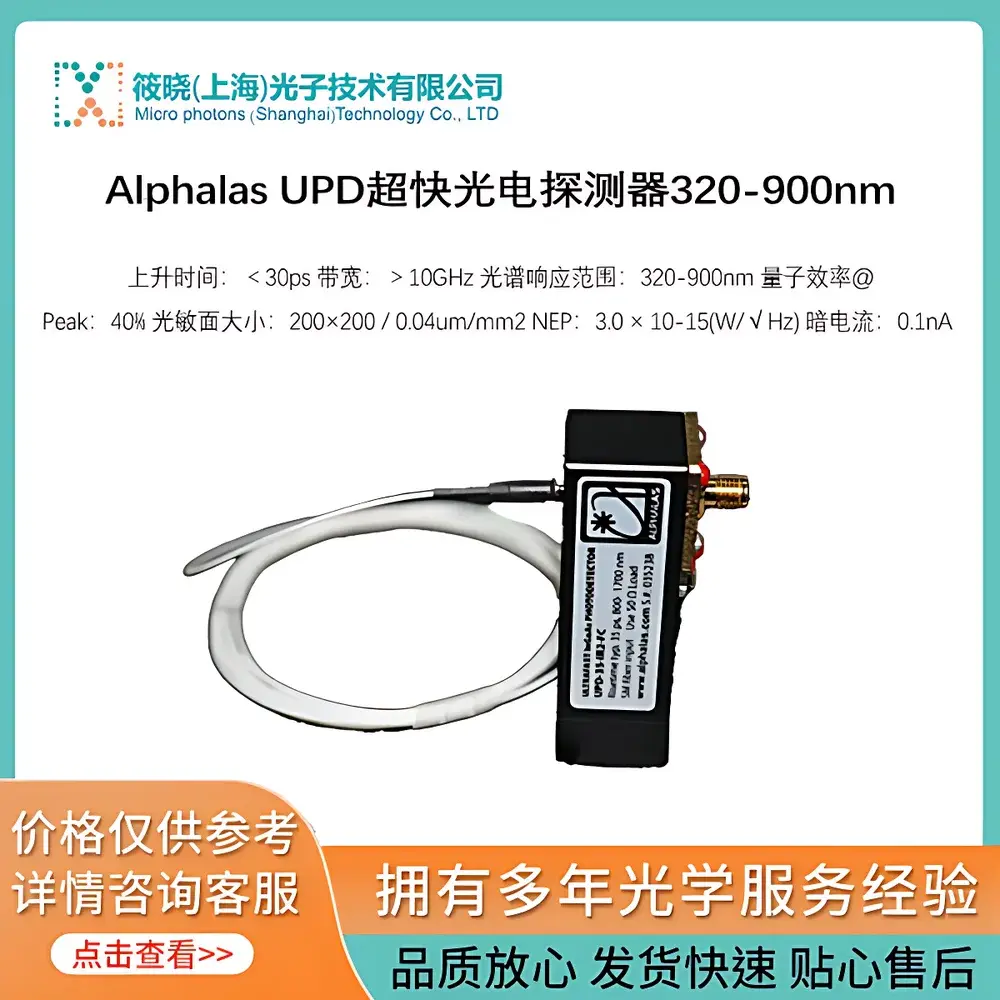
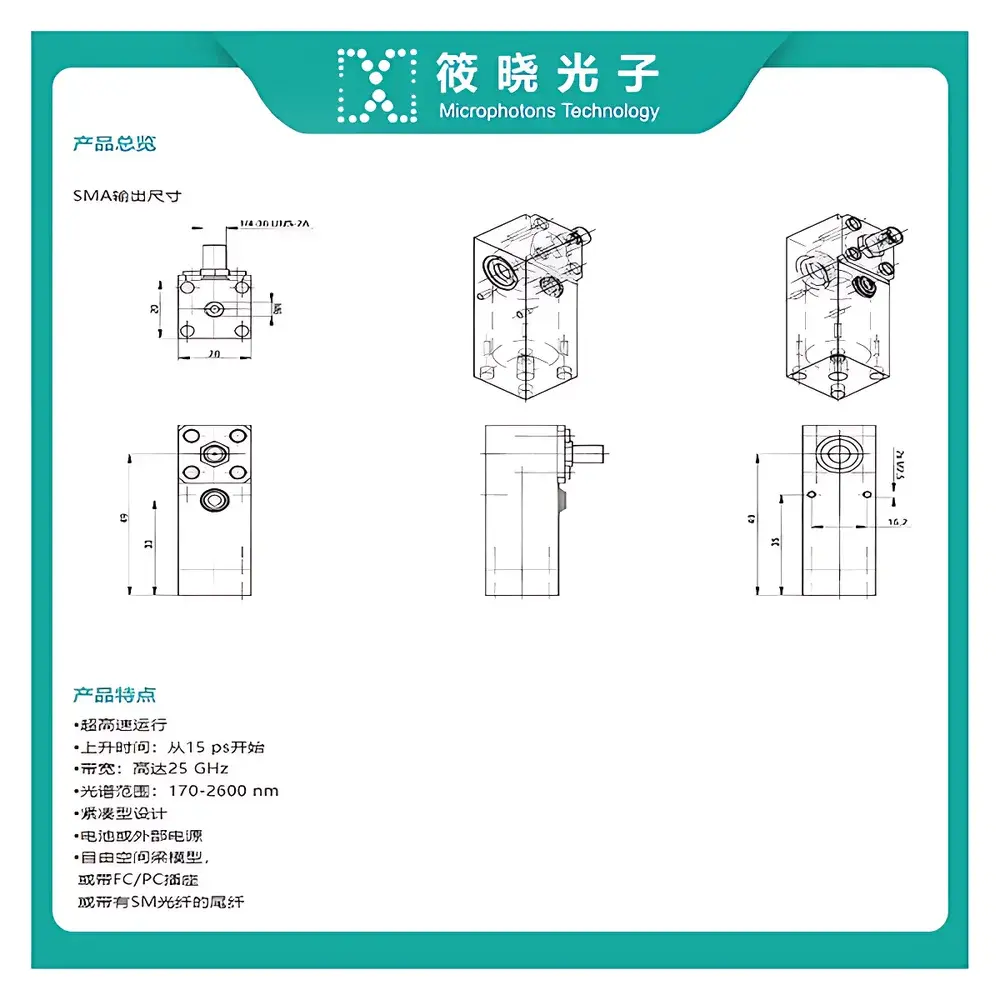
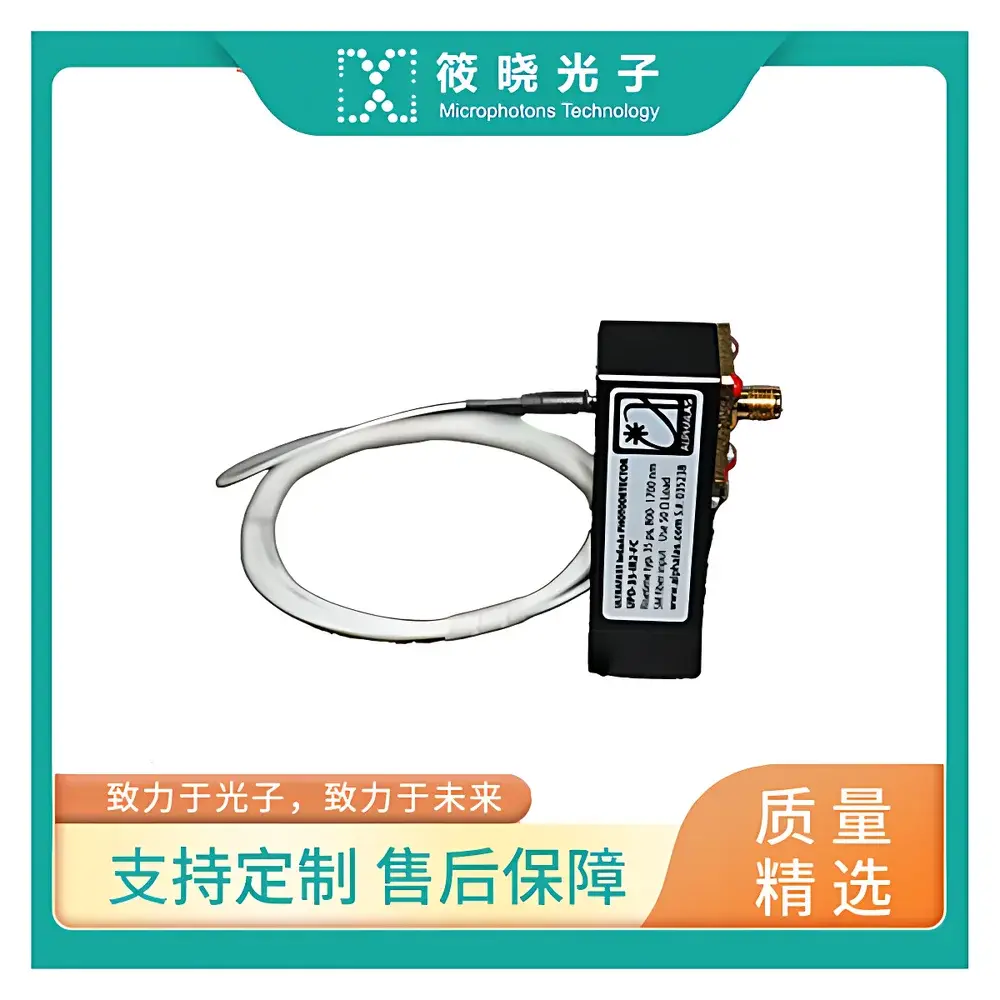
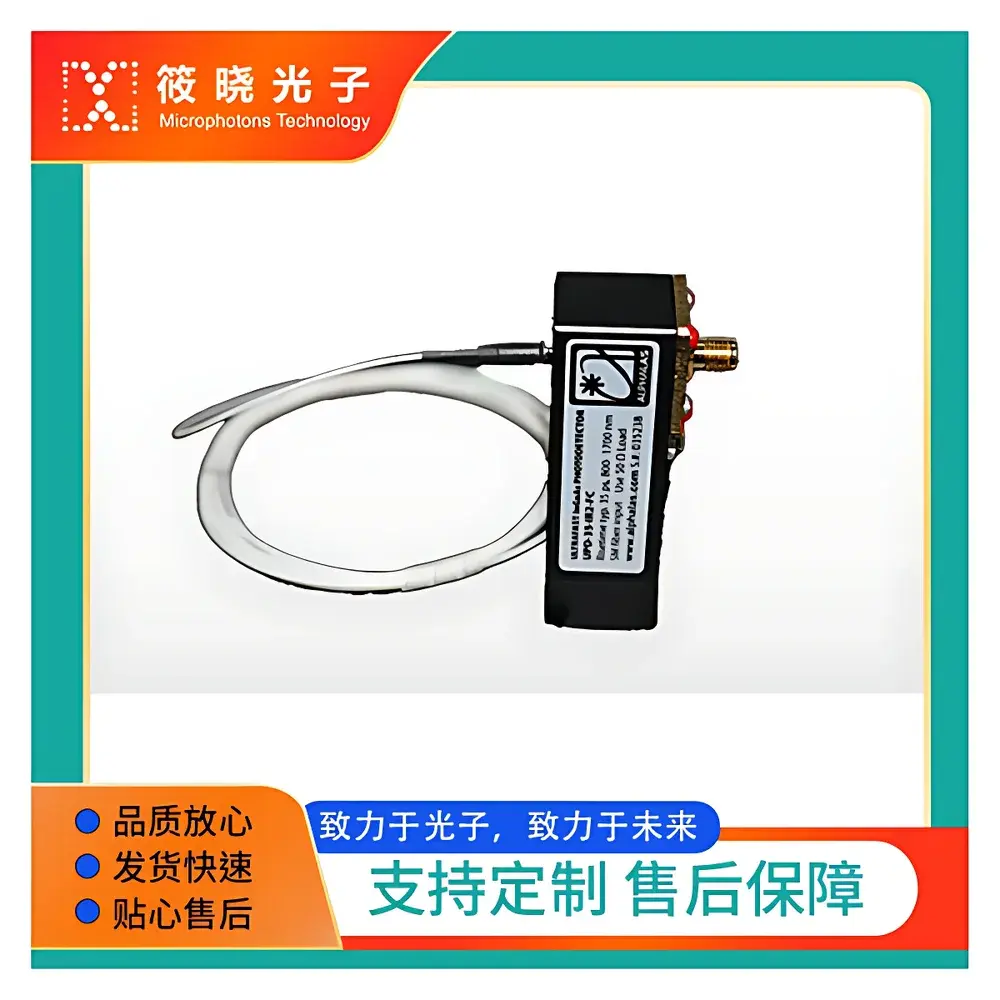
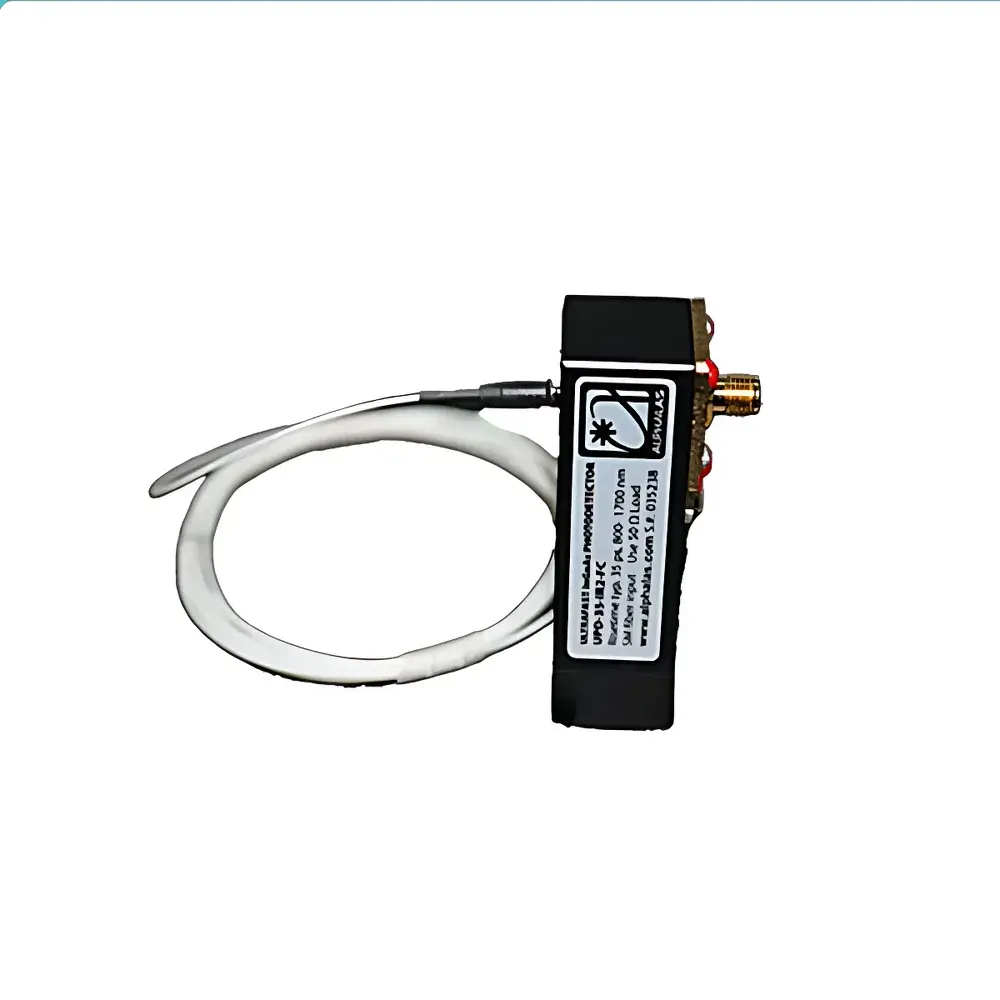
Alphalas UPD-30-VSG-P Ultrafast Photodetector (320–900 nm)
| Brand | Alphalas |
|---|---|
| Model | UPD-30-VSG-P |
| Detector Material | Si PIN |
| Spectral Range | 320–900 nm |
| Rise Time | < 30 ps |
| Bandwidth | > 12 GHz |
| Active Area Diameter | 0.2 mm |
| Responsivity | ~0.4 A/W @ 633 nm |
| Output Polarity | Positive |
| Connector | SMA |
| Bias Voltage | 0 V (photovoltaic mode) or –5 V (reverse bias) |
| Operating Temperature | –10 to +50 °C |
Overview
The Alphalas UPD-30-VSG-P is a high-performance, silicon-based ultrafast photodetector engineered for time-resolved optical measurements requiring sub-30-picosecond temporal resolution and broad visible-to-near-infrared spectral coverage (320–900 nm). Based on a low-capacitance, large-bandgap Si PIN diode architecture, the detector operates in either zero-bias (photovoltaic) or reverse-biased (–5 V) configurations—enabling optimization of linearity, dynamic range, and rise time depending on application requirements. Its monolithic design integrates a matched 50 Ω termination and SMA output connector, minimizing parasitic inductance and ensuring faithful signal fidelity up to 12 GHz. Unlike thermopile or slow photodiode alternatives, the UPD-30-VSG-P leverages carrier drift-dominated transport in a fully depleted junction to achieve intrinsic response times governed by carrier transit and RC-limited bandwidth—making it suitable for pump-probe spectroscopy, optical time-domain reflectometry (OTDR), mode-locked laser characterization, and ultrafast fluorescence lifetime analysis.
Key Features
- Sub-30 ps rise time with < 40 ps full-width-at-half-maximum (FWHM) pulse response
- DC-coupled, 50 Ω matched output for direct connection to sampling oscilloscopes, RF spectrum analyzers, or time-interval analyzers
- Photovoltaic operation (0 V bias) enables low-noise, self-powered detection; optional –5 V reverse bias improves linearity and extends dynamic range
- Hermetically sealed TO-8 package with AR-coated fused silica window optimized for 320–900 nm transmission
- Low dark current (< 10 pA at 0 V; 10 GΩ) ensure excellent signal-to-noise ratio in low-light conditions
- RoHS-compliant construction and CE-marked electrical safety per EN 61326-1 for laboratory and industrial environments
Sample Compatibility & Compliance
The UPD-30-VSG-P is compatible with free-space collimated beams (via adjustable focusing optics) and fiber-coupled inputs using FC/PC or SMA-terminated single-mode or multimode patch cables (with appropriate coupling efficiency calibration). Its 0.2 mm active diameter supports spatially resolved detection while maintaining sufficient quantum efficiency (> 70% at 633 nm) across its specified band. The detector meets ISO/IEC 17025 traceable calibration practices when used with NIST-traceable reference sources and calibrated power meters. It supports GLP-compliant workflows through documented installation qualification (IQ), operational qualification (OQ), and performance verification protocols aligned with ICH Q2(R2) guidelines for analytical instrument qualification.
Software & Data Management
While the UPD-30-VSG-P is an analog front-end device without embedded firmware, it integrates seamlessly into established data acquisition ecosystems. Users routinely pair it with Keysight Infiniium real-time oscilloscopes, Tektronix DPO70000SX series, or Zurich Instruments HF2LI lock-in amplifiers for time-domain waveform capture and spectral reconstruction. Raw voltage-time traces are exported in standard binary (e.g., .bin, .trc) or ASCII formats compatible with MATLAB, Python (NumPy/SciPy), LabVIEW, and OriginPro for deconvolution, jitter analysis, and cross-correlation processing. When deployed in regulated environments (e.g., ISO 13485 medical device R&D or FDA 21 CFR Part 11–governed photonics validation), audit trails, electronic signatures, and version-controlled acquisition scripts can be implemented via third-party DAQ software platforms meeting ALCOA+ data integrity principles.
Applications
- Characterization of femtosecond and picosecond laser pulses (autocorrelation, FROG, SPIDER)
- Time-of-flight (ToF) measurements in ultrafast optical ranging and LIDAR prototyping
- Synchronization and jitter analysis of mode-locked oscillators and optical frequency combs
- Transient absorption and time-resolved photoluminescence decay kinetics
- High-speed optical communications testing (NRZ/PAM4 eye diagram analysis up to 25 Gbaud)
- Quantum optics experiments requiring precise photon arrival timing (e.g., HBT interferometry, heralded photon generation)
FAQ
What is the maximum average optical power the UPD-30-VSG-P can handle without damage?
The detector is rated for ≤ 1 mW average power under continuous illumination; pulsed operation allows higher peak powers provided the energy per pulse remains below 100 pJ and repetition rate does not exceed 10 MHz.
Can this detector be used with UV light below 320 nm?
No—the AR coating and Si absorption edge limit effective responsivity to ≥ 320 nm; for UV applications down to 200 nm, consider the UPD-35-UVIR-P variant with quartz window and enhanced UV quantum efficiency.
Is calibration data supplied with each unit?
Yes—each detector ships with a factory-measured spectral responsivity curve (A/W vs. wavelength, 320–900 nm) and pulse response characterization report, traceable to PTB (Physikalisch-Technische Bundesanstalt) standards.
Does the device require external power for photovoltaic operation?
No—zero-bias operation is self-powered; only reverse bias (–5 V) requires an external low-noise DC supply, typically provided via the oscilloscope’s auxiliary bias port or a dedicated low-ripple source.
How is thermal drift managed during extended measurements?
The TO-8 package incorporates copper-tungsten alloy leads and a thermally anchored base plate to minimize temperature gradients; for sub-ps stability over hours, mounting on a temperature-stabilized stage (±0.1 °C) is recommended.
Related Products