
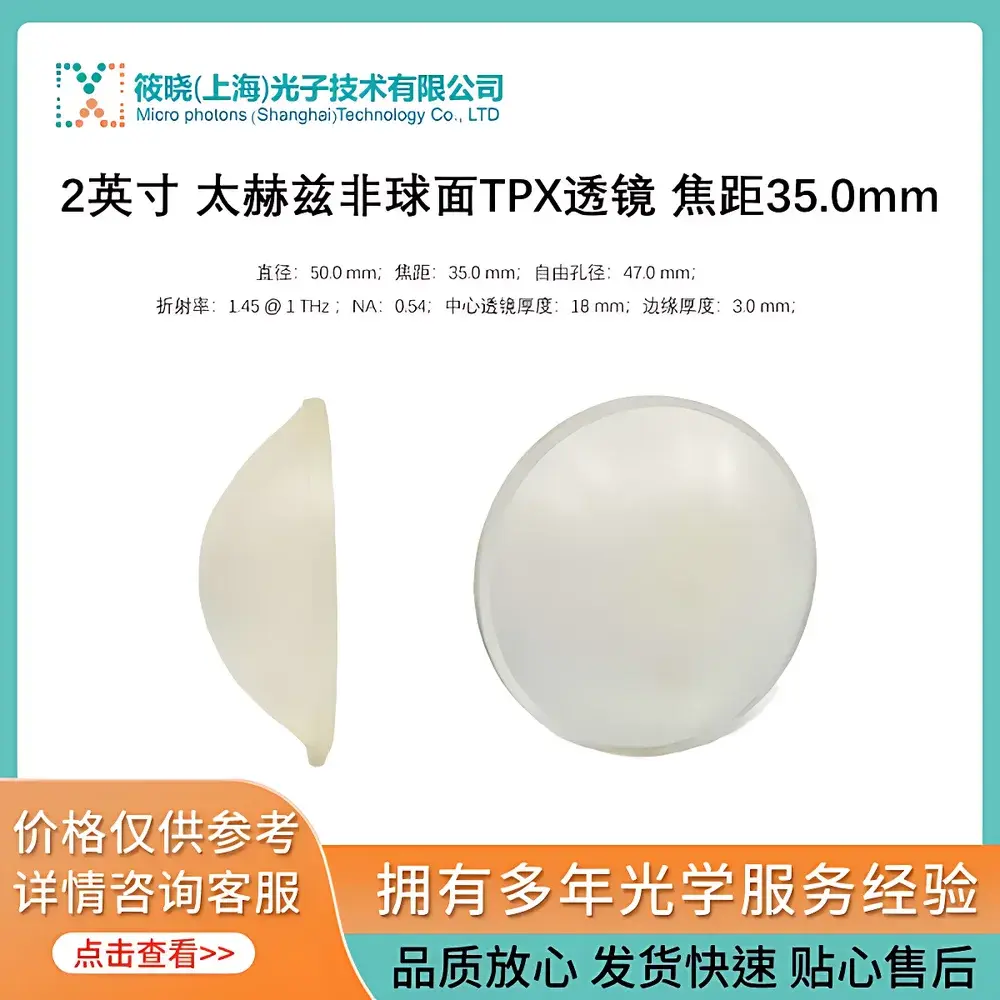
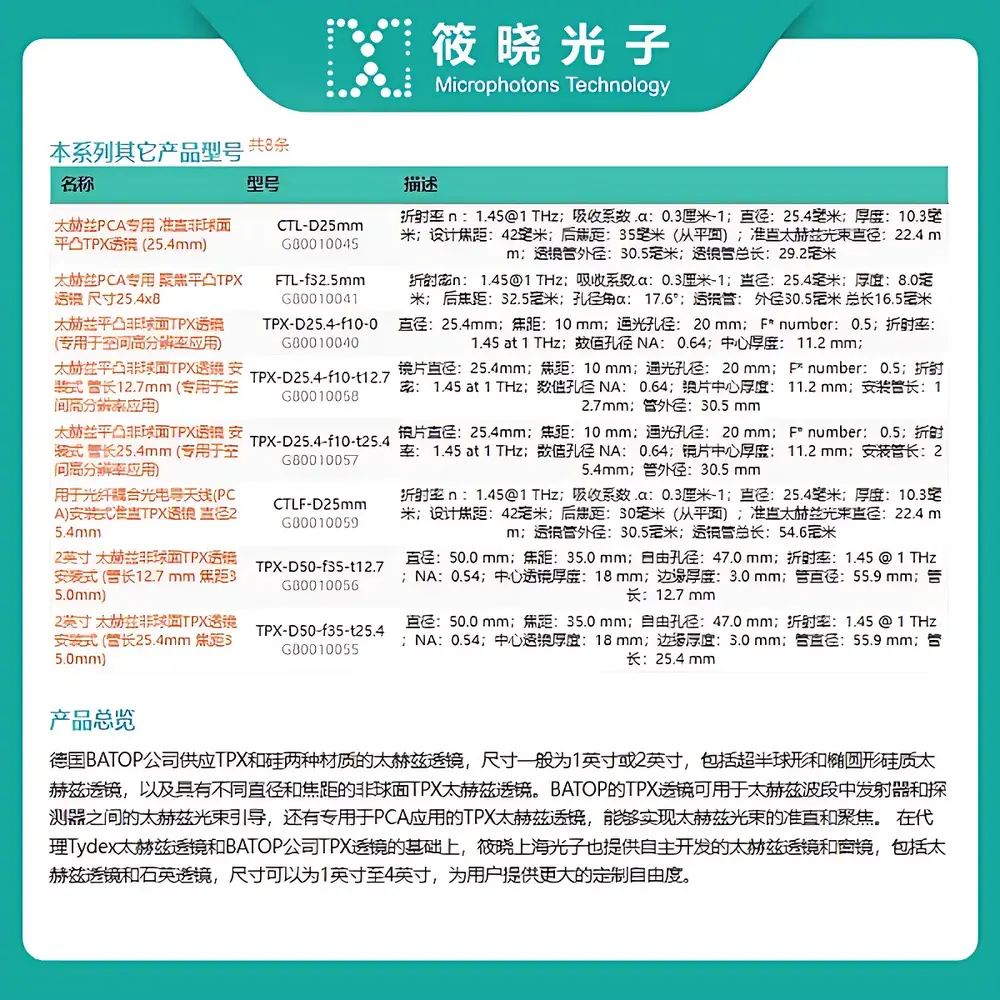
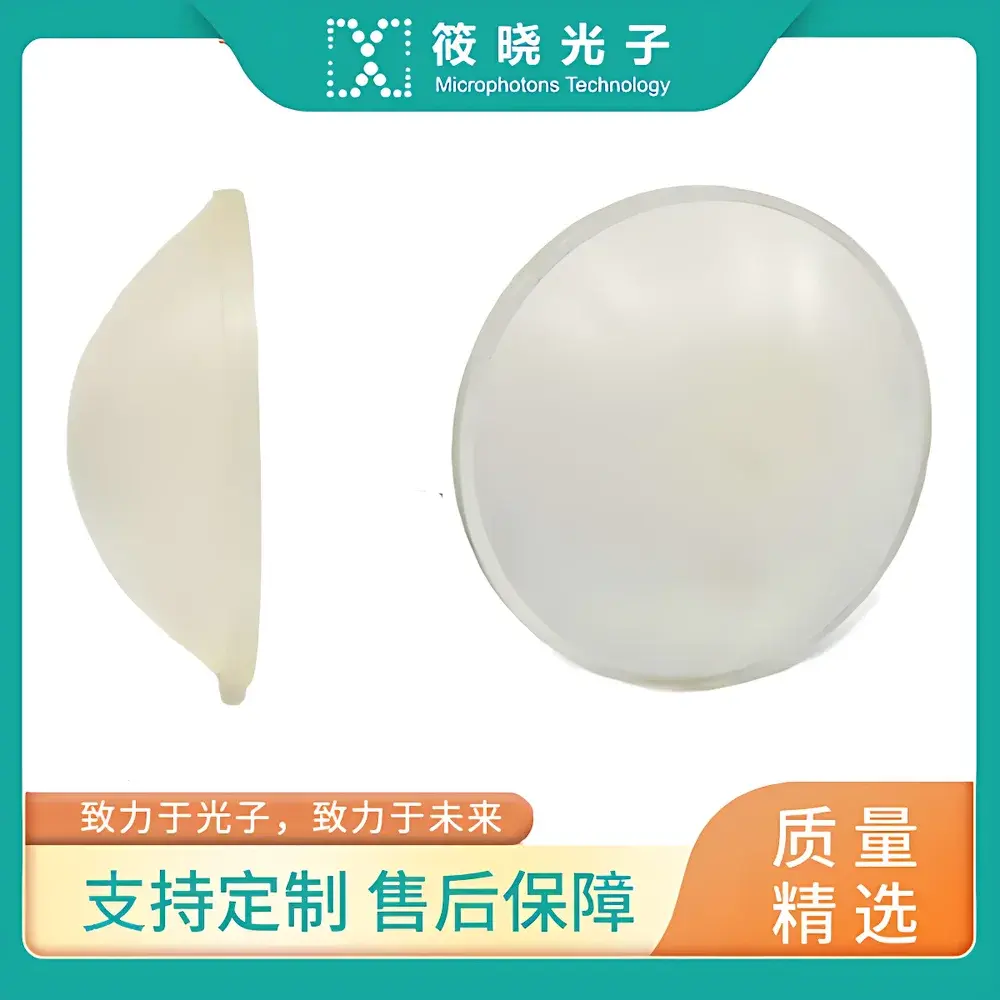
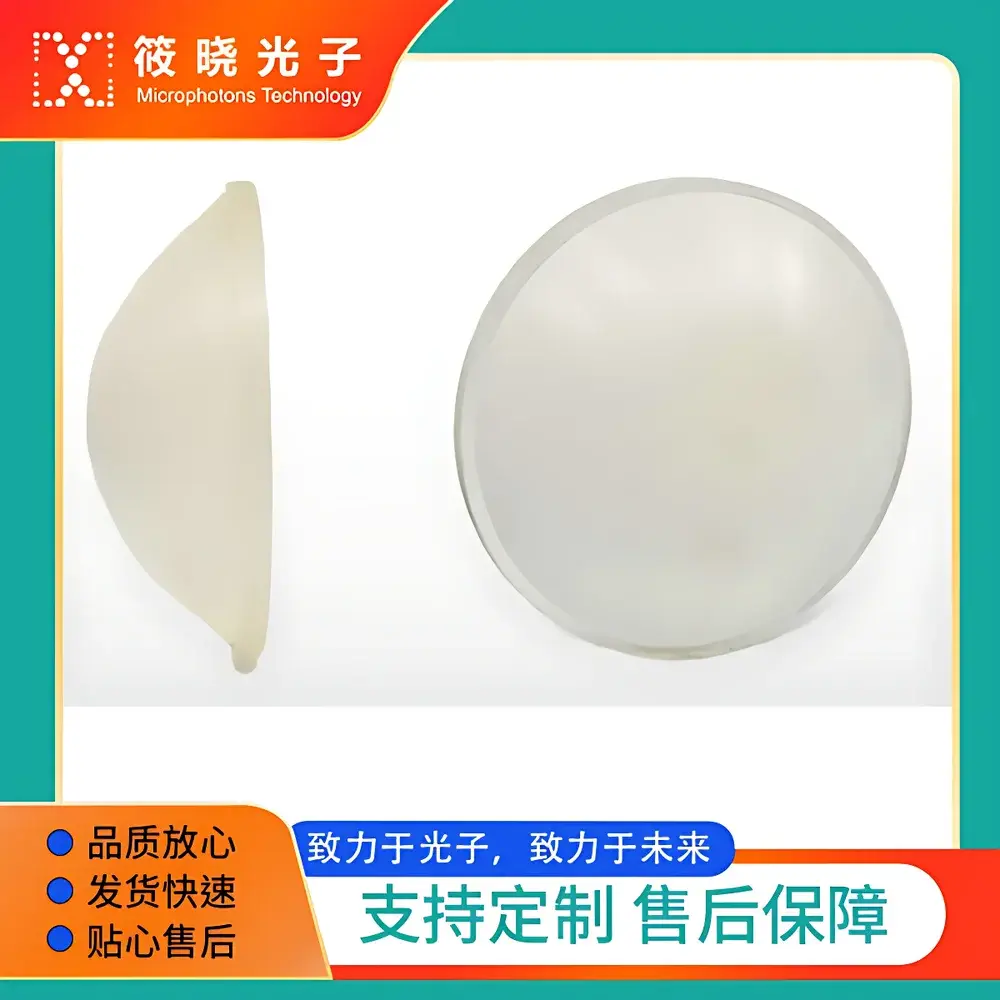
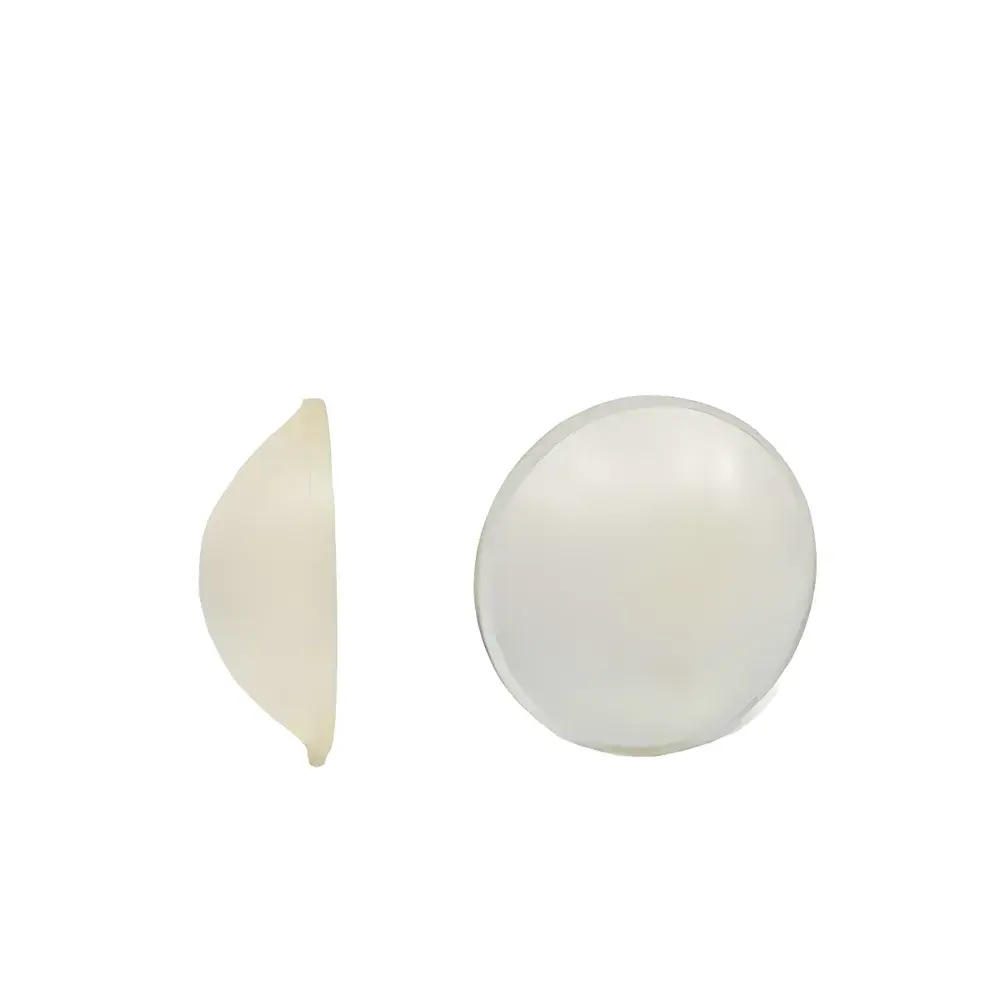
BATOP TPX-D50-f35-0 Aspheric THz Lens, 2-inch Diameter, f = 35.0 mm
| Brand | BATOP (distributed by Microphotons) |
|---|---|
| Origin | Germany |
| Manufacturer Type | OEM Manufacturer |
| Product Category | Optical Component |
| Model | TPX-D50-f35-0 |
| Material | Polymethylpentene (TPX) |
| Diameter | 50.8 mm (2 inch) |
| Focal Length | 35.0 mm |
| Mounting Tube Length | 12.7 mm |
| Compliance | ISO 9001-certified manufacturing |
| Optical Transmission Range | 0.1–4.0 THz (typical) |
Overview
The BATOP TPX-D50-f35-0 is a precision-engineered aspheric terahertz (THz) lens fabricated from high-purity polymethylpentene (TPX), a low-absorption, low-dispersion thermoplastic polymer widely adopted in broadband THz optics. Designed for rigorous laboratory and industrial THz time-domain spectroscopy (THz-TDS) systems, this lens operates within the 0.1–4.0 THz spectral band with minimal group delay distortion and negligible water vapor absorption—critical for maintaining temporal fidelity in pulsed THz measurements. Its aspheric surface profile eliminates spherical aberration across the full THz bandwidth, enabling diffraction-limited focusing and collimation performance. The lens is optimized for integration between THz emitters (e.g., photoconductive antennas, PCA) and detectors in free-space beam paths, supporting both quasi-optical coupling and spatial filtering applications. With a nominal focal length of 35.0 mm and 50.8 mm clear aperture, it delivers high numerical aperture (NA ≈ 0.72) while maintaining mechanical stability under vacuum or purged environments common in ultrafast THz setups.
Key Features
- Aspheric surface geometry engineered to minimize wavefront error (< λ/10 RMS @ 1 THz equivalent) and maximize Strehl ratio in THz band
- TPX substrate with 95% transmission per surface (uncoated)
- Integrated 12.7 mm mounting tube with SM1 (1.035″-40) external threading for compatibility with standard THz optical mounts and kinematic stages
- Thermally stable design: CTE ≈ 1.2 × 10⁻⁴ K⁻¹; suitable for operation from −40 °C to +80 °C without focal shift beyond ±0.15 mm
- OEM-grade surface figure accuracy (λ/8 @ 633 nm HeNe reference, verified via interferometry) and surface roughness < 5 nm RMS
- Compatible with anti-reflection (AR) coatings upon request for extended bandwidth (0.05–5.0 THz) and reduced Fresnel losses
Sample Compatibility & Compliance
This lens is routinely deployed in systems conforming to ASTM E2990-21 (Standard Guide for Terahertz Spectroscopy) and ISO/IEC 17025-accredited THz metrology laboratories. It supports non-contact characterization of dielectric, semiconductor, and pharmaceutical samples—including tablet coatings, polymer laminates, and layered 2D materials—without thermal loading or ionizing radiation. The TPX material is chemically inert toward common solvents (e.g., isopropanol, acetone) and exhibits no outgassing under UHV conditions (≤1×10⁻⁹ mbar), making it suitable for synchrotron-based THz beamlines and cryogenic THz imaging platforms. All units undergo 100% spectral transmission verification using Fourier-transform THz spectrometers traceable to NIST SRM 1921a.
Software & Data Management
While the lens itself is a passive optical component, its performance parameters are fully integrated into optical design workflows via Zemax OpticStudio (v23+) and CODE V (v12.2+) libraries, including dispersion-corrected Sellmeier coefficients for TPX across 0.1–5.0 THz. Beam propagation simulations (using ABCD matrix formalism and scalar diffraction models) are validated against experimental M² measurements and knife-edge scans. For GLP/GMP-regulated environments, batch-specific test reports—including interferometric surface maps, spectral transmittance curves, and focal spot intensity profiles—are archived with unique serial-number traceability and comply with FDA 21 CFR Part 11 electronic record requirements.
Applications
- Collimation and focusing of PCA-generated THz pulses in pump-probe configurations
- Spatial filtering in THz near-field microscopy (SNOM) and THz scanning near-field optical microscopy (s-SNOM)
- Beam shaping in THz computed tomography (THz-CT) and real-time security imaging systems
- Coupling efficiency optimization between fiber-coupled THz sources and parabolic mirror collectors
- Reference optics in inter-laboratory THz calibration round-robin studies coordinated by EURAMET and NPL
- Integration into compact THz endoscopes requiring high NA and minimal chromatic aberration
FAQ
What is the maximum peak power density this lens can withstand without damage?
TPX exhibits a laser-induced damage threshold (LIDT) of ≥1.2 J/cm² for 100-fs, 800-nm pump pulses (1 kHz rep rate), translating to >50 kW/cm² average power handling in CW THz regimes when actively cooled.
Is AR coating available, and what bandwidth does it cover?
Yes—single-layer MgF₂ or multi-layer quarter-wave stacks can be applied; standard AR coating covers 0.3–2.5 THz with <2% residual reflectance per surface.
Can this lens be used in vacuum or cryogenic environments?
Yes—validated for operation at 10⁻⁹ mbar and down to 4 K; no delamination or stress birefringence observed in thermal cycling tests (−269 °C ↔ +80 °C, 5 cycles).
How is focal length tolerance specified, and how is it measured?
Focal length tolerance is ±0.3 mm, measured via autocollimation with a 118-µm THz quantum cascade laser source and calibrated Si bolometer array.
Do you provide Zemax files and mechanical drawings?
Yes—native .ZAR files, STEP (.stp), and PDF dimensional drawings with GD&T annotations are supplied with each shipment under NDA-compliant licensing.





