
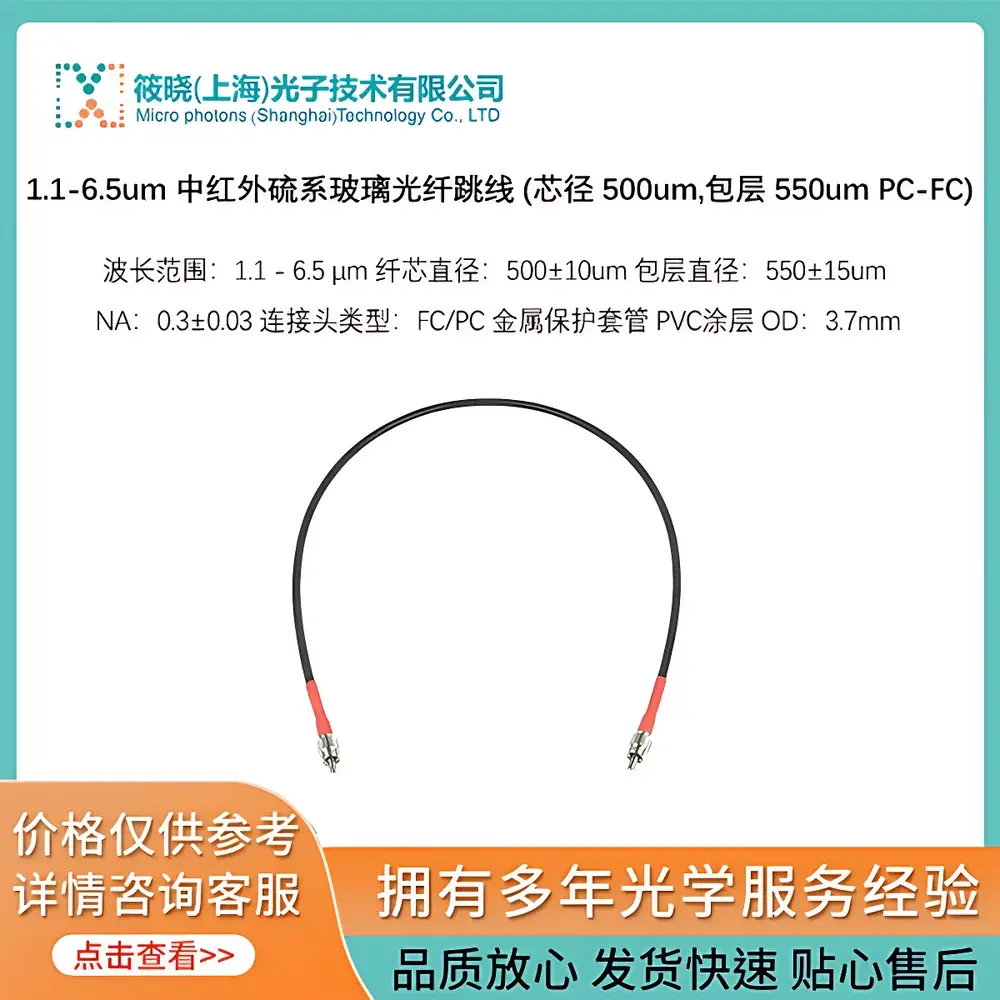
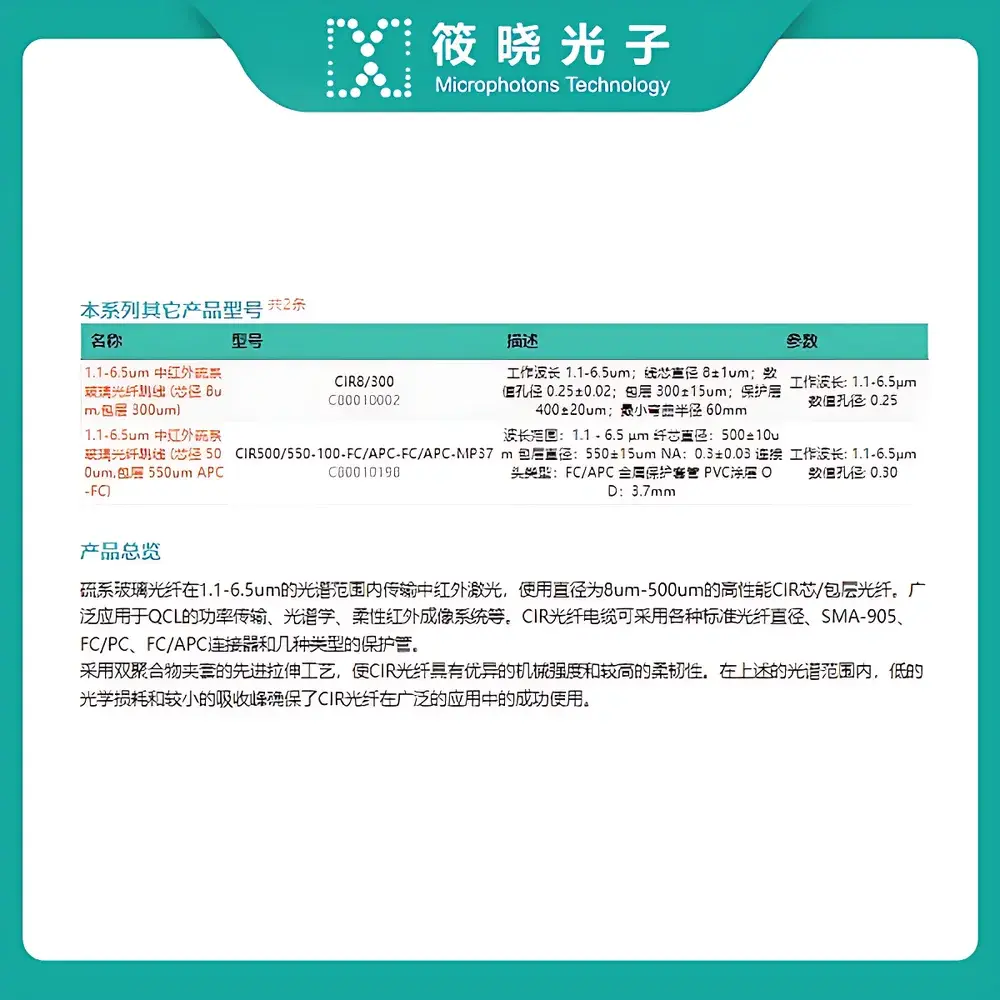
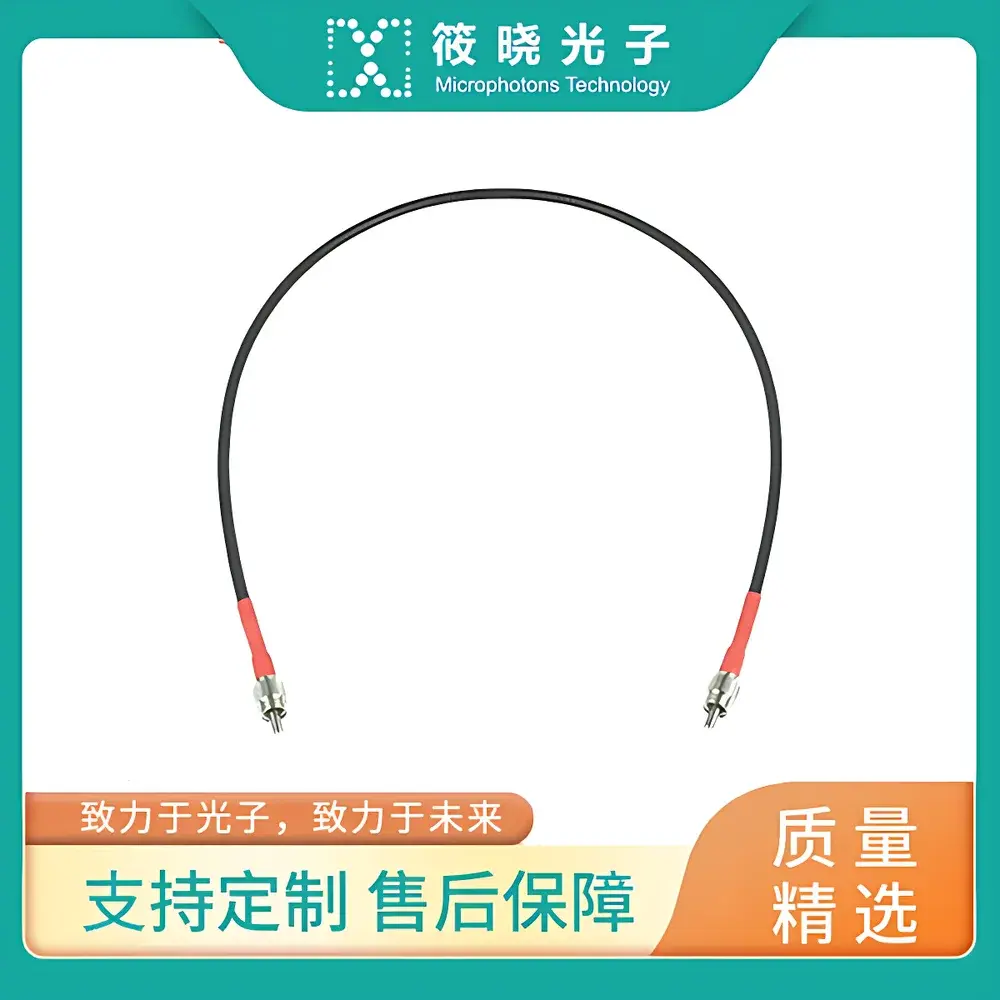
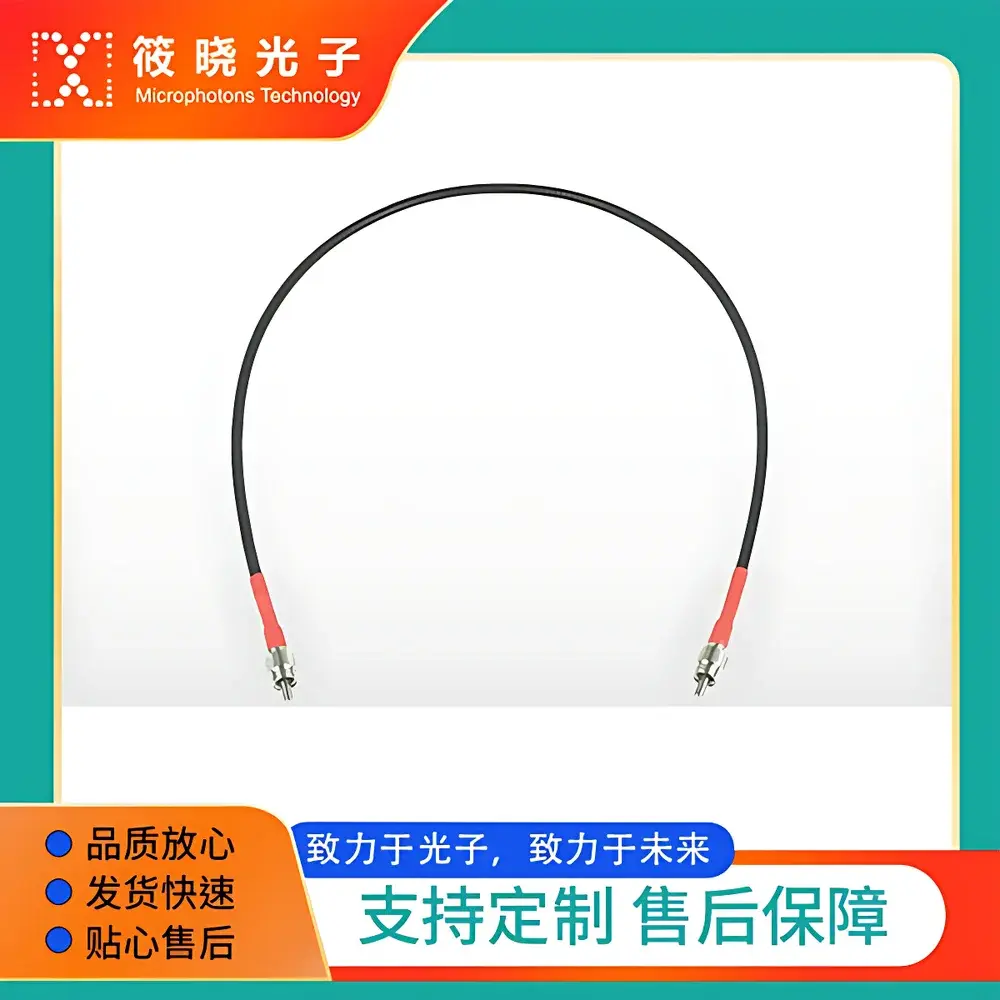
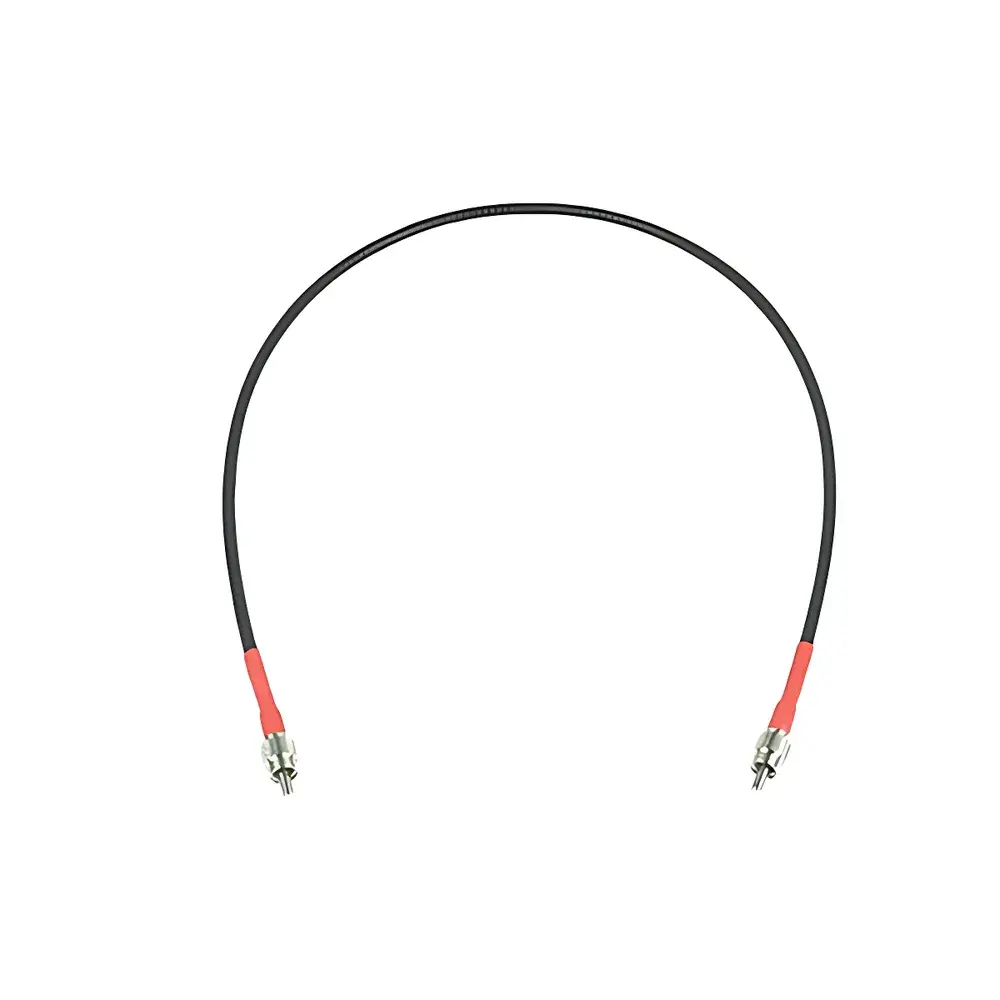
art photonics CIR500/550-100-FC/PC-FC/PC-MP37 Chalcogenide Glass Mid-IR Fiber Patch Cable (500 µm Core / 550 µm Cladding, FC/PC to FC/PC, 1 m)
| Brand | art photonics |
|---|---|
| Origin | Germany |
| Fiber Type | Step-index multimode chalcogenide (CIR) glass |
| Wavelength Range | 1.1–6.5 µm |
| Core Diameter | 500 ± 10 µm |
| Cladding Diameter | 550 ± 15 µm |
| Numerical Aperture (NA) | 0.30 ± 0.03 |
| Coating Diameter (dual-polymer) | 700 ± 30 µm |
| Connector Type | FC/PC to FC/PC |
| Protective Jacket | Metal sheath, OD 3.7 mm |
| Length | 1.00 ± 0.05 m |
| Minimum Bend Radius | 100 mm |
| Operating Temperature | –50 °C to +90 °C |
| Attenuation | 0.2–0.3 dB/m (at 2.5–4 µm and 4.5–5 µm) |
Overview
The art photonics CIR500/550-100-FC/PC-FC/PC-MP37 is a precision-engineered mid-infrared (mid-IR) fiber patch cable fabricated from high-purity arsenic sulfide–based chalcogenide glass (CIR series). Designed for robust optical transmission across the 1.1–6.5 µm spectral band, this multimode fiber leverages a step-index core/cladding architecture to maintain modal stability and low propagation loss in demanding mid-IR applications. Unlike silica-based fibers—opaque beyond ~2.2 µm—CIR fibers exhibit intrinsic transparency in the molecular fingerprint region, enabling direct delivery of quantum cascade laser (QCL) output, tunable OPO beams, and broadband thermal sources without free-space alignment. The 500 µm core diameter supports high-power coupling while preserving beam quality for spectroscopic interrogation and imaging; its 0.30 NA ensures efficient launch from common mid-IR collimators and focusing optics. The dual-polymer coating (PVC over primary acrylate) and stainless-steel armored jacket (OD 3.7 mm) provide mechanical resilience against torsion, crush, and environmental cycling—critical for integration into portable spectrometers, industrial process analyzers, and laboratory-grade FTIR accessories.
Key Features
- Ultra-broadband transmission from 1.1 µm to 6.5 µm—covering key absorption bands of CO, CO₂, CH₄, NOₓ, NH₃, and volatile organic compounds (VOCs)
- Low attenuation of 0.2–0.3 dB/m at 2.5–4 µm and 4.5–5 µm—optimized for QCL wavelengths at 4.5 µm (CO), 4.6 µm (NO), and 7.7 µm (hydrocarbons, via harmonic generation)
- Precision-drawn chalcogenide preform yielding tight dimensional tolerances: core ±10 µm, cladding ±15 µm, NA ±0.03
- Operating temperature range of –50 °C to +90 °C—suitable for cryogenic gas sensing and high-temperature industrial monitoring
- FC/PC connectors on both ends ensure repeatable, low-back-reflection coupling (< –35 dB) with standard mid-IR optical benches and spectrometer input ports
- Armored metal jacket (3.7 mm OD) with strain-relieved terminations meets IEC 61300-2-4 tensile and IEC 61300-2-22 flex endurance requirements
Sample Compatibility & Compliance
This fiber cable is compatible with all commercially available mid-IR light sources emitting within its transmission window—including continuous-wave and pulsed QCLs (e.g., Block Engineering, Hamamatsu), optical parametric oscillators (OPOs), and globar-based FTIR systems. It interfaces seamlessly with Fourier-transform infrared (FTIR) spectrometers equipped with MCT or InSb detectors, as well as with uncooled microbolometer arrays used in flexible infrared imaging probes. The CIR material complies with RoHS Directive 2011/65/EU and is manufactured under ISO 9001-certified processes. While not intrinsically ATEX- or IECEx-certified, the armored construction enables safe deployment in Class 1 Div 2 hazardous environments when integrated with appropriate opto-mechanical housings. No special handling protocols beyond standard IR fiber precautions (e.g., avoidance of sharp bends <100 mm radius, protection from moisture during storage) are required.
Software & Data Management
As a passive optical component, the CIR500/550-100-FC/PC-FC/PC-MP37 requires no embedded firmware or driver software. Its performance is fully characterized via standardized optical test methods per ISO 11999 (optical fiber attenuation measurement) and ASTM E1421 (FTIR calibration traceability). Spectral transmission data—including wavelength-dependent loss and bend-induced insertion loss—are supplied in CSV and MATLAB-compatible .mat formats upon request, supporting integration into instrument qualification documentation (IQ/OQ/PQ) and GLP/GMP-compliant analytical method validation packages. For users operating under FDA 21 CFR Part 11 requirements, the fiber’s fixed physical parameters (core size, NA, length) are recorded in permanent audit trails during system configuration in validated spectroscopy platforms such as Thermo Nicolet iS50 or Bruker Tensor II.
Applications
- Quantum cascade laser (QCL) beam delivery for real-time gas sensing in emissions monitoring, semiconductor fab ambient control, and medical breath analysis
- Flexible fiber-coupled FTIR spectroscopy for in situ reaction monitoring in catalytic reactors and pharmaceutical crystallization vessels
- Remote mid-IR thermometry using blackbody-radiation coupling—enabling non-contact temperature measurement in rotating machinery or vacuum chambers
- Endoscopic infrared imaging for biomedical diagnostics, including lipid mapping and tissue differentiation in minimally invasive procedures
- Mid-IR laser machining and ablation of polymers and biological tissues where UV or NIR photons induce excessive thermal damage
FAQ
What is the maximum average power this fiber can transmit?
For continuous-wave operation at 4.5 µm, the recommended maximum average power is 1.5 W. Peak pulsed power (e.g., nanosecond QCL pulses) should not exceed 10 kW to avoid nonlinear effects or surface damage at connectors.
Can this fiber be spliced to silica fiber?
No—chalcogenide and silica glasses are immiscible and possess vastly different thermal expansion coefficients and softening temperatures. Fusion splicing is not feasible; butt-coupling with precision kinematic mounts is the industry-standard interface method.
Is the FC/PC connector polished for mid-IR use?
Yes—the end-faces are polished to λ/10 surface flatness at 4.5 µm and coated with a broadband anti-reflection (AR) layer optimized for 1.1–6.5 µm, reducing Fresnel losses to <0.5% per interface.
Does the metal jacket interfere with magnetic fields in NMR-coupled spectroscopy setups?
The stainless-steel braid is non-magnetic (AISI 304) and introduces negligible perturbation to static magnetic fields up to 14 T; however, eddy-current heating under RF excitation (>100 kHz) should be evaluated case-by-case.
How is calibration traceability maintained for spectral transmission measurements?
Each production lot undergoes reference-grade spectral attenuation profiling using NIST-traceable calibrated photodetectors and monochromated synchrotron radiation at PTB (Physikalisch-Technische Bundesanstalt), with full uncertainty budgets provided in the Certificate of Conformance.




