
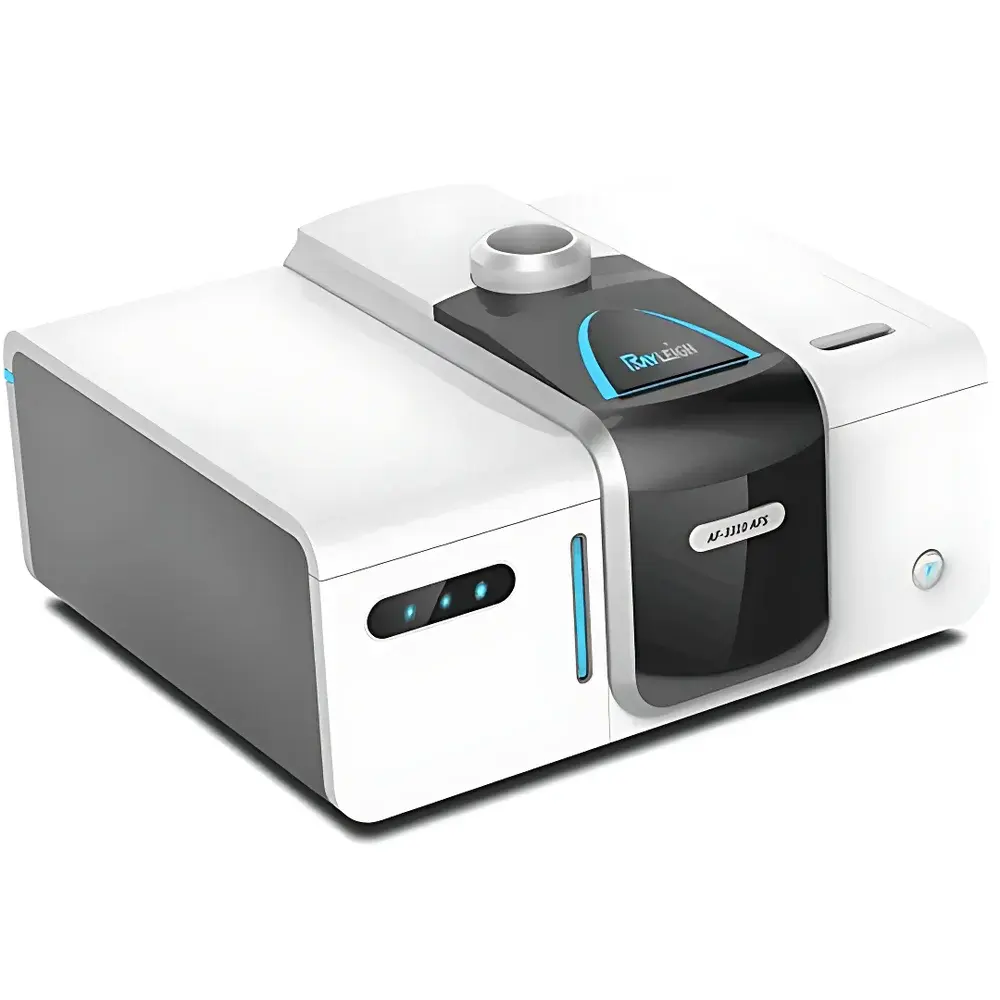
Beifen Ruili AF3000 Series Atomic Fluorescence Spectrometer
| Brand | Beifen Ruili |
|---|---|
| Origin | Beijing, China |
| Model | AF3000 |
| Instrument Type | Multi-channel Atomic Fluorescence Spectrometer |
| Sample Introduction | Peristaltic Pump |
| Detectable Elements | As, Sb, Bi, Se, Te, Pb, Sn, Hg, Cd, Ge, Zn, Au, Ag, Co, Cu, Ni |
| Relative Standard Deviation (RSD) | < 0.7% |
| Linear Dynamic Range | > 3 orders of magnitude |
| Detection Limits | As, Sb, Bi, Se, Te, Pb, Sn < 0.01 µg/L |
Overview
The Beifen Ruili AF3000 Series Atomic Fluorescence Spectrometer is a high-performance, multi-channel analytical instrument engineered for trace-level quantification of hydride-forming and cold-vapor elements in environmental, geological, food safety, pharmaceutical, and clinical laboratories. It operates on the principle of atomic fluorescence spectroscopy (AFS), where analyte atoms—generated in situ via hydride generation (HG) or cold vapor (CV) techniques—are excited by a high-intensity, element-specific hollow cathode lamp (HCL), and the resulting fluorescence emission at characteristic wavelengths is measured by a photomultiplier tube (PMT). The AF3000 series integrates a short-focal-length, fully enclosed, dispersion-free optical path with an integrated optical trap to suppress stray light, ensuring exceptional signal stability and baseline reproducibility. Its design conforms to internationally recognized performance benchmarks for trace metal analysis—including ASTM D5673 (for arsenic in water), ISO 17892-11 (geotechnical testing), and USP / (elemental impurities in pharmaceuticals)—and supports GLP/GMP-compliant workflows through audit-trail-enabled software and hardware diagnostics.
Key Features
- Multi-element capability: Simultaneous or sequential detection of 16 elements including As, Sb, Bi, Se, Te, Pb, Sn, Hg, Cd, Ge, Zn, Au, Ag, Co, Cu, and Ni—each optimized for hydride generation or cold vapor atomization.
- Advanced optical architecture: Sealed, non-dispersive optical system with automatic digital beam alignment (AF-3310/AF-3320 models); real-time flame visualization via integrated atomic chamber video monitoring.
- Intelligent light source management: Universal HCL compatibility with auto-recognition chip; high-frequency pulse-width modulation and square-wave smoothing for enhanced sensitivity and extended lamp life; built-in energy self-calibration to compensate for lamp drift.
- Precision gas control: Dual intelligent gas circuit with mass flow controllers (1 mL/min resolution); adaptive pressure-balanced vapor generation; active argon-saving mode and automatic shutoff upon shutdown.
- Stable hydride generation: Micro-volume PEEK check valves and transparent four-way mixing modules enable laminar flow, minimal turbulence, and real-time observation of hydride formation kinetics.
- Robust atomization: Fully enclosed quartz cell with pulsed hot-surface ignition (>100,000 ignitions lifetime); corrosion-resistant, EMI-free ignition system independent of ambient temperature fluctuations.
- Zero-maintenance gas–liquid separation: Three-stage jet-type separator with passive water-seal formation and automatic waste discharge—eliminating risk of backflow into the atomizer.
Sample Compatibility & Compliance
The AF3000 accommodates aqueous samples across diverse matrices—including drinking water, wastewater, soil extracts, biological fluids, and food digests—following standard EPA Method 1631E (Hg), 200.9 (As, Se), and ISO 11969 (Hg in fish tissue). Its modular vapor generation system ensures compatibility with both continuous-flow and sequential-injection sample introduction protocols (AF-3200/AF-3300 vs. AF-3320 configurations). All fluidic pathways employ inert PEEK and quartz materials to prevent adsorption or memory effects. The instrument meets CE marking requirements and complies with IEC 61326-1 for electromagnetic compatibility. Optional accessories—including the PDI-10 speciation module, WM-10 ultra-trace mercury kit, and VM-10 gaseous mercury sampling unit—extend compliance to ISO/IEC 17025-accredited testing scopes for elemental speciation and volatile mercury analysis.
Software & Data Management
The AF3000 runs on Windows-compatible acquisition software featuring full RS-232 and USB interface support, automatic port scanning, and plug-and-play recognition of peripheral modules (e.g., AS-10 45-position or AS-20 150-position autosamplers). Key software capabilities include: multi-sample group processing with customizable blank definitions; single-standard curve generation with auto-dilution and out-of-range flagging; remote pre-heating activation; and comprehensive expert system integration—containing >2,500 peer-reviewed method references, element-specific parameters, digestion protocols, interference mitigation strategies, and optimized instrument settings. All data operations are timestamped and logged with user authentication; audit trails comply with FDA 21 CFR Part 11 requirements when configured with electronic signature modules.
Applications
The AF3000 delivers reliable sub-part-per-trillion (ng/L) detection for regulatory monitoring and research applications. Typical use cases include: arsenic speciation (AsIII/AsV) in rice and groundwater; total and methylmercury analysis in seafood and human hair; selenium speciation in dietary supplements; antimony quantification in PET plastic leachates; and bismuth monitoring in pharmaceutical catalyst residues. Its low RSD (103) support both routine QC/QA batch analysis and method validation per ISO/IEC 17025 Clause 5.4. It is routinely deployed in national environmental monitoring stations, third-party testing labs accredited to CNAS (China), UKAS (UK), and DAkkS (Germany), and university core facilities conducting trace metal biogeochemistry.
FAQ
What elements can the AF3000 detect, and what are typical detection limits?
The AF3000 detects 16 elements via hydride generation or cold vapor techniques. For As, Sb, Bi, Se, Te, Pb, and Sn, the instrumental detection limit is <0.01 µg/L under standard operating conditions.
Does the system support automated operation?
Yes—optional AS-10 (45-position) or AS-20 (150-position) autosamplers enable fully programmable, unattended batch analysis with editable cup mapping and method recall.
Is the software compliant with regulatory data integrity standards?
When deployed with optional electronic signature and audit trail modules, the software satisfies FDA 21 CFR Part 11 and EU Annex 11 requirements for electronic records and signatures.
Can the AF3000 perform elemental speciation?
With the PDI-10 speciation upgrade module and compatible HPLC coupling, it supports As, Hg, and Se species separation and quantification using hyphenated AFS-HPLC methodology.
What maintenance is required for the gas–liquid separator?
The jet-type three-stage separator is designed for lifetime operation without consumables or servicing—no pump replacement, no membrane cleaning, and no manual drainage required.
Related Products





