
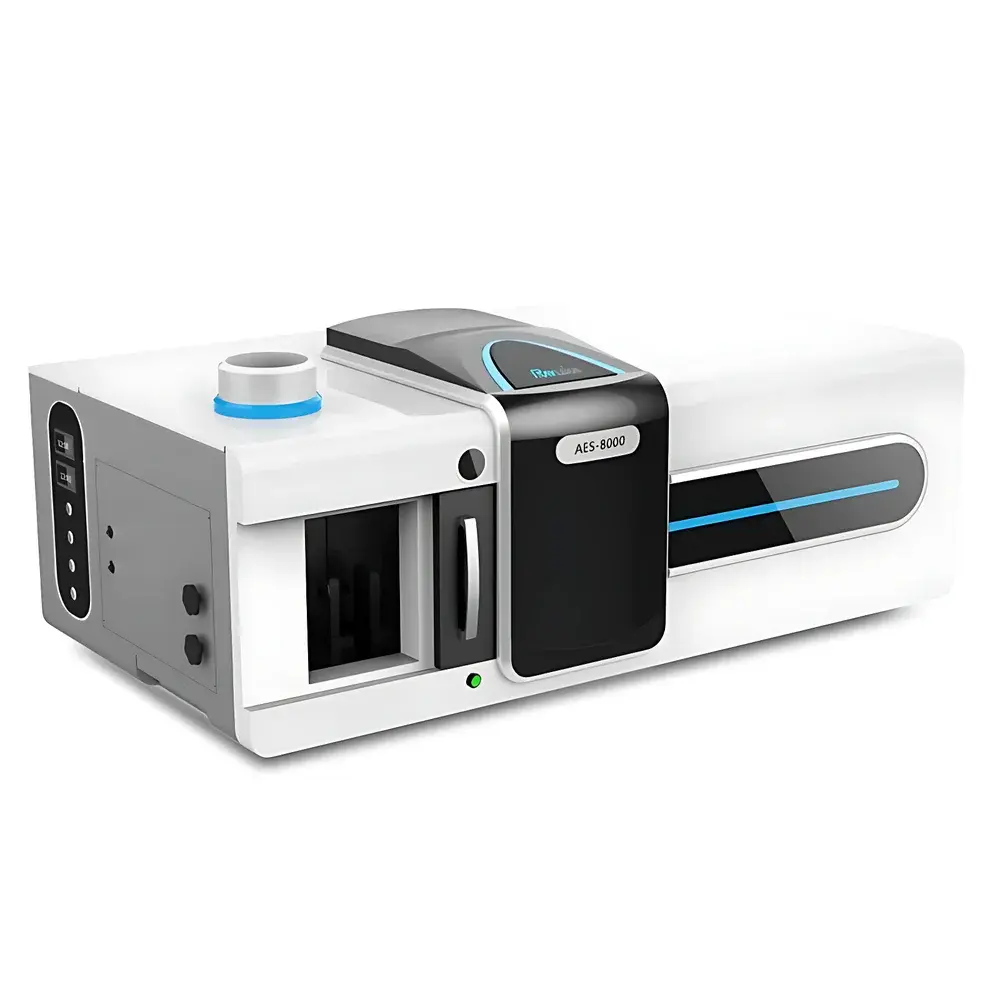
Beifen Ruili AES-8000 AC/DC Arc Emission Spectrometer
| Brand | Beifen Ruili |
|---|---|
| Origin | Beijing, China |
| Model | AES-8000 Series |
| Instrument Type | Benchtop Direct-Reading Spectrometer |
| Excitation Source | AC/DC Arc |
| Detector | UV-Sensitive CMOS Array |
| Focal Length | 600 mm |
| Grating Grooves | 2400 lines/mm |
| Wavelength Range | 230–340 nm |
| Spectral Coverage | Full-Spectrum Acquisition |
| Optical Design | Vertical Symmetric Ebert-Fastie |
| Reciprocal Linear Dispersion | 0.64 nm/mm (1st order) |
| Theoretical Spectral Resolution | 0.003 nm @ 300 nm |
| Spectrometer Chamber Temperature Control | 35 °C ± 0.1 °C |
| Arc Current Range | 2–20 A (AC), 2–15 A (DC) |
| Dimensions (L×W×H) | 1500 × 820 × 650 mm |
| Weight | ~180 kg |
| Operating Environment | 15–30 °C, RH < 80 % |
Overview
The Beifen Ruili AES-8000 AC/DC Arc Emission Spectrometer is a benchtop direct-reading optical emission spectrometer engineered for qualitative and quantitative multi-element analysis of solid, non-conductive, and refractory powdered samples without dissolution. It operates on the principle of arc-excited atomic emission spectroscopy (AES), where high-energy electrical discharge between carbon or graphite electrodes vaporizes and atomizes sample material, generating element-specific line spectra in the ultraviolet region. The instrument employs a vertical symmetric Ebert-Fastie optical configuration with a 600 mm focal length and a 2400 lines/mm plane grating—optimized to deliver high spectral fidelity, minimal stray light, and uniform line intensity across the 230–340 nm range. Its full-spectrum acquisition capability, enabled by a thermally stable UV-sensitive CMOS array detector, eliminates the need for pre-defined analytical channels and supports post-acquisition spectral reprocessing. Designed for laboratories requiring trace-level detection in geological matrices, high-purity metals, ceramics, and coal ash, the AES-8000 meets core performance expectations for GLP-compliant elemental screening workflows.
Key Features
- Ebert-Fastie optical system with triple-lens beam path: suppresses chromatic aberration, halo effects, and stray light; ensures flat focal plane and high signal-to-background ratio.
- UV-optimized CMOS detector: no phosphor coating or quantum efficiency degradation over time; wide dynamic range (>10⁵), low thermal drift (<0.01% per °C), and intrinsic resistance to spectral broadening artifacts.
- FPGA-based real-time acquisition architecture: enables synchronized multi-CMOS readout, automatic wavelength calibration using internal reference lines, and on-the-fly background subtraction.
- Dual-mode arc excitation source: seamless switching between AC (for insulating powders) and DC (for conductive metals); programmable current control (2–20 A AC / 2–15 A DC) with electrode auto-alignment via motorized Z-axis positioning.
- Patented electrode projection imaging window: provides real-time visual monitoring of arc stability, plasma morphology, and sample consumption behavior—critical for method development and troubleshooting.
- Thermostatically stabilized spectrometer chamber: maintained at 35 °C ± 0.1 °C to minimize thermal drift of grating alignment and detector response.
Sample Compatibility & Compliance
The AES-8000 is optimized for direct analysis of pressed powder pellets, fused beads, and sintered conductive targets. It accommodates geological exploration samples (e.g., soils, stream sediments, rock powders), high-purity metal oxides (W, Mo, Ta, Nb, In, Bi), ceramic glazes, glass frits, and coal fly ash—without acid digestion or fusion. Its detection capability spans major, minor, and trace elements including Ag, Sn, B, Mo, Pb, Zn, Ni, Cu, and noble metals (e.g., Au, Pt, Pd after pre-concentration). While not certified to ISO/IEC 17025 as a standalone testing platform, its hardware architecture and software audit trail functions—including timestamped calibration logs, parameter change history, and raw spectrum archiving—support alignment with GLP and GMP documentation requirements. Data export formats (CSV, ASCII, .spc) are compatible with LIMS integration and satisfy minimum traceability criteria under ASTM E1317 and ISO 11885.
Software & Data Management
The proprietary analysis software provides fully automated spectral processing: real-time peak identification using NIST Atomic Spectra Database references; iterative least-squares fitting combining Gaussian and Lorentzian line profiles; interference correction via neighboring-line deconvolution algorithms; and multi-line integration for extended linear dynamic range. All calibration curves support both single-point and multi-point standardization, with optional internal standard normalization (e.g., C I 247.86 nm). Raw spectra are stored with metadata (excitation mode, current, integration time, ambient temperature), enabling retrospective re-evaluation. Audit-ready features include user-access logs, electronic signature prompts for report finalization, and immutable data archives compliant with FDA 21 CFR Part 11 basic requirements (though full electronic signature validation requires third-party PKI integration).
Applications
- Geochemical survey labs: simultaneous quantification of Ag, Sn, B, Mo, Pb, Zn, Ni, Cu in soil and sediment powders; detection of sub-ppm noble metals following fire assay preconcentration.
- Materials purity certification: impurity profiling of tungsten carbide, molybdenum disilicide, cobalt alloys, and rare-earth oxides—covering 30+ elements from Li to U within one acquisition.
- Ceramic and glass R&D: rapid screening of transition metal dopants (Fe, Mn, Co, Cr) and alkali contaminants (Na, K, Li) affecting color stability and thermal expansion.
- Coal and ash analysis: determination of environmentally regulated elements (As, Se, Hg, Cd, Pb) in fly ash fractions per ASTM D6349 and ISO 1171.
- Academic spectroscopy labs: teaching platform for fundamental studies in plasma physics, line broadening mechanisms, and self-absorption effects in arc sources.
FAQ
Does the AES-8000 require vacuum or purge gas for UV spectral transmission?
No—the 230–340 nm range is fully accessible under ambient air; the optical path is sealed and purged only internally during detector cooldown cycles.
Can the instrument analyze liquid samples?
Not directly; it is designed exclusively for solid powders. Liquid analysis requires prior evaporation onto graphite electrodes or freeze-drying into homogeneous pellets.
What standards are recommended for calibration?
Certified reference materials (CRMs) with matrix-matched composition: GBW series (China), NIST SRM 2782 (stainless steel), USGS GSP-2 (granite), and IRMM-038 (tungsten oxide).
Is remote diagnostics supported?
Yes—the embedded Ethernet interface enables secure SSH access for firmware updates and log retrieval; remote operation requires local network authentication and TLS-encrypted VNC session initiation.
How often must the grating be recalibrated?
Under stable environmental conditions and routine use, wavelength calibration remains valid for ≥6 months; automatic daily verification uses C I 247.86 nm and Fe I 259.94 nm reference lines.






