
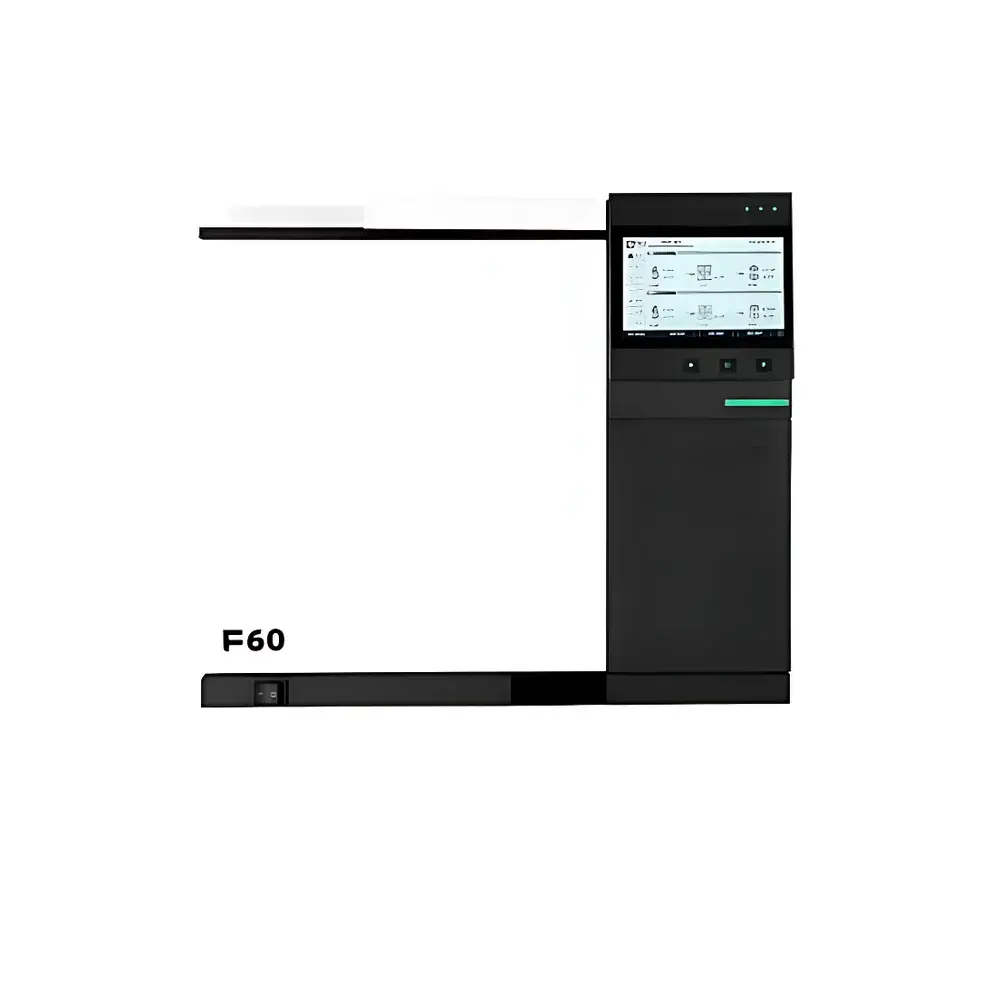
Fulit F60 Laboratory Gas Chromatograph
| Brand | Fulit |
|---|---|
| Origin | Zhejiang, China |
| Manufacturer Type | Authorized Distributor |
| Product Origin | Domestic (China) |
| Model | F60 |
| Instrument Type | Laboratory Gas Chromatograph |
| Application Scope | General-Purpose |
| Temperature Control Range | 6°C to 400°C |
| Maximum Ramp Rate | 120°C/min |
| Cooling Time | <7.0 min (from 350°C to 50°C) |
| Carrier Gas Flow Control | Electronic Flow Display |
| Carrier Gas Pressure Control | Electronic Pressure Display |
| Injector Maximum Operating Temperature | 400°C |
Overview
The Fulit F60 is a benchtop laboratory gas chromatograph engineered for precision, reliability, and operational efficiency in routine and research-grade analytical laboratories. It operates on the fundamental principle of gas-liquid partition chromatography, where volatile and semi-volatile compounds are separated based on their relative volatility and affinity toward the stationary phase within a fused-silica capillary column. The system employs a temperature-programmable oven with precise PID-controlled heating and rapid cooling capability, enabling high-resolution separation across complex sample matrices. Designed for general-purpose applications—including environmental monitoring, petrochemical analysis, food safety testing, and pharmaceutical impurity profiling—the F60 delivers consistent retention time stability and peak shape fidelity under both isothermal and multi-step temperature ramp conditions.
Key Features
- Intuitive 7-inch capacitive touchscreen interface with real-time instrument status visualization, method editing, and direct access to diagnostic logs—eliminating reliance on external PCs for basic operation.
- Hybrid pneumatic architecture combining robust mechanical valves for carrier gas switching and electronic pressure/flow monitoring (EPC/EFC) for reproducible inlet and detector gas control.
- Optimized detector modules—including configurable FID (Flame Ionization Detector) and TCD (Thermal Conductivity Detector)—featuring enhanced signal-to-noise ratio, reduced baseline drift, and improved linear dynamic range (10⁷ for FID).
- Thermally insulated injection port capable of stable operation up to 400°C, supporting split, splitless, and cold-on-column injection modes with programmable temperature ramping.
- Integrated safety interlocks including flame-out detection for FID, overtemperature cutoff, and leak monitoring via pressure decay diagnostics—ensuring compliance with IEC 61010-1 laboratory equipment safety standards.
Sample Compatibility & Compliance
The F60 accommodates a broad spectrum of sample types, including aqueous extracts, organic solvent solutions, headspace vials, and thermal desorption tubes—compatible with standard 0.25–0.53 mm ID capillary columns (up to 60 m length). Its temperature programming flexibility supports ASTM D3606 (benzene/toluene in gasoline), ISO 11843-2 (detection limit validation), and USP chromatographic procedure requirements. Data acquisition and instrument control meet ALCOA+ principles; audit trail functionality, user access levels, and electronic signature support align with FDA 21 CFR Part 11 readiness when paired with validated third-party chromatography data systems (CDS).
Software & Data Management
The F60 operates natively via embedded firmware with method storage capacity for ≥100 sequences and raw data retention for ≥10,000 runs. Export formats include standard .cdf (NetCDF-based) and .csv for interoperability with LIMS, OpenLab CDS, Chromeleon, or Empower. Optional PC-based software provides advanced peak integration algorithms (tangent skim, valley-to-valley, exponential curve fitting), calibration curve generation (linear, quadratic, weighted least squares), and automated report templating compliant with GLP/GMP documentation workflows. All method parameters—including temperature ramps, valve events, and detector settings—are version-controlled and timestamped.
Applications
- Environmental: Quantification of BTEX (benzene, toluene, ethylbenzene, xylenes), PAHs, chlorinated solvents, and pesticides in soil/water extracts per EPA Method 8260D and 8081B.
- Petrochemical: Hydrocarbon group-type analysis (PIONA), simulated distillation (ASTM D5292), and sulfur compound profiling using sulfur-selective detectors.
- Food & Flavor: Residual solvent screening in packaging materials (ISO 105-E03), essential oil fingerprinting, and ethanol quantification in beverages.
- Pharmaceutical: Assay of residual solvents in drug substances (ICH Q3C), assay purity determination, and stability-indicating method development.
FAQ
Is the F60 compatible with third-party chromatography data systems (CDS)?
Yes—the instrument supports standard RS-232, USB, and Ethernet communication protocols and exports data in vendor-neutral .cdf format, enabling seamless integration with major CDS platforms.
Does the F60 support unattended operation?
Yes—it features a 16-position autosampler interface (optional) and built-in scheduler for overnight or weekend sequence execution with automatic shutdown and purge cycles.
What column dimensions and phases are recommended for optimal performance?
Standard 30 m × 0.32 mm × 0.25 µm DB-5ms or HP-5 columns are validated for general use; column selection should be guided by analyte polarity, boiling point, and required resolution per application-specific method development.
How is detector sensitivity verified and maintained?
Sensitivity is verified using certified test mixtures (e.g., 1 ng/µL n-decane in hexane for FID); routine maintenance includes jet cleaning, ceramic igniter inspection, and reference gas calibration at defined intervals per SOP.
Can the F60 be upgraded to support additional detectors?
Yes—hardware预留 positions and power/data interfaces support field installation of ECD, NPD, or PID modules, subject to factory configuration and regulatory validation requirements.






