
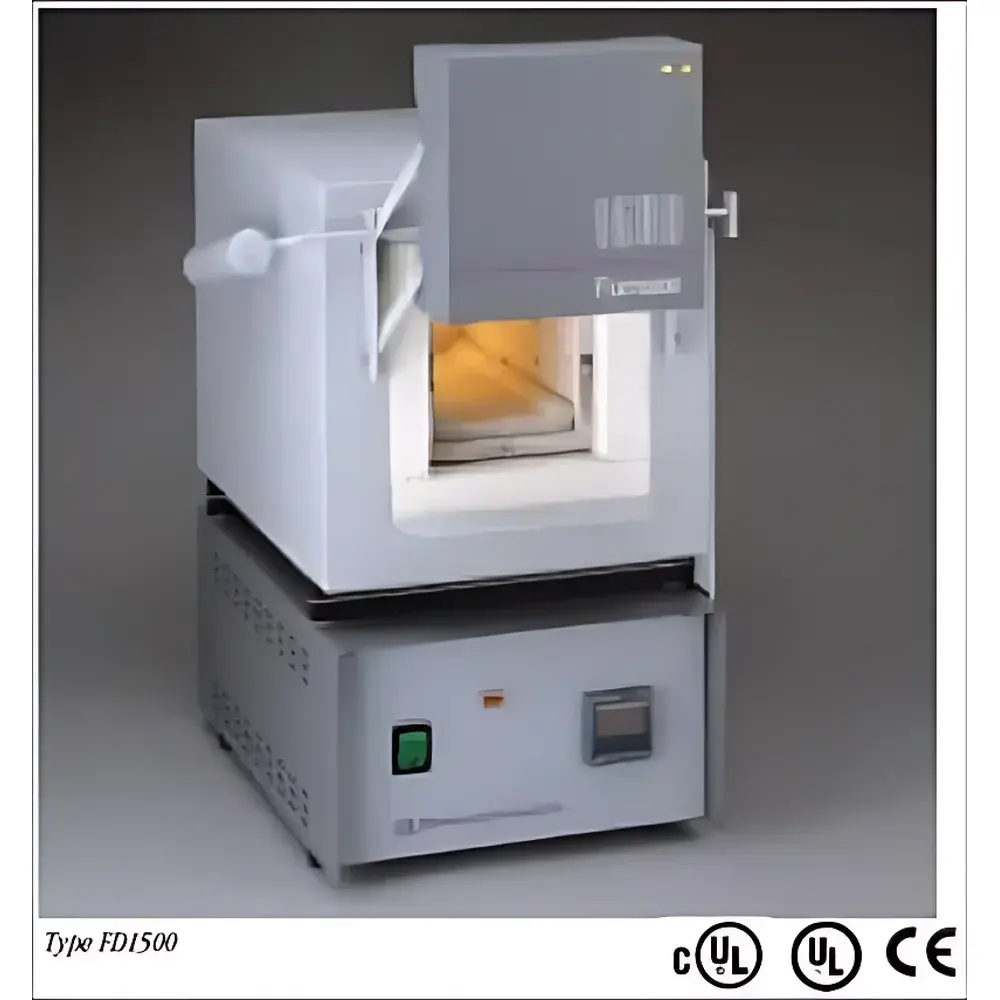
Thermo Fisher Scientific FD1500 Benchtop Muffle Furnace
| Brand | Thermo Fisher Scientific |
|---|---|
| Origin | USA |
| Model | FD1500 |
| Temperature Range | 100–1200 °C |
| Chamber Volume | 2.2 L |
| Heating Elements | 4 independent embedded in refractory cement |
| Safety Features | Door-activated power cutoff, dual overtemperature protection (mechanical relay + thermocouple fault detection), adjustable audible alarm |
| Interface Options | B1 (single-setpoint digital controller with ramp delay) or C1 (8-segment programmable digital controller) |
| Rear Port | 0.95 cm diameter for external temperature monitoring |
| Construction | Refractory brick-lined chamber with firebrick door seal |
| Power Cord | Included |
| Compliance | Designed for GLP-compliant weight loss and ashing workflows per ASTM E1868, ISO 1171, and USP <281> |
Overview
The Thermo Fisher Scientific FD1500 Benchtop Muffle Furnace is an engineered solution for precise, repeatable high-temperature thermal treatment in regulated laboratory environments. Operating on the principle of radiant heat transfer within a fully insulated, sealed muffle chamber, it isolates samples from combustion byproducts—ensuring contamination-free ashing, calcination, and volatilization. Its compact footprint (2.2 L chamber) and robust refractory architecture support routine use in quality control labs, environmental testing facilities, and academic research settings where space efficiency and thermal stability are critical. The furnace is calibrated and validated to maintain ±5 °C uniformity across the working zone at 1000 °C (per internal verification protocol), making it suitable for standardized methods requiring strict thermal consistency.
Key Features
- Four independently embedded heating elements integrated into high-density refractory cement—enabling rapid thermal response and minimizing axial/radial temperature gradients.
- Upward-swinging door design with firebrick insulation on all contact surfaces; positions the hottest surface away from operator access during loading/unloading.
- Dual-layer safety architecture: (1) mechanical door interlock that de-energizes all heating circuits upon door opening, and (2) redundant overtemperature protection—including a dedicated mechanical limit relay and thermocouple failure detection circuit that cuts power if sensor signal loss or drift exceeds defined thresholds.
- Rear-mounted 0.95 cm port allows insertion of an independent reference thermocouple or fiber-optic probe—supporting real-time validation of chamber temperature against controller readings for audit-ready traceability.
- Two field-selectable control systems: B1 (single-setpoint digital controller with ramp delay and real-time display of setpoint/actual temperature) and C1 (8-segment programmable controller with non-volatile memory for method storage and recall).
- Refractory brick lining throughout chamber walls, floor, and door—providing long-term thermal integrity and resistance to thermal cycling fatigue beyond 5,000 operational hours under standard ashing protocols.
Sample Compatibility & Compliance
The FD1500 accommodates standard crucibles (up to 60 mm height × 45 mm OD), porcelain boats, and quartz sample holders. It supports ashing of biological tissues, food matrices, polymers, soils, and pharmaceutical excipients per AOAC 990.19, EPA Method 3010A, and ASTM D3174. Its temperature stability profile and muffle isolation meet requirements for gravimetric analysis under ISO 1171 (determination of ash in coal and coke) and USP (loss on drying and residue on ignition). The unit is constructed and documented to facilitate 21 CFR Part 11–compliant electronic recordkeeping when paired with validated C1 controller firmware and external data acquisition systems.
Software & Data Management
While the FD1500 operates as a standalone instrument, the C1 controller supports RS-232 serial output for integration with LIMS or custom SCADA platforms. All temperature profiles, setpoints, dwell times, and alarm events are timestamped and stored in non-volatile memory with audit trail capability. When connected to compliant software, the system generates immutable logs including operator ID, method name, start/stop timestamps, maximum achieved temperature, and any triggered safety interventions—fulfilling ALCOA+ data integrity principles for GLP and GMP environments.
Applications
- Quantitative ash determination in feed, fertilizer, and biomass samples per AOAC and ISO standards.
- Preparation of inorganic residues for subsequent elemental analysis (e.g., ICP-OES, AAS) following complete organic matrix removal.
- Calcination of catalyst precursors and ceramic powders under controlled oxidative atmospheres.
- Thermogravimetric pre-treatment for polymer degradation studies and filler content verification.
- Residue-on-ignition testing in pharmacopeial quality control laboratories (USP , Ph. Eur. 2.2.34).
FAQ
What is the maximum recommended continuous operating temperature?
The FD1500 is rated for continuous operation up to 1200 °C; however, sustained use above 1100 °C may reduce heating element service life. For optimal longevity, Thermo Fisher recommends limiting exposure >1150 °C to ≤2 hours per cycle.
Can the furnace be used under inert or reducing atmospheres?
No—the FD1500 is designed exclusively for ambient air operation. Its muffle construction and safety interlocks do not support gas purging or pressure-rated modifications.
Is calibration documentation provided with shipment?
Each unit ships with a factory-as-tested certificate listing chamber uniformity data at 500 °C and 1000 °C, thermocouple calibration offset values, and mechanical interlock verification results. NIST-traceable calibration services are available through authorized Thermo Fisher Field Service Engineers.
How is temperature uniformity verified during routine use?
Users may insert a calibrated reference thermocouple through the rear port while operating under load; deviation between controller reading and reference probe must remain within ±5 °C at target setpoint to satisfy internal QC criteria.
Does the C1 controller support password-protected method editing?
Yes—the C1 firmware includes configurable user access levels (operator, supervisor, administrator) with encrypted method storage and change logging, supporting compliance with FDA 21 CFR Part 11 Annex 11 requirements.



