
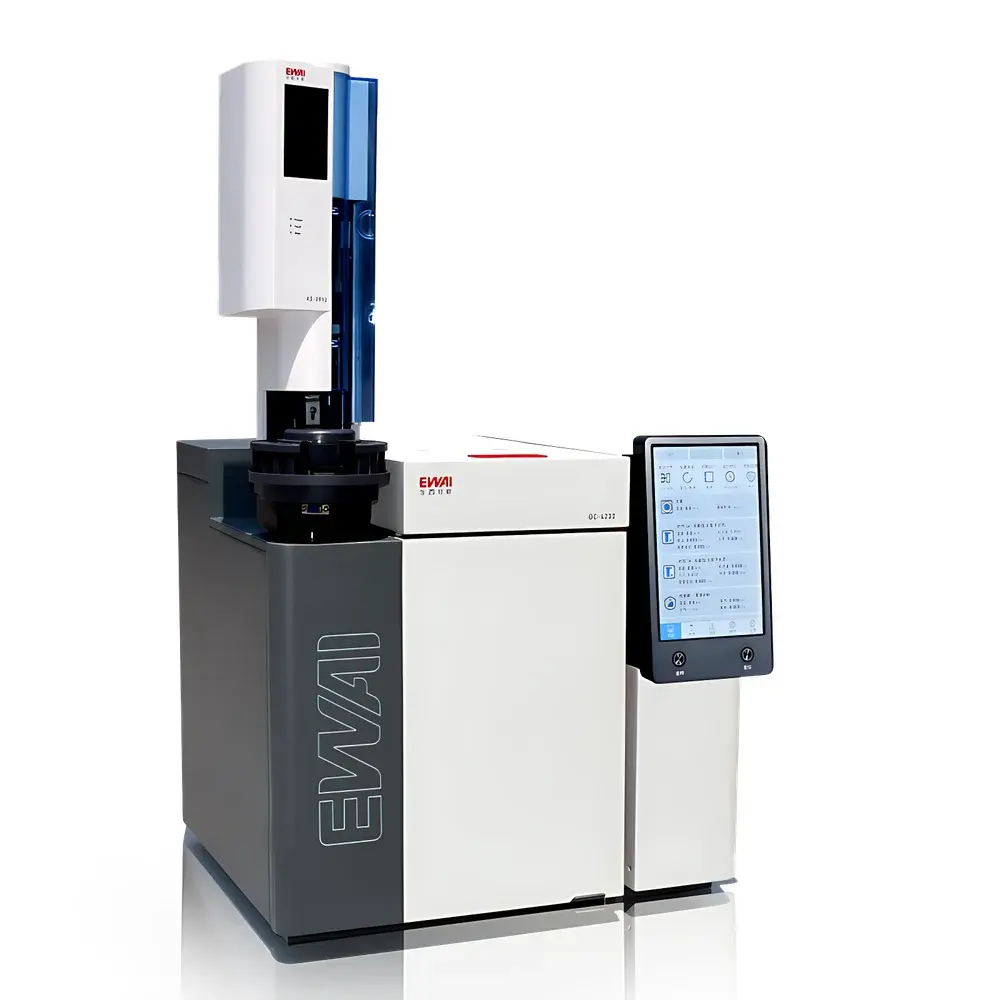
Dongxi Analysis GC-4200 Gas Chromatograph
| Brand | Dongxi Analysis |
|---|---|
| Origin | Beijing, China |
| Manufacturer Type | Original Equipment Manufacturer (OEM) |
| Instrument Type | Laboratory Gas Chromatograph |
| Application Scope | General-Purpose |
| Oven Temperature Range | Ambient +5 °C to 460 °C |
| Injector Maximum Operating Temperature | 450 °C |
| Operating System | Linux-based Embedded OS |
| Communication Interface | Ethernet (RJ-45) |
| Display | 10-inch Capacitive Touchscreen |
| Auto-sampler Compatibility | Dual-tower liquid auto-sampler mounting platform |
| Oven Design | Dual rear-opening column oven with rapid thermal response architecture |
| Pneumatic Control | Fully Electronic Pressure Control (EPC) for all gas channels |
Overview
The Dongxi Analysis GC-4200 Gas Chromatograph is a laboratory-grade, general-purpose analytical instrument engineered for high reproducibility, long-term baseline stability, and robust operation in regulated and research environments. Built upon gas chromatographic separation principles—where volatile and semi-volatile compounds are partitioned between a mobile phase (carrier gas) and a stationary phase (capillary or packed column)—the GC-4200 delivers precise retention time alignment and quantitative accuracy across diverse sample matrices. Its core architecture integrates an embedded Linux operating system, enabling deterministic real-time control of temperature programming, pressure regulation, and detector signal acquisition without reliance on external host computers. Designed for routine QC/QA labs, environmental monitoring facilities, petrochemical testing centers, and academic research groups, the system meets foundational requirements for method validation under ISO/IEC 17025 and supports traceability frameworks aligned with GLP and GMP practices.
Key Features
- Embedded Linux-based control system ensuring deterministic task scheduling, reduced firmware latency, and resistance to OS-level vulnerabilities common in Windows-based instruments.
- 10-inch high-resolution capacitive touchscreen interface with intuitive icon-driven navigation, multi-language support (English, Chinese, Spanish), and context-sensitive help overlays.
- Dual rear-opening column oven with independent dual-zone heating elements and PID-controlled thermal management—enabling ramp rates up to 60 °C/min and temperature stability of ±0.01 °C at isothermal conditions.
- Full electronic pneumatic control (EPC) across all gas channels (carrier, make-up, fuel, and air), with pressure resolution of 0.01 psi and flow accuracy better than ±0.5% of setpoint.
- Ethernet (RJ-45) connectivity supporting TCP/IP-based remote monitoring and control via standard web browsers on PCs, tablets, or smartphones—no proprietary client software required.
- Integrated mechanical platform for dual-tower liquid auto-samplers (e.g., CTC PAL or equivalent), accommodating up to 162 vials per run with programmable syringe wash and needle purge sequences.
Sample Compatibility & Compliance
The GC-4200 accommodates a broad spectrum of sample types—including environmental water extracts, petroleum distillates, pharmaceutical residual solvents, food flavor volatiles, and polymer degradation products—when paired with appropriate inlet configurations (split/splitless, PTV, or cold-on-column) and detectors (FID, TCD, ECD, or optional NPD). It complies with key international standards governing chromatographic instrumentation: ASTM D3606 (benzene/toluene in gasoline), ISO 8518 (residual solvents in pharmaceuticals), and USP . The embedded audit trail functionality—logging user actions, method changes, calibration events, and system diagnostics—supports compliance with FDA 21 CFR Part 11 when deployed in validated environments with appropriate administrative controls.
Software & Data Management
Data acquisition and processing are performed using Dongxi’s GC Navigator™ software (v3.2+), compatible with Windows 10/11 and macOS 12+. The software implements peak integration algorithms compliant with ICH Q2(R2) guidelines, supports AIA/ANDI file export, and enables batch processing with customizable reporting templates (PDF, CSV, Excel). Raw data files include embedded metadata (instrument ID, method parameters, operator ID, timestamp) and are stored in a relational SQLite database with automatic backup to network shares or NAS devices. Remote access logs, method versioning, and electronic signature workflows are configurable to meet ALCOA+ data integrity criteria.
Applications
- Environmental analysis: VOCs in ambient air (EPA Method TO-17), pesticides in soil/water (EPA 8081B), PAHs in sediment (EPA 8310).
- Petrochemical QA: Hydrocarbon group-type analysis (ASTM D5186), sulfur compound profiling (ASTM D5453), and reformulated gasoline composition (ASTM D6730).
- Pharmaceutical testing: Residual solvent quantification per ICH Q3C, extractables/leachables screening, and stability-indicating assays.
- Food & flavor: Fatty acid methyl ester (FAME) profiling, terpene quantification in essential oils, and off-flavor compound identification.
- Academic research: Reaction monitoring, polymer thermal degradation product characterization, and metabolomic profiling of biological headspace samples.
FAQ
Does the GC-4200 support regulatory-compliant electronic signatures?
Yes—when configured with user role management, audit trail logging, and secure authentication (LDAP/Active Directory integration), it fulfills core requirements of 21 CFR Part 11 for electronic records and signatures.
Can third-party auto-samplers be integrated?
The instrument provides standardized RS-232 and TTL trigger interfaces, enabling interoperability with major OEM auto-samplers including CTC Analytics, Gerstel, and Thermo Fisher AS series.
Is method transfer possible from legacy GC platforms?
Method translation tools are included in GC Navigator™ software, supporting conversion of Agilent, Shimadzu, and Thermo methods—including retention time indexing, pressure-to-flow mapping, and detector parameter harmonization.
What maintenance intervals are recommended for EPC modules?
EPC transducers require no routine recalibration; however, annual verification against NIST-traceable pressure standards is advised as part of preventive maintenance planning.
Is remote diagnostic capability available?
Yes—the embedded web server supports secure HTTPS access, real-time status dashboards, and diagnostic log export for technical support escalation without physical instrument access.






