
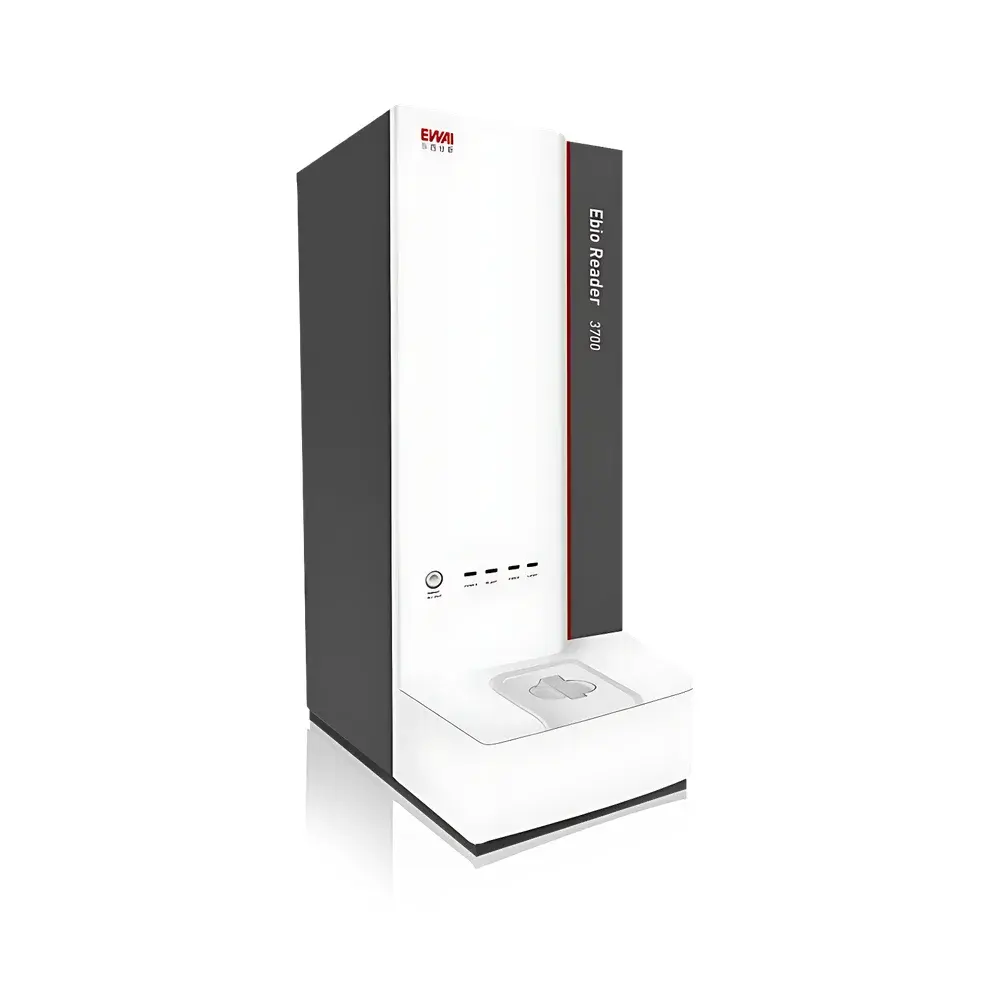
EbioReader3700 Matrix-Assisted Laser Desorption/Ionization Time-of-Flight Mass Spectrometer
| Brand | East & West Analytical Instruments |
|---|---|
| Origin | Beijing, China |
| Manufacturer Type | OEM Manufacturer |
| Instrument Type | TOF Mass Spectrometer |
| Model | Ebio Reader 3700 |
| Resolution | ≥2500 (FWHM) |
| Sensitivity | 250 amol/μL for Human Fibrinopeptide B |
| Mass Stability | ≤300 ppm relative mass drift over 8 hours |
| Sampling Rate | 2 GS/s |
| Mass Accuracy | ≤200 ppm (internal calibration), ≤300 ppm (external calibration) |
| Laser | N₂ laser, 337 nm, 1–60 Hz repetition rate, lifetime ≥9×10⁷ shots |
| Flight Tube Material | Low-thermal-expansion alloy |
| Vacuum System | Oil-free diaphragm pump |
| Data Acquisition | FPGA-accelerated digitizer with on-board spectral preprocessing |
| Ion Mode | Positive-mode standard |
Overview
The EbioReader3700 is a high-performance matrix-assisted laser desorption/ionization time-of-flight (MALDI-TOF) mass spectrometer engineered for robust, high-throughput biomolecular analysis in clinical, industrial, and research laboratories. Based on orthogonal acceleration TOF architecture, it delivers rapid acquisition of intact protein and peptide mass spectra with consistent mass accuracy and reproducible signal intensity across extended operational cycles. Its design prioritizes analytical stability under variable ambient conditions—critical for routine diagnostic applications where instrument uptime and inter-day repeatability directly impact workflow integrity. The system integrates a long-life nitrogen laser (337 nm), low-drift flight tube constructed from ultra-low thermal expansion alloy, and an oil-free vacuum architecture to minimize maintenance and eliminate hazardous exhaust byproducts—aligning with ISO 14001 environmental management principles and laboratory safety standards.
Key Features
- High-stability TOF platform: Achieves ≤300 ppm mass deviation over 8-hour continuous operation, enabling reliable longitudinal studies and multi-shift clinical workflows.
- Optimized ion source and reflectron: Delivers ≥2500 resolution (FWHM) at m/z 2000, supporting confident discrimination of post-translational modifications and sequence variants in peptides and small proteins.
- FPGA-based real-time data acquisition: 2 GS/s sampling rate with on-board spectral averaging, baseline correction, and noise suppression—reducing raw data volume while preserving peak shape fidelity for downstream quantitation.
- Modular ionization capability: Standard positive-ion mode optimized for microbial ribosomal protein profiling; field-upgradable negative-ion module for acidic metabolites, oligonucleotides, and glycosaminoglycans.
- Integrated vacuum architecture: Compact, oil-free diaphragm pump ensures silent operation (<45 dB(A)), zero hydrocarbon contamination, and compliance with ISO 8573-1 Class 0 clean air requirements for MALDI sample chambers.
Sample Compatibility & Compliance
The EbioReader3700 supports direct analysis of crude biological samples—including whole-cell lysates, serum digests, tissue homogenates, and nucleic acid extracts—without chromatographic separation. Its robustness enables routine use in CLIA-certified clinical microbiology labs and GMP-compliant biopharmaceutical QC environments. The system meets essential regulatory expectations for analytical instrumentation: full audit trail logging (21 CFR Part 11 compliant software modules available), traceable calibration protocols per ASTM E2912-22, and compatibility with ISO/IEC 17025 method validation frameworks. Microbial identification workflows align with EUCAST and CLSI M100 guidelines for MALDI-TOF-based taxonomy assignment.
Software & Data Management
The proprietary acquisition and analysis suite features a bilingual (English/Chinese) GUI optimized for dual-role operators—clinical technologists and research scientists. Core capabilities include: real-time spectral acquisition with 12,000 reference strains (bacterial, fungal, mycobacterial); customizable library builder supporting user-defined spectral libraries with metadata tagging (strain origin, growth condition, antibiotic resistance profile). All spectral data are stored in open-format .mzML files, ensuring interoperability with third-party tools such as Proteome Discoverer, MaxQuant, and OpenMS. Software update history, user action logs, and spectral processing parameters are retained for GLP/GMP audit readiness.
Applications
- Microbial Identification: Rapid species-level identification of Gram-positive/negative bacteria, yeasts, and molds directly from colonies or blood culture broths—validated against >300 clinically relevant taxa.
- ADAMTS13 Activity Assay: Quantitative measurement of von Willebrand factor-cleaving protease activity in plasma via MALDI detection of cleavage-specific peptide fragments—supporting early diagnosis of thrombotic microangiopathies.
- Viral Protein Fingerprinting: High-confidence classification of influenza subtypes, SARS-CoV-2 variants, and HPV genotypes using immobilized peptide arrays coupled with spectral pattern matching.
- SNP Genotyping: Allele-specific primer extension assays followed by MALDI-TOF detection of extension products—enabling scalable, low-cost genotyping in pharmacogenomics and epidemiological screening.
- Biomarker Discovery: Comparative profiling of serum/CSF proteomes for candidate biomarker selection, with built-in statistical tools for ANOVA, PCA, and ROC curve generation.
FAQ
Is the EbioReader3700 compliant with FDA 21 CFR Part 11 for electronic records and signatures?
Yes—optional 21 CFR Part 11-compliant software configuration includes role-based access control, electronic signature capture, and immutable audit trails for all acquisition and analysis events.
Can the system perform quantitative analysis without internal standards?
Semi-quantitative profiling is supported via peak height/area normalization against endogenous reference ions; absolute quantitation requires isotopically labeled internal standards or calibrated external references.
What maintenance intervals are recommended for the laser and vacuum system?
The N₂ laser requires no routine alignment or gas replenishment; service interval is specified at 9×10⁷ shots or 18 months—whichever occurs first. The oil-free pump has no scheduled replacement; filter elements are inspected annually.
Does the system support remote diagnostics and firmware updates?
Yes—secure TLS-encrypted remote connection enables proactive health monitoring, log retrieval, and validated firmware updates via authenticated vendor portal.
How is method transfer validated between instruments?
Cross-platform reproducibility is verified using NIST-traceable peptide calibrants and certified microbial reference standards per ISO/IEC 17025 clause 7.7, with documented %RSD for mass accuracy and intensity CV across ≥3 instruments.





