
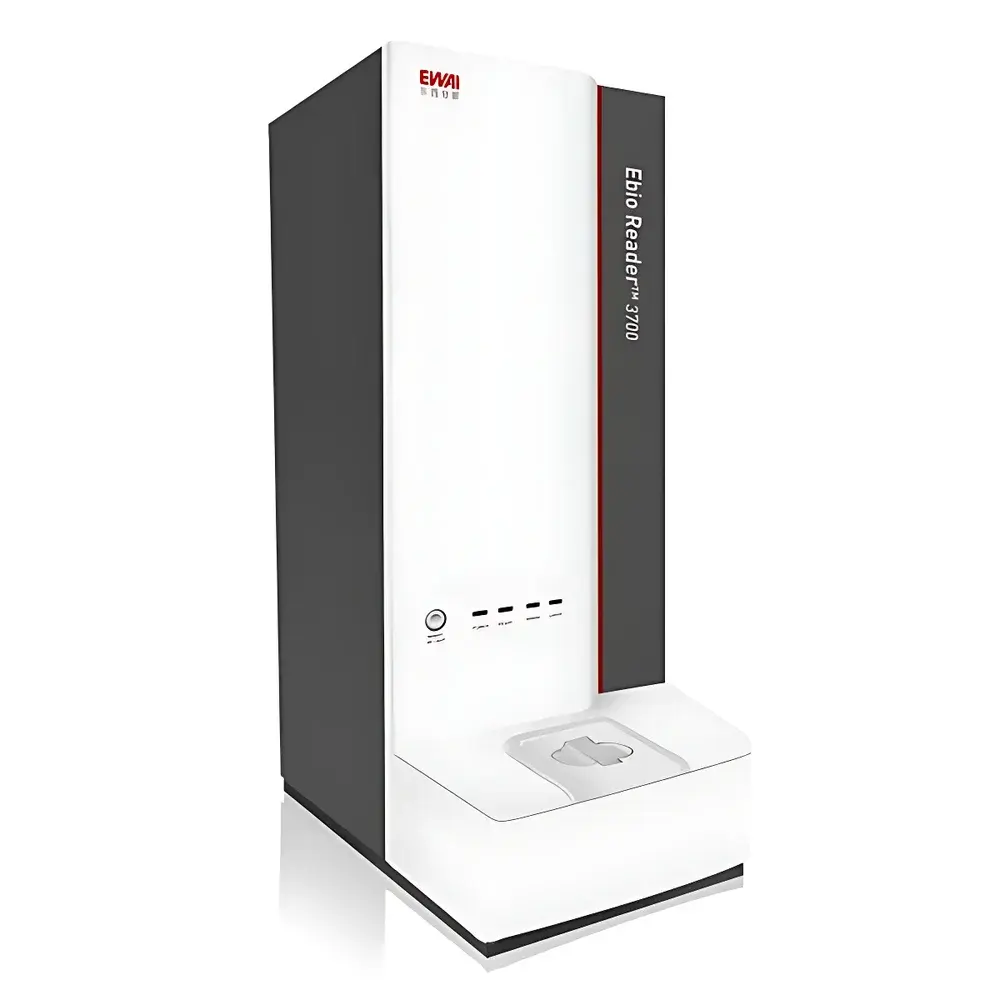
Dongxi Analytical Ebio Reader™ 3700M MALDI-TOF Mass Spectrometer
| Brand | Dongxi Analytical |
|---|---|
| Origin | Beijing, China |
| Manufacturer Type | OEM Manufacturer |
| Region Classification | Domestic (PRC) |
| Model | Ebio Reader™ 3700M |
| Instrument Type | Matrix-Assisted Laser Desorption/Ionization Time-of-Flight (MALDI-TOF) Mass Spectrometer |
| Resolution | ≥2500 (FWHM) |
| Sensitivity | ≥250 amol/μL Febrinopeptide Human B (S/N ≥50:1) |
| Mass Stability | ≤300 ppm relative mass drift over 8 h |
| Sampling Rate | 2 GS/s |
| Mass Accuracy | ≤200 ppm (internal calibration) |
Overview
The Dongxi Analytical Ebio Reader™ 3700M is a high-performance, benchtop MALDI-TOF mass spectrometer engineered for rapid, label-free biomolecular profiling in both clinical and non-clinical laboratories. Based on orthogonal acceleration time-of-flight (oa-TOF) architecture with reflectron mode operation, the system delivers high mass resolution, excellent mass accuracy, and robust signal reproducibility—critical for reliable microbial identification, protein fingerprinting, nucleic acid analysis, and post-translational modification screening. Its core design emphasizes analytical stability under variable ambient conditions, achieved through thermally invariant flight tube construction and integrated environmental compensation algorithms. Unlike conventional quadrupole or ion trap platforms, the TOF analyzer enables simultaneous detection of ions across a broad m/z range (typically 1–300 kDa), supporting high-throughput workflows without duty cycle loss.
Key Features
- High-stability MALDI source with long-life nitrogen laser (337 nm, 1–60 Hz adjustable repetition rate, ≥9 × 10⁷ shots lifetime)
- Thermally compensated flight tube fabricated from low-coefficient-of-thermal-expansion (CTE) composite material, minimizing m/z drift induced by ambient temperature/humidity fluctuations
- Dedicated FPGA-based high-speed data acquisition card (2 GS/s sampling rate) enabling real-time spectral preprocessing—including baseline correction, noise suppression, and peak centroiding
- Oil-free diaphragm vacuum pump system compliant with ISO 8573-1 Class 0 air purity standards, eliminating hydrocarbon contamination and reducing laboratory environmental impact
- Integrated dual-mode calibration capability supporting both internal (e.g., peptide calibrants co-spotted with sample) and external (grid-based or sequential) calibration strategies
- Modular ion optics optimized for high transmission efficiency across wide mass ranges, particularly enhancing sensitivity for intact proteins and oligonucleotides
Sample Compatibility & Compliance
The Ebio Reader™ 3700M accepts standard MALDI target plates (e.g., 96-well, 384-well stainless steel or conductive polymer formats) and supports direct analysis of cultured microorganisms (intact cells or formic acid-extracted ribosomal proteins), purified peptides/proteins, synthetic oligonucleotides, glycans, and small-molecule metabolites. Sample preparation follows CLSI-approved protocols for clinical microbiology (e.g., MALDI Sepsityper®-compatible workflows) and adheres to ISO/IEC 17025 requirements for method validation. The system meets key regulatory expectations for GxP environments: audit-trail-enabled software architecture compliant with FDA 21 CFR Part 11 (electronic records/signatures), full traceability of calibration events and instrument parameters, and configurable user access levels aligned with GLP/GMP role-based security models.
Software & Data Management
Controlled by Dongxi’s proprietary BioSpecSuite™ v4.x software suite, the Ebio Reader™ 3700M provides integrated acquisition, processing, database matching, and reporting modules. The software includes embedded spectral libraries for bacterial/fungal identification (covering >400 genera and >2,500 species), human serum protein markers, SNP-associated peptide variants, and foodborne pathogen strain typing profiles. All raw data (.raw) and processed results (.msp, .csv) are stored in vendor-neutral formats compatible with third-party bioinformatics pipelines (e.g., Proteome Discoverer, MaxQuant, R/Bioconductor). Built-in QC dashboards monitor daily performance metrics—including mass accuracy drift, peak intensity CV%, and resolution decay—automatically flagging deviations beyond predefined control limits per ISO 15197 and CLIA guidelines.
Applications
- Clinical microbiology: Species-level identification of Gram-positive/negative bacteria, yeasts, and mycobacteria directly from positive blood cultures or colony picks
- Biomarker discovery: Rapid profiling of serum/plasma proteomes for differential expression analysis in oncology and autoimmune disease cohorts
- Food safety surveillance: Detection of adulterants (e.g., melamine, Sudan dyes), allergen cross-contamination, and pathogenic strain discrimination (e.g., Salmonella serovars, Listeria monocytogenes lineages)
- Industrial biotechnology: Monitoring fermentation batches via metabolic fingerprinting; verifying recombinant protein integrity during upstream/downstream processing
- Functional enzymology: Quantitative activity assays—for example, ADAMTS13/vWF-cleaving protease kinetics measured via time-resolved cleavage product generation
- SNP genotyping: Allele-specific peptide mass shifts detected without PCR amplification or fluorescent labeling
FAQ
What is the typical turnaround time for microbial identification using the Ebio Reader™ 3700M?
Typical identification from isolated colonies takes ≤5 minutes per sample, including sample spotting, drying, and automated acquisition/analysis. Direct-from-blood-culture workflows require an additional 15–20 min for sample preparation.
Does the system support quantitative analysis?
Yes—relative quantitation is supported via peak intensity normalization against internal standards or spiked reference peptides; absolute quantitation requires integration with stable-isotope-labeled standards and calibration curves.
Is remote diagnostics and software update capability available?
Yes—the instrument supports secure TLS-encrypted remote maintenance sessions and over-the-air firmware/software updates via Dongxi’s authorized service portal, subject to customer-configured network policies.
Can the Ebio Reader™ 3700M be integrated into existing LIMS environments?
Yes—it provides HL7 v2.5.1 and ASTM E1384-compliant interfaces for bidirectional data exchange with major clinical and research LIMS platforms.
What routine maintenance is required?
Daily: Target plate cleaning and laser energy verification. Weekly: Vacuum pump oil check (if applicable; oil-free configuration eliminates this step). Quarterly: Ion optic alignment validation and detector gain calibration using certified reference standards.






