
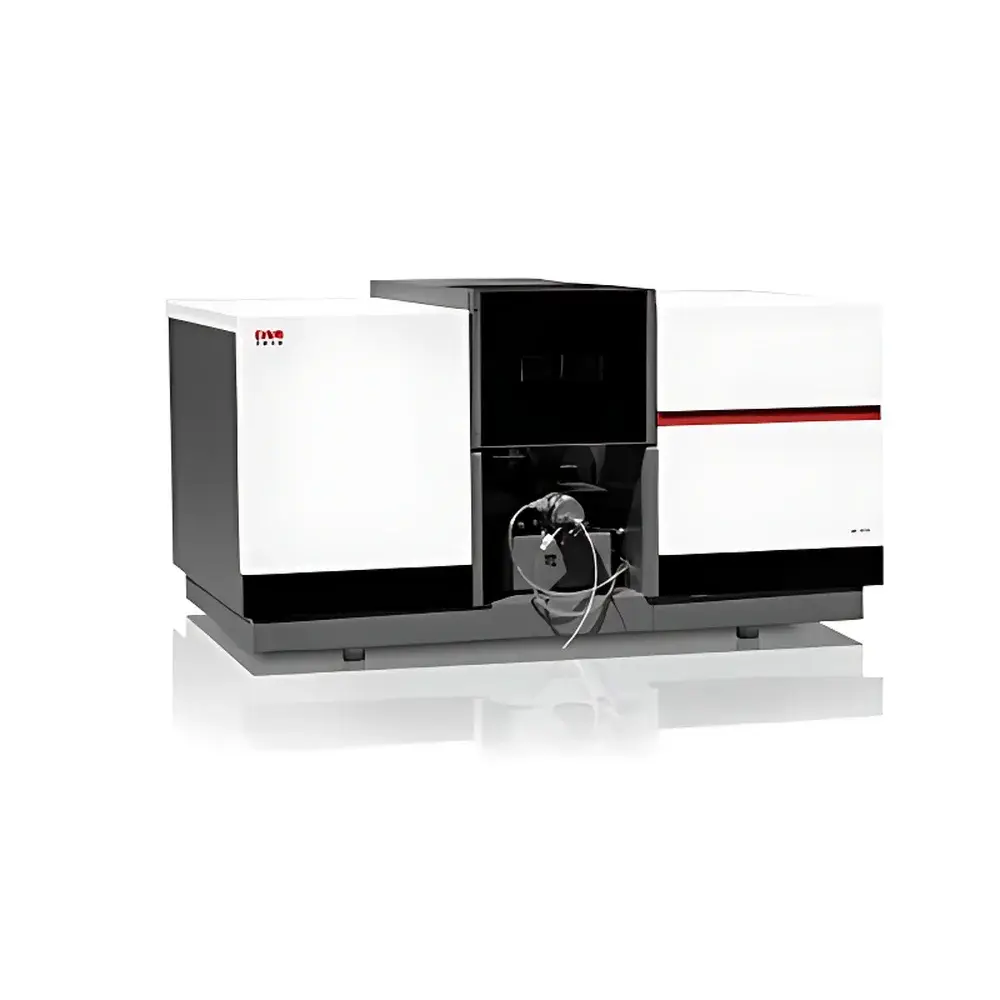
East & West Analysis AA-7050 Flame and Graphite Furnace Atomic Absorption Spectrometer
| Brand | East & West Analysis |
|---|---|
| Origin | Beijing, China |
| Manufacturer Type | Direct Manufacturer |
| Instrument Type | Flame and Graphite Furnace AAS |
| Model | AA-7050 |
| Monochromator | Plane Grating |
| Detector | Photomultiplier Tube (PMT) |
| Background Correction | Deuterium Lamp + Self-Reversal |
| Resolution | ≤0.2 nm |
| Sensitivity | 0.0044 Abs for Cu (248.3 nm, 1 µg/mL) |
| Repeatability (RSD) | ≤0.8% (n=10) |
| Detection Limit | 0.002 mg/L for Cd (228.8 nm, graphite furnace mode) |
| Sample Introduction | Integrated AS-600 Autosampler (optional standard) |
| Lamp System | Automatic Hollow Cathode Lamp Selector with Encoding Recognition |
Overview
The East & West Analysis AA-7050 is a dual-mode atomic absorption spectrometer engineered for high-precision elemental quantification in environmental, pharmaceutical, food safety, clinical, and metallurgical laboratories. Operating on the fundamental principle of atomic absorption spectroscopy—where ground-state free atoms in a flame or graphite furnace absorb characteristic radiation from hollow cathode lamps—the AA-7050 delivers trace-level detection across 70+ elements. Its integrated flame and electrothermal atomization architecture enables seamless switching between rapid flame analysis (for major and minor elements at ppm levels) and ultra-trace graphite furnace analysis (sub-ppt detection capability). The system employs a Czerny–Turner optical layout with a 1800-line/mm plane grating monochromator, delivering spectral resolution ≤0.2 nm—meeting ISO 11170 and ASTM E1901 requirements for line separation and stray light control. The photomultiplier tube detector ensures high signal-to-noise ratio and linear dynamic range exceeding 3 orders of magnitude.
Key Features
- Dual-atomization platform: Independently optimized flame and graphite furnace systems with automatic gas flow control, enabling method-specific optimization without hardware reconfiguration.
- Graphite furnace visualization system: Integrated coaxial CCD camera with real-time imaging of the graphite tube interior—enabling precise needle positioning, visual assessment of sample deposition/drying/pyrolysis stages, and empirical temperature program refinement.
- Gas-saving mode for graphite furnace: Adaptive argon flow regulation reduces carrier gas consumption by up to 60% during inert gas purging phases while maintaining thermal stability and matrix removal efficiency—validated per ISO 11171:2010 gas utilization protocols.
- Encoded lamp recognition: Automatic identification and parameter recall for hollow cathode lamps—including manufacturer-defined current, wavelength, and recommended slit width—ensuring reproducible lamp alignment and compliance with USP and EP 2.2.24 lamp validation guidelines.
- Multi-element sequential analysis: Supported via AS-600 autosampler with programmable rinse cycles, cross-contamination mitigation, and position-calibrated syringe actuation—capable of unattended analysis of up to 60 samples per sequence.
- Thermal management architecture: Dual-zone furnace temperature control with independent feedback loops for tube and platform heating, achieving ramp rates up to 2000 °C/s and isothermal precision ±2 °C over 20–3000 °C range.
Sample Compatibility & Compliance
The AA-7050 accommodates aqueous solutions, acid-digested biological tissues, soil extracts, and diluted industrial effluents. It supports direct solid sampling via slurry introduction (with optional ultrasonic probe) and certified reference material (CRM) analysis per ISO/IEC 17025:2017 requirements. All operational parameters—including lamp current, slit width, integration time, and background correction mode—are logged with timestamped metadata and user ID, satisfying FDA 21 CFR Part 11 audit trail and electronic signature requirements. Instrument qualification documentation aligns with ICH Q2(R2) analytical procedure validation principles for specificity, linearity, accuracy, precision, and robustness.
Software & Data Management
The proprietary AAWin software (v4.3+) provides GxP-compliant data acquisition, processing, and reporting. It features built-in calibration curve fitting (linear, quadratic, and weighted least-squares), QC flagging (control charting per ISO 8466-1), and automated report generation compliant with GLP/GMP templates. Raw spectral data, furnace temperature profiles, and autosampler event logs are stored in vendor-neutral .CSV and .XML formats. Software modules include method transfer utilities for cross-platform compatibility with legacy AA-7020 methods and digital signature support for electronic record retention per Annex 11.
Applications
- Environmental monitoring: Quantification of Pb, Cd, As, and Hg in drinking water per EPA Method 200.9 and ISO 11885.
- Pharmaceutical quality control: Residual catalyst metal testing (e.g., Pd, Pt, Ni) in active pharmaceutical ingredients (APIs) per ICH Q3D.
- Food and feed safety: Determination of toxic elements (e.g., Al, Cr, Sn) in infant formula and cereals under EU Commission Regulation (EU) No 1881/2006.
- Clinical toxicology: Measurement of serum Cu/Zn ratios and whole-blood lead levels per CLIA-waived protocols.
- Geochemical exploration: Multi-element analysis of rock digests using standardized HF-HNO₃-HClO₄ digestion followed by flame-AAS screening and GF-AAS confirmation.
FAQ
Does the AA-7050 support simultaneous multi-element analysis?
No—it performs sequential element analysis. True simultaneous detection requires ICP-OES or ICP-MS instrumentation. However, its rapid lamp switching (<1.5 s) and AS-600 autosampler enable high-throughput multi-element workflows.
Is the graphite furnace visualization system compatible with third-party graphite tubes?
Yes—the camera system is optically decoupled from tube geometry and supports all standard L’vov-platform tubes (e.g., PerkinElmer, Thermo Fisher,国产 brands) with diameter tolerance ±0.1 mm.
How does the software handle background correction verification?
It records both deuterium and self-reversal background signals independently, calculates correction residuals, and flags anomalies exceeding ±5% deviation from baseline—generating automated alerts per ISO/IEC 17025 clause 7.7.2.
Can the AA-7050 be integrated into a LIMS environment?
Yes—via ASTM E1482-compliant ODBC driver and HL7 v2.5 interface module, supporting bidirectional sample ID exchange and result push to validated laboratory information management systems.
What maintenance intervals are recommended for the PMT detector?
Photomultiplier tube gain calibration is required every 90 days or after 2000 lamp hours; full optical alignment verification is recommended annually or following instrument relocation.




