
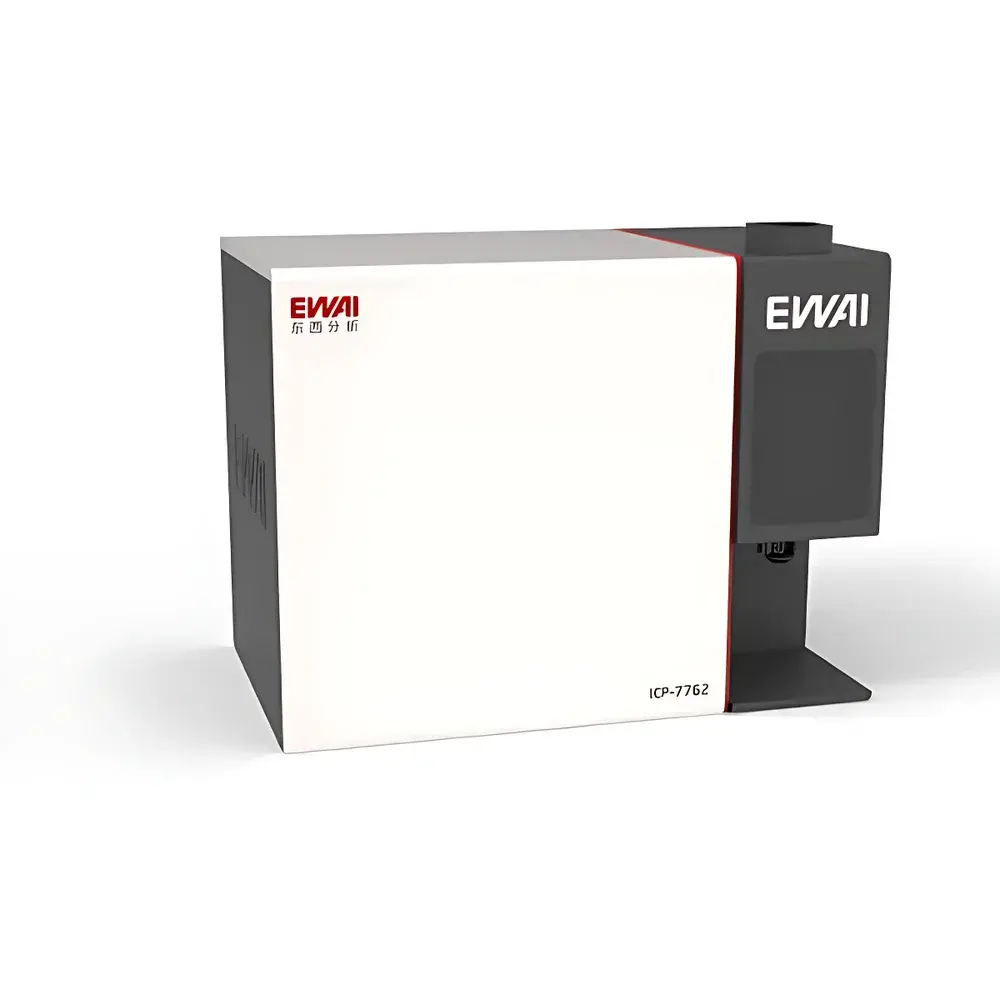
East & West Analysis ICP-7762 Inductively Coupled Plasma Optical Emission Spectrometer
| Brand | East & West Analysis |
|---|---|
| Origin | Beijing, China |
| Manufacturer Type | Direct Manufacturer |
| Product Origin | Domestic (China) |
| Model | ICP-7762 |
| Price | Upon Request |
| Wavelength Range | 165–800 nm |
| Observation Mode | Vertical Torch Dual-View Configuration |
| Detector | CCD with Auto-Adaptive Purge |
| Purge Gas System | Independent Dual-Path Purging (CCD + Optics Chamber) |
| Purge Gas Options | Argon or Nitrogen (Selectable) |
Overview
The East & West Analysis ICP-7762 is a high-performance, vertically configured inductively coupled plasma optical emission spectrometer (ICP-OES) engineered for robust elemental analysis across environmental, geological, metallurgical, and regulatory testing laboratories. It operates on the fundamental principle of atomic emission spectroscopy: liquid samples are nebulized into an argon plasma at ~6,000–10,000 K, where constituent elements are atomized and excited; upon relaxation, they emit characteristic photons across the ultraviolet–visible spectrum (165–800 nm). The ICP-7762 captures this full spectral output simultaneously using a high-resolution charge-coupled device (CCD) detector, enabling true simultaneous multi-element quantification without sequential wavelength scanning. Its vertical torch dual-view configuration provides enhanced sensitivity for trace elements and improved matrix tolerance for complex sample types—particularly advantageous for high-salt or organic matrices where radial viewing alone may suffer from self-absorption or plasma instability.
Key Features
- Full-spectrum simultaneous detection (165–800 nm) with no mechanical grating movement, ensuring rapid acquisition (<60 s per sample) and high spectral fidelity.
- Vertical torch dual-view observation mode: axial view for ultra-trace detection (sub-ppt LODs for many elements), radial view for high-concentration analysis and improved robustness against matrix interferences.
- Independent dual-path purge system: separate, regulated gas flows for the optical chamber and CCD detector—eliminating cross-contamination and thermal drift.
- CCD auto-adaptive purge control: real-time humidity sensing modulates nitrogen (or argon) flow rate to maintain optimal detector cooling and dew-point stability—reducing gas consumption by up to 40% versus fixed-flow systems.
- Modular, field-upgradable architecture: supports optional accessories including autosamplers, UV-protective purge housings, and high-efficiency nebulizers (e.g., MicroMist, SeaSpray) for specialized applications.
- Integrated RF generator with solid-state design (27.12 MHz or 40.68 MHz options), delivering stable plasma power (750–1500 W) with <±0.1% long-term output variation.
Sample Compatibility & Compliance
The ICP-7762 accepts aqueous solutions, digested solids (EPA 3050B/3052), leachates (TCLP, SPLP), and diluted organic extracts (after appropriate matrix removal). It complies with core analytical standards including ASTM D1976 (metals in water), ISO 11885 (water quality—determination of selected elements), and EPA Methods 200.7 and 6010D. Its software supports audit-ready data handling aligned with GLP and GMP requirements, including user access levels, electronic signatures, and full metadata logging (instrument parameters, calibration history, purge logs). While not pre-certified for FDA 21 CFR Part 11, the system architecture supports validation protocols required for regulated environments when deployed with compliant IT infrastructure and procedural controls.
Software & Data Management
Control and analysis are executed via EW-ICP v4.x software—a Windows-based platform supporting method development, calibration curve generation (linear, quadratic, internal standard correction), interference correction (e.g., spectral overlap, background shift), and automated QC checks (continuing calibration verification, drift correction). All raw spectral data (intensity vs. pixel) is stored in open-format HDF5 files, enabling third-party reprocessing and integration with LIMS via ODBC or REST API. The software maintains full traceability: every spectrum is timestamped, tagged with operator ID, instrument state (RF power, nebulizer gas flow, purge status), and linked to associated calibration files. Audit trails record all user actions—including method edits, result overrides, and report exports—with immutable timestamps.
Applications
- Environmental monitoring: quantification of As, Cd, Cr, Pb, Hg, Se, and rare earth elements in drinking water, wastewater, soil digests, and airborne particulate filters.
- Geochemical exploration: rapid screening of rock, sediment, and ore samples for major, minor, and trace elements (e.g., Li, Be, Sc, Y, REEs) to support mineral prospecting and provenance studies.
- Materials science: compositional verification of alloys, catalysts, battery cathode materials (Ni, Co, Mn, Al), and semiconductor-grade reagents.
- Food safety & agriculture: detection of toxic metals (Pb, Cd, As) in crops, infant formula, and dietary supplements per EU Commission Regulation (EC) No 1881/2006 and FDA guidance.
- Pharmaceutical excipients: elemental impurity testing per ICH Q3D guidelines, particularly for Class 1 and 2A elements (e.g., Cd, Pb, As, Hg, Co, V).
FAQ
Does the ICP-7762 support both argon and nitrogen as purge gases?
Yes—the independent purge system allows either argon or nitrogen to be used for both the CCD and optical chamber, with automatic switching and flow optimization based on ambient humidity and operational mode.
Can the instrument perform qualitative analysis without prior calibration?
Yes. Full-spectrum acquisition enables library-based spectral matching for rapid elemental identification in unknown samples, though quantitative results require calibration standards.
Is the dual-view configuration hardware-switchable or software-controlled?
It is fully software-selectable per measurement—users can define axial-only, radial-only, or hybrid acquisition strategies within a single method.
What maintenance intervals are recommended for routine operation?
Daily: nebulizer inspection, torch cleaning; Weekly: injector tube check, drain trap emptying; Quarterly: RF coil inspection, optical alignment verification; Annually: CCD quantum efficiency validation and wavelength calibration with certified holmium oxide reference.
Does the system include compliance documentation for ISO/IEC 17025 accreditation?
Factory-supplied IQ/OQ documentation is provided; full accreditation support requires site-specific PQ execution and integration with laboratory quality management systems.




