
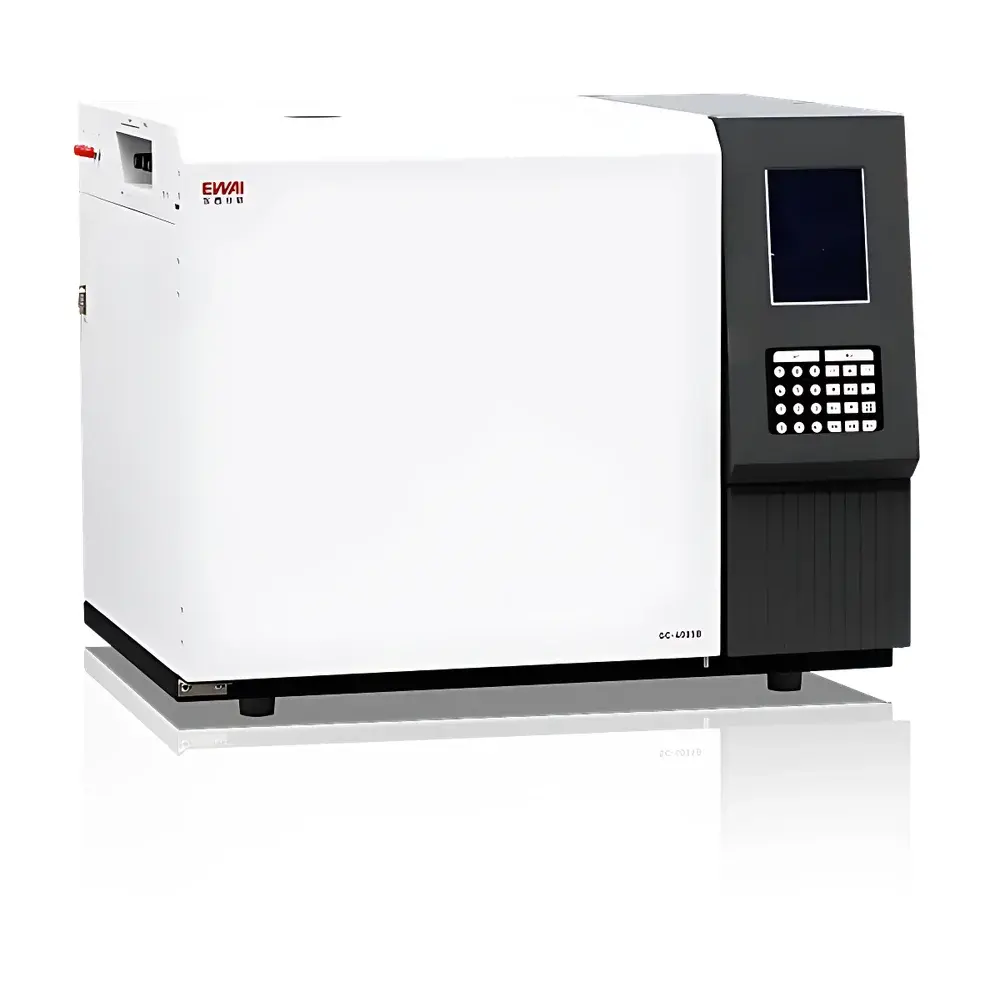
East & West Analysis GC-4085B Multi-Point Mine Gas Chromatographic Auto-Analyzer
| Brand | East & West Analysis |
|---|---|
| Origin | Beijing, China |
| Manufacturer Type | Manufacturer |
| Origin Category | Domestic |
| Model | GC-4085B |
| Pricing | Upon Request |
Overview
The East & West Analysis GC-4085B Multi-Point Mine Gas Chromatographic Auto-Analyzer is a purpose-built gas chromatography (GC) system engineered for continuous, real-time monitoring and quantitative analysis of critical gaseous species in underground coal mine atmospheres. Designed as the core analytical unit of the national “Eighth Five-Year Plan” scientific research project on mine gas monitoring, the GC-4085B implements dual-column oven temperature programming coupled with automated multi-point sampling to detect and resolve key indicators of spontaneous coal combustion—including CO, CH₄, C₂H₄, C₂H₆, C₃H₆, C₃H₈, C₄H₈, C₄H₁₀, H₂, and O₂—within a single injection cycle. Its operational principle relies on partition chromatography in capillary or packed columns, followed by parallel detection using dual flame ionization detectors (FID) and a thermal conductivity detector (TCD), augmented by an integrated methane conversion furnace for enhanced hydrocarbon sensitivity. The system enables early-stage fire risk assessment by tracking concentration trends across oxidation phases (slow oxidation → accelerated oxidation → intense oxidation), supporting proactive fire prevention and safe re-entry into sealed fire zones.
Key Features
- Dual independent column ovens with precise, programmable temperature control—enabling simultaneous high-resolution separation of polar (e.g., CO, H₂) and non-polar (e.g., alkanes, alkenes) compounds under optimized thermal gradients
- Automated multi-point sampling capability for 1–32 monitoring locations (expandable to 32 points), with fully computer-controlled sequential loop sampling and pneumatic valve switching
- Triple-column parallel configuration: two analytical columns plus one pre-column per channel, minimizing contamination and extending column lifetime without manual intervention
- Integrated methane conversion furnace upstream of the FID, converting CO and CO₂ to CH₄ for improved detection sensitivity and linearity in low-concentration ranges
- Hybrid detection architecture: dual FIDs for trace hydrocarbons and a TCD for permanent gases (H₂, O₂, CH₄), ensuring comprehensive coverage of the full mine gas spectrum
- Embedded microprocessor-based controller with large-backlit LCD interface; supports local operation and remote supervision via RS-232/485 or Ethernet
Sample Compatibility & Compliance
The GC-4085B accepts gaseous samples directly from mine ventilation ducts or borehole extraction lines via standardized 1/8″ stainless steel tubing and pressure-regulated sampling manifolds. It complies with Chinese national standards for mine safety instrumentation (AQ 1078–2009, MT/T 757–1997) and incorporates design elements aligned with international functional safety principles (IEC 61508 SIL 2). All wetted materials are 316 stainless steel or fused silica; no elastomers contact sample streams. The system supports GLP-compliant operation through audit-trail-enabled method storage, user-access logging, and electronic signature-capable reporting—facilitating alignment with ISO/IEC 17025 laboratory accreditation requirements.
Software & Data Management
Control and data acquisition are managed via proprietary Windows-based software featuring real-time chromatogram visualization, peak integration with retention time locking, and customizable alarm thresholds per analyte. Raw data files (.cdf or .csv) include full metadata: injection timestamp, column oven profiles, detector voltages, valve event logs, and calibration history. The software supports automated report generation compliant with mine safety documentation protocols, including trend charts for CO/C₂H₄ ratio, C₂H₄/C₂H₆ ratio, and total hydrocarbon accumulation rates. Optional OPC UA integration allows seamless data export to SCADA or DCS platforms used in modern mine automation systems.
Applications
- Early warning of spontaneous coal combustion via kinetic gas ratio analysis (e.g., Graham’s ratio, Jones-Trickett index)
- Post-fire zone monitoring during controlled reventilation and atmospheric stabilization
- Validation of inertization effectiveness (N₂/CO₂ injection) through O₂ depletion and hydrocarbon suppression tracking
- Baseline ambient air profiling in longwall panels, belt entries, and goaf zones
- Supporting regulatory compliance reporting under China’s Coal Mine Safety Regulations (Order No. 87)
FAQ
What gases can the GC-4085B quantify simultaneously in one run?
CO, CH₄, C₂H₄, C₂H₆, C₃H₆, C₃H₈, C₄H₈, C₄H₁₀, H₂, and O₂—with detection limits ranging from 0.1 ppm (C₂H₄) to 10 ppm (O₂), depending on column/detector configuration.
Is the system certified for use in explosive atmospheres?
The GC-4085B analyzer unit itself is rated for safe operation in non-hazardous areas (Zone 2/Class I Division 2); sampling probes and pre-concentrators must be separately certified for Zone 0/1 installation per GB 3836.1–2021.
Can it integrate with existing mine monitoring networks?
Yes—via Modbus RTU/TCP or OPC UA protocols; hardware-level analog outputs (4–20 mA) are available for critical parameters (CO, CH₄, C₂H₄) upon request.
What maintenance intervals are recommended for sustained field operation?
Column conditioning every 3 months; FID nozzle cleaning every 2 weeks; carrier gas filter replacement every 6 months; full system performance verification quarterly per AQ 1078–2009 Annex B.
Does the software support 21 CFR Part 11 compliance?
The standard version provides audit trails and user-level access control; Part 11-compliant electronic signatures and secure e-record archiving require optional validation package and IT infrastructure alignment.





