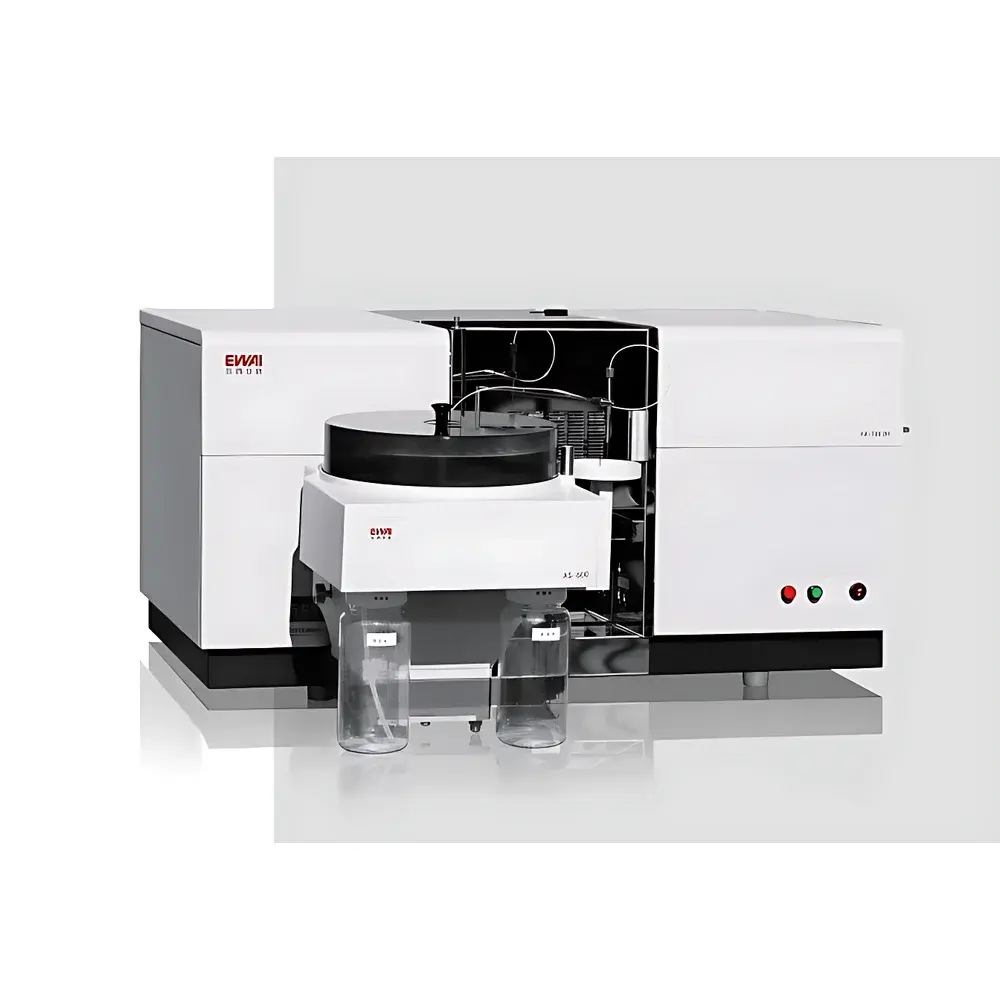
AA-7003M Atomic Absorption Spectrophotometer by East & West Analytical Instruments
| Brand | East & West Analytical Instruments |
|---|---|
| Origin | Beijing, China |
| Manufacturer Type | Direct Manufacturer |
| Origin Category | Domestic (China) |
| Model | AA-7003M |
| Pricing | Available Upon Request |
Overview
The AA-7003M Atomic Absorption Spectrophotometer is a dual-mode clinical atomic absorption spectrometer engineered for high-precision elemental quantification in human biological matrices—primarily whole blood, serum, and urine. It operates on the fundamental principle of atomic absorption spectroscopy (AAS), where ground-state free atoms in a graphite furnace or flame atomizer absorb characteristic wavelengths of light emitted by hollow cathode lamps. The instrument integrates flame and graphite furnace atomization into a single, mechanically aligned optical platform, enabling seamless mode switching without realignment or recalibration. Its design prioritizes clinical validation requirements: it implements the Stable Temperature Platform Furnace (STPF) concept—standardized in CDC-recommended protocols for blood lead analysis—and conforms to ISO/IEC 17025–compliant analytical workflows. The system is optimized for trace metal analysis at sub-µg/L levels with demonstrated repeatability (RSD < 3% at 10 µg/L Pb) under routine clinical operation.
Key Features
- Dual-atomization architecture: Integrated flame and transversely heated graphite furnace (THGF) modules with automatic mode recognition and optical path compensation.
- STPF-compliant graphite furnace system: Features rapid thermal ramping (up to 2000 °C/s), integrated platform heating, and integrated background correction (D₂ or Zeeman) to minimize matrix interference in whole blood analysis.
- Whole-blood direct analysis capability: Supports both venous and capillary blood specimens using proprietary reagent kits—eliminating acid digestion, centrifugation, or dilution steps per CLIA-waived workflow guidelines.
- Fully automated sample introduction: Robotic XYZ autosampler with 60-position rack capacity, programmable pipetting, and integrated rinse/blank cycles to prevent carryover.
- Flame safety architecture: Auto-ignition via piezoelectric spark; redundant gas cutoffs (solenoid valves triggered by acetylene pressure loss, air supply failure, or power interruption); explosion-resistant burner head with thermal fusing.
- Titanium-based nebulization system: Investment-cast Grade 1 titanium雾化 chamber and burner head—resistant to HCl, HNO₃, and organic solvents; certified for >10,000 analyses without performance degradation.
- Passive optical stabilization: Patented suspended monochromator assembly with elastomeric isolation mounts—maintains wavelength accuracy ±0.05 nm despite ambient temperature drift (±5 °C/h) or floor vibration (≤2.5 µm RMS).
Sample Compatibility & Compliance
The AA-7003M is validated for direct analysis of anticoagulated EDTA whole blood, heparinized plasma, and random urine—without derivatization or extraction. It supports FDA-cleared IVD assays for Pb, Cd, Zn, Cu, Ca, Mg, and Fe, with method equivalence established against CDC’s NHANES reference protocol (NIST SRM 955c). Instrument compliance includes adherence to IEC 61010-1 (electrical safety), ISO 15195 (clinical laboratory quality requirements for AAS), and GLP/GMP-aligned audit trail generation. Data integrity meets 21 CFR Part 11 requirements through electronic signatures, immutable run logs, and user-access-tiered permissions.
Software & Data Management
Controlled by Windows XP Embedded–based firmware (with backward-compatible drivers for Windows 10/11 LTSB), the system features a HIPAA-compliant patient data module supporting HL7 v2.5.1 message exchange with LIS/HIS systems. The software provides structured patient record entry (ID, demographics, specimen type, collection time), customizable QC flagging (Westgard rules), and automated report generation compliant with CLIA and CAP checklist requirements. All raw absorbance spectra, calibration curves, and peak integration parameters are stored in encrypted SQLite databases with SHA-256 hashing for forensic traceability.
Applications
- Clinical toxicology: Blood lead screening and confirmation per CDC action level thresholds (≥3.5 µg/dL).
- Nutritional assessment: Quantification of essential elements (Zn, Cu, Mg) in pediatric and geriatric populations.
- Occupational health monitoring: Serial Cd and Pb exposure tracking in battery manufacturing and smelting facilities.
- Neonatal metabolic screening: Rapid Ca/Mg ratio analysis in cord blood specimens.
- Research applications: Multi-element profiling in longitudinal cohort studies—supports method development for As, Se, Mn, and Co using standard addition or matrix-matched calibration.
FAQ
Does the AA-7003M require external cooling water for graphite furnace operation?
No—it employs air-cooled THGF electronics and passive heat-sink design, eliminating dependency on recirculating chillers.
Can the instrument be integrated into a hospital’s existing LIS without middleware?
Yes—native HL7 ADT and ORU message support enables direct bidirectional interface with Epic, Cerner, and Meditech systems using configurable TCP/IP sockets.
Is method validation documentation provided for regulatory submission?
Yes—includes IQ/OQ/PQ protocols, linearity reports (5–100 µg/L), LOD/LOQ verification per CLSI EP17-A2, and inter-laboratory reproducibility data from CAP surveys.
What maintenance intervals are recommended for clinical operation?
Graphite tubes: Replace every 200–300 injections; Titanium雾化 chamber: Clean weekly with 5% HNO₃; Hollow cathode lamps: Calibrate intensity monthly per NIST-traceable standards.
Related Products