
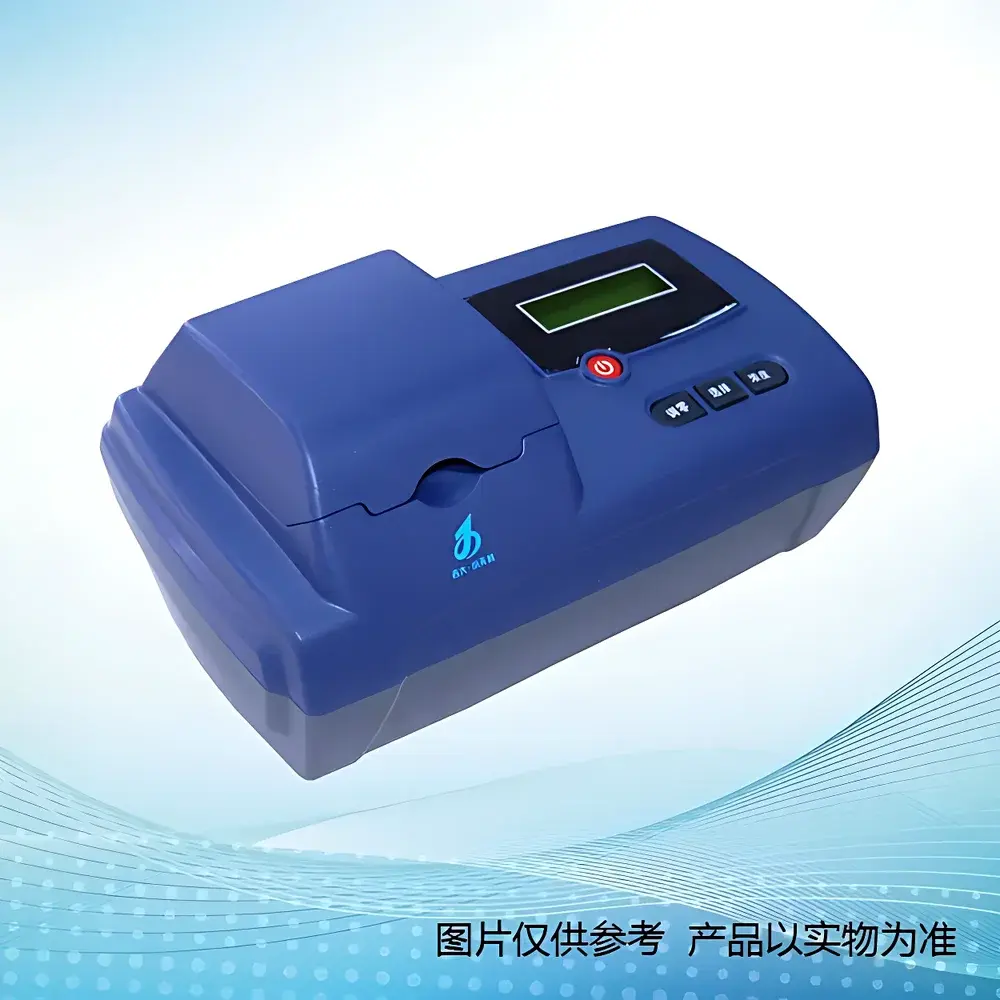
Jiada Xiaotian’e GDYS-301S Portable Residual Chlorine, Chlorine Dioxide and Chlorite Analyzer
| Brand | Jiada Xiaotian’e |
|---|---|
| Origin | Jilin, China |
| Manufacturer Type | Direct Manufacturer |
| Country of Origin | China |
| Model | GDYS-301S |
| Instrument Type | Portable |
| Measurement Principle | DPD Spectrophotometry |
| Measured Parameters | Residual Chlorine, Chlorine Dioxide, Chlorite |
| Measurement Ranges | Chlorine Dioxide: 0.00–3.00 mg/L |
| Residual Chlorine | 0.00–2.50 mg/L |
| Chlorite | 0.00–2.00 mg/L |
| Accuracy | ±5% |
| LOD | Chlorine Dioxide: 0.02 mg/L |
| Residual Chlorine | 0.01 mg/L |
| Chlorite | 0.05 mg/L |
| Light Source | High-Brightness LED |
| Wavelength | 520 nm |
| Absorbance Range | 0.000–2.000 Abs |
| Stability | ≤0.005 Abs/h |
| Power Supply | 9 V Battery (Auto-Shutdown after 30 min |
| Operating Temperature | 0–50 °C |
Overview
The Jiada Xiaotian’e GDYS-301S Portable Residual Chlorine, Chlorine Dioxide and Chlorite Analyzer is a compact, field-deployable spectrophotometric instrument engineered for quantitative determination of three critical disinfectant-related parameters in drinking water and source water: free residual chlorine, chlorine dioxide (ClO₂), and chlorite ion (ClO₂⁻). It operates on the standardized N,N-diethyl-p-phenylenediamine (DPD) colorimetric method—fully compliant with APHA Standard Methods 4500-Cl G, 4500-ClO₂ B, and 4500-ClO₂⁻ C, as well as ISO 7393-2 and EPA Method 334.1 for chlorine species. The analyzer integrates fixed-wavelength photometry at 520 nm using high-stability light-emitting diodes (LEDs), enabling robust optical performance under variable ambient conditions without thermal drift or lamp aging concerns typical of tungsten-halogen sources. Designed for routine compliance monitoring, it supports rapid, on-site verification of disinfection efficacy and byproduct formation—key requirements under national drinking water standards (e.g., China’s GB 5749-2022) and international frameworks including WHO Guidelines for Drinking-water Quality.
Key Features
- Pre-calibrated internal calibration curves eliminate the need for daily standard solution preparation—reducing operator error and reagent consumption while ensuring traceable measurement consistency across field and lab settings.
- Single-button operation workflow: zero calibration → reagent addition → measurement → digital readout—designed for non-specialist users including water utility technicians, environmental inspectors, and field researchers.
- Ultra-portable architecture (≤350 g, dimensions < 180 × 100 × 60 mm) with ergonomic housing and splash-resistant interface—validated for continuous operation in humid outdoor environments and mobile laboratories.
- Energy-efficient design featuring intelligent power management: automatic shutdown after 30 minutes of inactivity and real-time low-battery warning via LCD icon—enabling >200 measurements per battery set under typical usage.
- Optical system optimized for DPD chemistry: narrow-band 520 nm LED excitation minimizes spectral interference from turbidity, colored organics, or transition metal ions commonly present in surface water matrices.
Sample Compatibility & Compliance
The GDYS-301S accepts raw or filtered water samples (10 mL volume) without pretreatment for most municipal and groundwater applications. It accommodates samples with turbidity up to 5 NTU and pH between 4.0–8.5—within the operational envelope specified for DPD-based chlorine assays per ASTM D1253 and ISO 7393-2. All measurement protocols align with Good Laboratory Practice (GLP) documentation requirements: each test record includes date/time stamp, operator ID (manual entry), and instrument serial number. While not FDA 21 CFR Part 11-certified out-of-the-box, the device supports audit-ready manual logging compatible with ISO/IEC 17025-accredited quality systems. Calibration verification checks are recommended before each sampling shift using certified reference materials traceable to NIST SRM 2828 (chlorine) and NIST SRM 3191a (chlorite).
Software & Data Management
The GDYS-301S operates as a standalone, embedded-system analyzer with no external software dependency. All calculations—including blank subtraction, linear interpolation against stored calibration polynomials, and unit conversion—are performed internally using firmware compliant with IEC 61508 SIL 2 functional safety principles for measurement integrity. Results display simultaneously in mg/L for all three analytes on a high-contrast monochrome LCD with backlight. Data export is manual: users record values directly into field notebooks or LIMS-compatible spreadsheets. For organizations requiring electronic data capture, optional RS-232 or Bluetooth adapters (sold separately) enable integration with third-party data aggregation platforms supporting CSV or MODBUS RTU protocols—facilitating batch upload to centralized water quality dashboards aligned with SDG 6.1 monitoring objectives.
Applications
- Routine disinfectant residual monitoring at water treatment plant effluent points and distribution system hydrants.
- Verification of ClO₂ dosing efficacy during primary disinfection and post-chlorination stages.
- Chlorite byproduct surveillance in systems using chlorine dioxide generators—supporting regulatory compliance with maximum contaminant levels (MCLs) per US EPA (1.0 mg/L) and EU Directive 98/83/EC (0.7 mg/L).
- Educational use in undergraduate environmental engineering labs for method validation exercises and inter-laboratory comparison studies.
- Emergency response deployment during contamination events or infrastructure failures requiring rapid assessment of disinfectant decay kinetics and residual persistence.
FAQ
What sample pretreatment is required prior to analysis?
No filtration or acidification is needed for clear, low-turbidity drinking water. For raw surface water with turbidity >5 NTU, a 0.45 µm membrane filter is recommended to minimize scattering artifacts.
Can the GDYS-301S distinguish between free chlorine and combined chlorine?
No—the instrument measures total residual chlorine using DPD Method 1. Separate free/combined differentiation requires sequential DPD titration (Methods 2 and 3), which is outside its automated scope.
How often must the optical path be cleaned or recalibrated?
The cuvette chamber should be wiped with lint-free tissue after each sample. Full recalibration using factory-provided verification standards is advised every 30 days or after 100 measurements, whichever occurs first.
Is the device suitable for seawater or high-salinity brackish water?
Not recommended: chloride concentrations >1000 mg/L may interfere with DPD oxidation kinetics and produce positive bias in chlorine dioxide readings; alternative amperometric or iodometric methods are preferred for saline matrices.
Does the analyzer meet GLP or GMP documentation requirements?
It supports GLP-compliant manual recordkeeping. For GMP-regulated pharmaceutical water systems, supplementary procedural controls (e.g., defined calibration logs, change control for firmware updates) must be implemented per organizational SOPs.







