
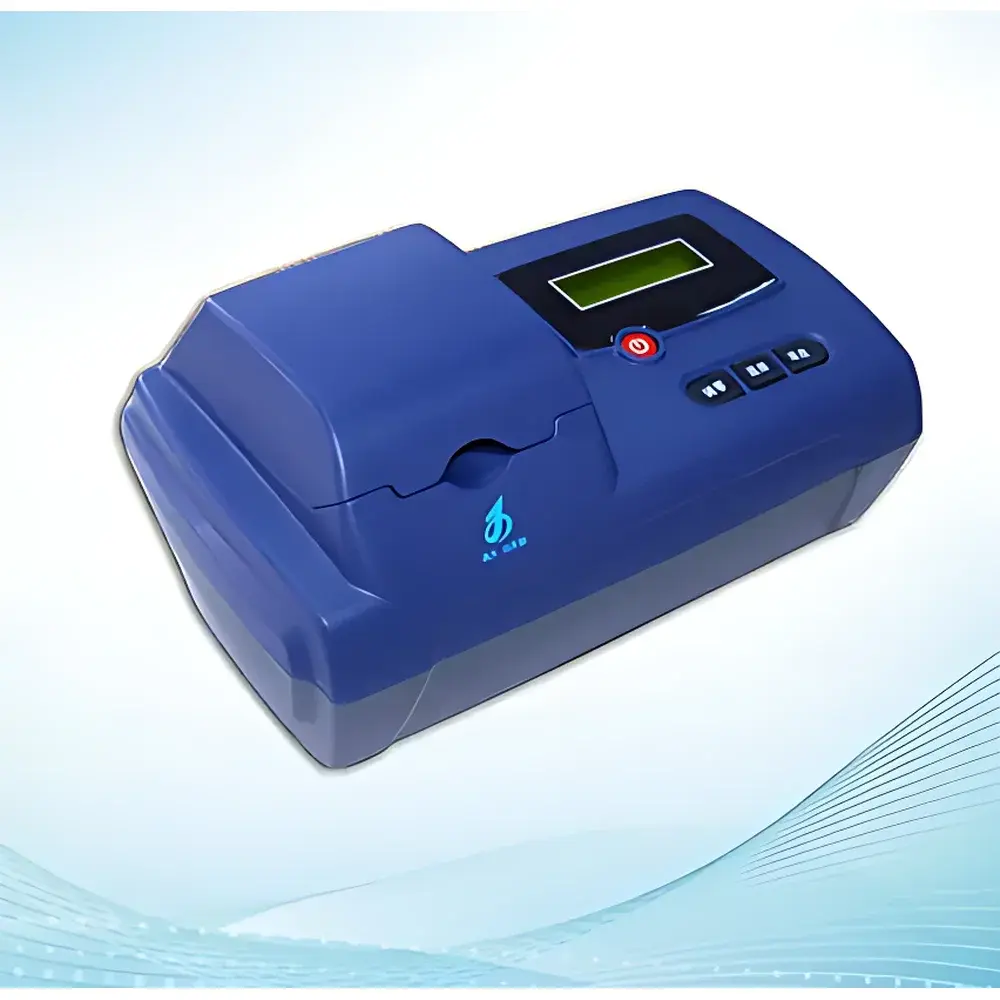
JiDa-Xiaotian’e GDYS-101SF Fluoride Water Quality Analyzer
| Brand | JiDa-Xiaotian'e |
|---|---|
| Origin | Jilin, China |
| Manufacturer Type | Direct Manufacturer |
| Country of Origin | China |
| Model | GDYS-101SF |
| Instrument Type | Portable/Handheld Water Quality Analyzer |
| Analyte | Fluoride |
| Detection Limit | 0.01 mg/L |
| Measurement Range | 0.00–1.00 mg/L |
| Accuracy | ±5% |
| Analysis Time | ≤30 minutes |
| Method Compliance | GB/T 5750.5–2006 |
Overview
The JiDa-Xiaotian’e GDYS-101SF Fluoride Water Quality Analyzer is a field-deployable, colorimetric instrumentation system engineered for rapid, on-site quantification of fluoride ions (F⁻) in drinking water, surface water, groundwater, and treated effluent. It operates on the principle of SPADNS (Sodium 2-(p-Sulfophenylazo)-1,8-dihydroxy-3,6-naphthalenedisulfonate) spectrophotometric detection, in strict accordance with the Chinese national standard GB/T 5750.5–2006 “Standard Examination Methods for Drinking Water – Inorganic Nonmetallic Indices.” This method relies on the formation of a stable pink-colored complex between fluoride and zirconium–SPADNS under controlled pH conditions, with absorbance measured at 580 nm using an integrated solid-state photodetector and LED light source. The instrument’s optical architecture is calibrated to deliver high reproducibility across variable ambient lighting and temperature conditions typical of field environments (10–35 °C), making it suitable for routine surveillance, emergency response, and regulatory compliance verification in municipal water utilities, environmental monitoring stations, and rural water safety programs.
Key Features
- Field-optimized portable design: Compact, lightweight (≤0.8 kg), battery-powered (rechargeable Li-ion, ≥8 hours continuous operation), and IP65-rated for dust and water resistance.
- Pre-calibrated optical path: Fixed-wavelength LED (580 ± 2 nm) and matched photodiode eliminate need for manual wavelength selection or lamp alignment.
- Dedicated single-use reagent kits: Each kit contains pre-measured, lyophilized SPADNS–zirconium reagents sealed in aluminum foil pouches—ensuring stability, minimizing operator error, and eliminating liquid handling variability.
- Integrated digital readout: LCD display shows concentration directly in mg/L (as F⁻), with automatic zeroing and blank compensation functions.
- Trace-level sensitivity: Detection limit of 0.01 mg/L meets WHO guideline values (1.5 mg/L) and Chinese drinking water standard (GB 5749–2022, max 1.0 mg/L) for fluoride, supporting early-warning capability.
- No external PC or software required for basic operation: All calibration curves and calculation algorithms are embedded in firmware.
Sample Compatibility & Compliance
The GDYS-101SF accepts raw or filtered water samples (no pretreatment required for turbidity 0.3 mg/L), or aluminum (>0.5 mg/L) may interfere and require sample dilution or masking agents per GB/T 5750.5–2006 Annex B. The analyzer conforms to the metrological verification requirements specified in JJG 973–2018 (Verification Regulation for Portable Water Quality Analyzers) and supports documentation traceability aligned with GLP principles. While not certified to ISO/IEC 17025, its method equivalence to GB/T 5750.5–2006 ensures data acceptability in domestic regulatory reporting contexts, including provincial environmental protection bureaus and health supervision institutions.
Software & Data Management
Data storage is limited to internal memory (up to 200 test records), each timestamped and tagged with batch ID, operator code (user-defined), and measurement mode (standard or diluted). Export is supported via USB-C interface to CSV files compatible with Microsoft Excel or LIMS platforms. Firmware supports over-the-air updates through manufacturer-provided desktop utility (Windows only). Audit trail functionality includes immutable logging of calibration events, zero adjustments, and critical error codes—satisfying minimum traceability requirements for internal quality control and third-party audit readiness under China’s Environmental Monitoring Technical Specifications (HJ 168–2020).
Applications
- Routine fluoridation monitoring in municipal water distribution systems
- Field screening of endemic fluorosis-prone regions (e.g., high-fluoride aquifers in North China Plain)
- Emergency assessment following industrial spill incidents involving hydrofluoric acid or fluorosilicates
- Validation of point-of-use defluoridation devices (e.g., activated alumina, bone char filters)
- Training and capacity building in rural water safety programs and community-based monitoring initiatives
- Compliance verification for rural centralized water supply facilities under China’s “Rural Drinking Water Safety Project”
FAQ
What is the shelf life of the reagent kits?
Unopened reagent pouches retain performance for 18 months when stored at 2–8 °C; room-temperature storage (≤25 °C) reduces shelf life to 12 months.
Can the instrument measure fluoride in seawater or brackish water?
No—high chloride and ionic strength cause significant interference; the method is validated only for freshwater matrices with TDS < 1000 mg/L.
Is user calibration required before each test?
A one-point blank calibration using deionized water is recommended before each testing session; full multi-point calibration is performed annually or after sensor replacement.
Does the device meet international standards such as ISO 10304 or EPA Method 300.0?
It implements GB/T 5750.5–2006, which is technically equivalent to ISO 10304-1 for fluoride but lacks formal ISO/IEC 17025 accreditation; it is not validated against EPA methods.
How is measurement uncertainty estimated?
Total uncertainty (k=2) is ±5% relative, derived from repeatability (RSD ≤3.2%, n=6), reagent lot-to-lot variation (±1.1%), and photometric drift (±0.8%) under field conditions.
Related Products







