
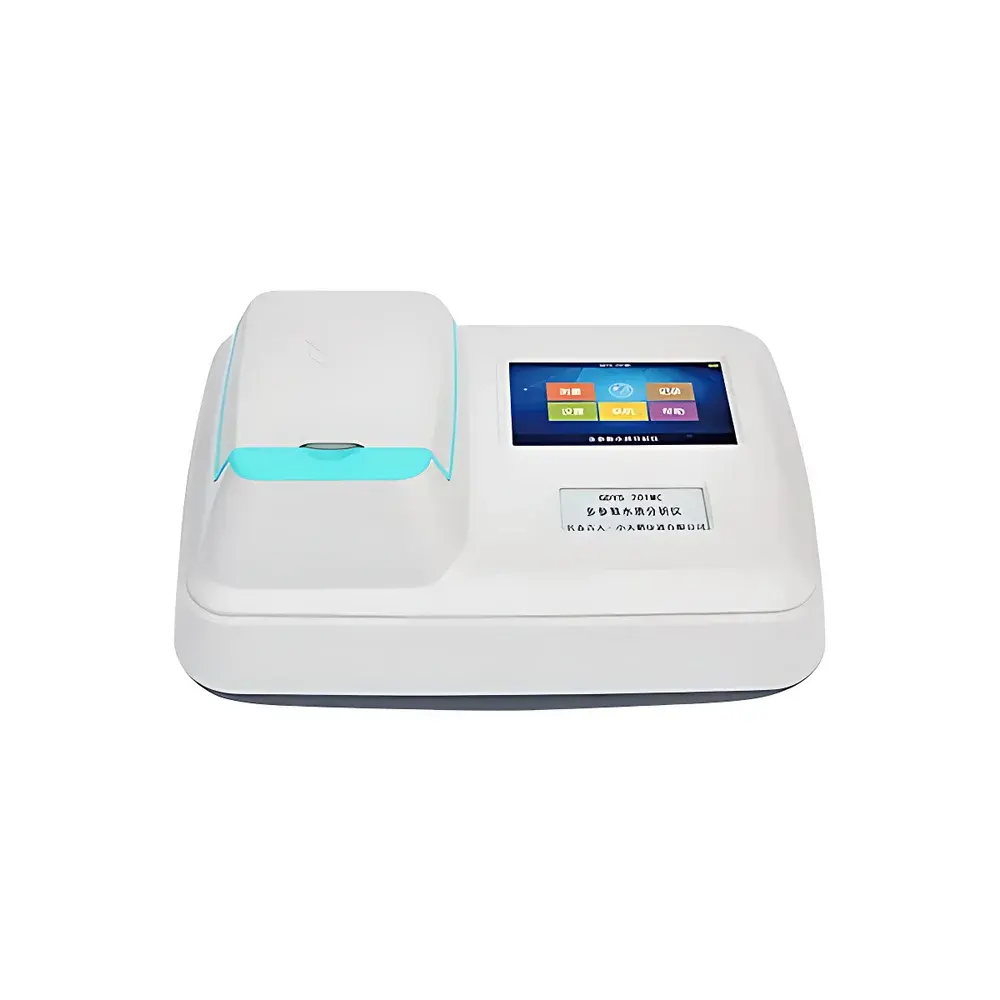
JiDa Xiaotian’e GDYS-201MC Portable Multi-Parameter Water Quality Analyzer
| Brand | JiDa Xiaotian'e |
|---|---|
| Origin | Jilin, China |
| Model | GDYS-201MC |
| Instrument Type | Portable/HANDHELD Water Quality Analyzer |
| Detection Parameters | Free Chlorine, Total Chlorine, Ozone, Turbidity, Fluoride, Nitrite Nitrogen, Ammonia Nitrogen, Dissolved Oxygen |
| Light Source | High-Brightness LED |
| Optical Stability | 0.005 Abs/h |
| Sample Cell | Cylindrical Glass Cuvette & Standard Glass Cuvette |
| Power Supply | AC 220 V ± 22 V, 50 Hz ± 1 Hz |
| Rechargeable Battery | 7.4 V / 1800 mAh |
| Operating Temperature | 5 °C to 40 °C |
| Connectivity | USB, RS232, Bluetooth (for wireless printing) |
Overview
The JiDa Xiaotian’e GDYS-201MC Portable Multi-Parameter Water Quality Analyzer is an integrated photometric platform engineered for field-deployable, quantitative analysis of critical water quality indicators in compliance with standard environmental testing protocols. It operates on the principle of absorbance-based spectrophotometry, utilizing high-stability light-emitting diodes (LEDs) as narrow-band light sources matched to the absorption maxima of target analytes. Unlike benchtop spectrophotometers requiring external calibration and manual dilution, the GDYS-201MC embeds pre-validated calibration curves—generated from NIST-traceable reference standards—for over 80 parameters, including chromium(VI), manganese, iron, fluoride, total phosphorus, total nitrogen, ammonia nitrogen, nitrite nitrogen, sulfate, sulfide, aluminum, copper, zinc, turbidity, color, and dissolved oxygen. Its dual-channel optical architecture enables simultaneous or sequential measurement of two independent parameters without cross-interference, significantly improving throughput during multi-analyte surveys in drinking water distribution systems, surface water monitoring stations, groundwater wells, and emergency response scenarios.
Key Features
- Dual-channel photometric detection system with independent optical paths and wavelength selection—eliminates sequential filter wheel delays and supports concurrent analysis of paired parameters (e.g., free chlorine + turbidity).
- Zero-power-off display: LCD retains last-measured values and instrument status after shutdown via ultra-low-power memory retention circuitry—critical for unattended field deployments.
- User-customizable parameter menu: Operators can define up to 20 frequently used test configurations—including reagent lot-specific curve offsets, unit preferences (mg/L, ppm, NTU, µmol/L), and pass/fail thresholds—stored in non-volatile memory.
- Pre-packaged, factory-prepared reagents in sealed vials: Eliminates on-site standard preparation, minimizes analyst error, and ensures batch-to-batch reproducibility aligned with ISO 8466-1 requirements for calibration function validation.
- Integrated rechargeable lithium-ion battery (7.4 V / 1800 mAh) supporting ≥8 hours of continuous operation; compatible with universal AC adapters and vehicle DC inputs (12 V).
- Robust mechanical design: IP65-rated enclosure with rubberized grip and shock-absorbing housing certified for transport under IEC 60068-2-6 (vibration) and IEC 60068-2-27 (shock) conditions.
Sample Compatibility & Compliance
The GDYS-201MC accepts standard 10 mm and 16 mm pathlength glass cuvettes and cylindrical borosilicate sample vials (10–25 mL), accommodating raw, filtered, or preserved samples per EPA Method 365.3 (phosphate), EPA Method 352.1 (nitrate/nitrite), and ISO 7027 (turbidity). All embedded calibration curves are validated against ASTM D1253 (residual chlorine), ISO 6777 (ammonia), and ISO 5667-3 (sampling preservation). The analyzer meets GLP data integrity requirements through time-stamped, operator-ID-tagged result logging and supports audit-ready export of raw absorbance data (Aλ1, Aλ2) alongside calculated concentrations. While not FDA 21 CFR Part 11–certified out-of-the-box, its firmware architecture permits configuration of electronic signature workflows and secure user role management (Admin/Operator/Reviewer) when deployed within GMP-aligned water safety plans.
Software & Data Management
Data acquisition and reporting are managed via the bundled GDYS-Link PC software (Windows 10/11), which imports measurement logs via USB mass storage mode or RS232 serial protocol (9600 baud, N-8-1). Each record includes timestamp (RTC-backed), GPS coordinates (when connected via Bluetooth-enabled external module), instrument serial number, reagent lot ID, cuvette ID, raw absorbance values at primary and reference wavelengths, and QC flag status (e.g., “out-of-range blank”, “curve deviation >5%”). Export formats include CSV (for LIMS integration), PDF reports compliant with ISO/IEC 17025 Clause 7.8.2, and XML files structured to meet national environmental monitoring database schemas (e.g., China’s National Environmental Monitoring Center NMDC format). Bluetooth 4.2 support enables direct thermal printing to certified portable printers (e.g., Zebra ZQ520) without intermediary devices.
Applications
- Drinking water safety verification: On-site screening for disinfectant residuals (free/total chlorine, ozone), DBPs precursors (ammonia, nitrite), and heavy metals (Cr(VI), Pb, As) at treatment plant outlets and distribution network taps.
- Surface and groundwater quality assessment: Quantification of eutrophication markers (total P, total N, NH3-N, NO2−-N), redox-sensitive species (Fe2+, Mn2+, S2−), and geogenic contaminants (F−, Al, As) during routine surveillance or contamination incident response.
- Wastewater effluent compliance: Rapid verification of discharge permit limits for turbidity, color, sulfate, and dissolved oxygen prior to release into receiving waters.
- Educational and capacity-building use: Pre-configured teaching modules with guided workflows for undergraduate environmental science laboratories and municipal technician training programs.
FAQ
Does the GDYS-201MC require daily recalibration?
No. Factory-loaded calibration curves remain stable for ≥6 months under normal storage and usage conditions. A single-point verification using a certified reference standard is recommended before each sampling shift.
Can the instrument store results without connecting to a computer?
Yes. Internal flash memory retains ≥5,000 test records with full metadata, including timestamps, operator IDs, and raw optical readings.
Is method validation documentation available for regulatory submissions?
Yes. Certificate of Conformance, calibration traceability statements (to NIM, China), and performance verification reports per ISO/IEC 17025 are provided upon request.
What maintenance is required for long-term reliability?
Annual optical alignment verification and LED intensity check by authorized service centers; no user-serviceable optical components.
Are reagents supplied with instrument purchase compliant with ISO 8466-2 stability requirements?
Yes. All included reagent kits carry expiration dates validated under accelerated stability testing (40 °C / 75% RH for 6 months), with documented degradation profiles for key chromogenic reactions.







