
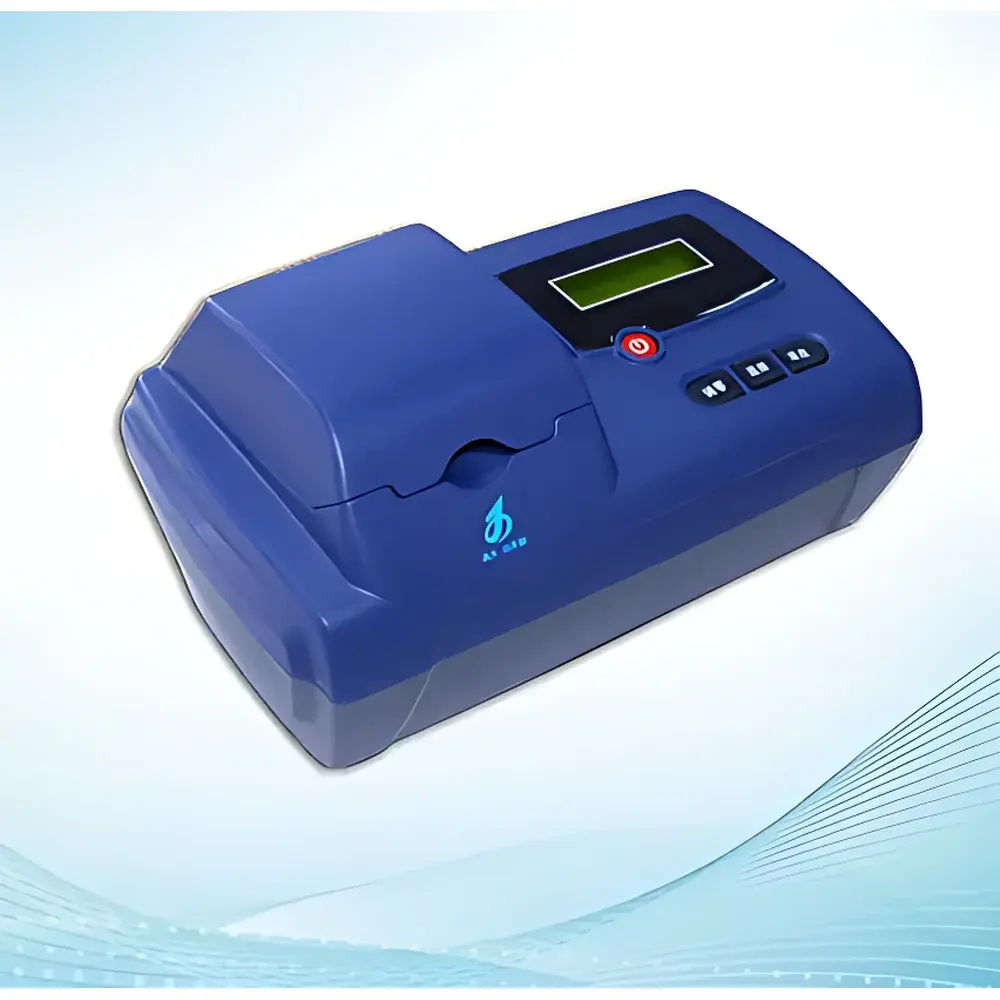
GDYS-101SZ Turbidity Analyzer by Jilin University Xiaotianshe
| Brand | Jilin University Xiaotianshe |
|---|---|
| Origin | Jilin, China |
| Manufacturer Type | Original Equipment Manufacturer (OEM) |
| Origin Category | Domestic (China) |
| Model | GDYS-101SZ |
| Pricing | Available Upon Request |
| Detection Limit | 5 NTU |
| Measurement Range | 0–400 NTU |
| Accuracy | ±5% of reading |
Overview
The GDYS-101SZ Turbidity Analyzer is a portable, field-deployable optical instrument engineered for rapid, quantitative measurement of turbidity in water samples according to the Chinese national standard GB/T 5750.4–2006 — equivalent in principle to ISO 7027 (nephelometric method using 860 nm infrared LED light source and 90° scattered light detection). Turbidity, expressed in Nephelometric Turbidity Units (NTU), serves as a critical indicator of suspended particulate matter—including silt, clay, organic matter, microorganisms, and colloidal particles—in drinking water, surface water, wastewater effluents, and process water streams. The GDYS-101SZ employs a stable solid-state infrared light source and calibrated photodetector architecture to ensure consistent signal-to-noise performance under variable ambient lighting conditions, enabling reliable on-site assessment without laboratory infrastructure.
Key Features
- Compliance with GB/T 5750.4–2006, aligned with fundamental principles of ISO 7027 for nephelometric turbidity measurement
- Field-ready design: battery-powered operation, integrated sample cell holder, and ruggedized housing suitable for outdoor use
- Three-minute analysis cycle — includes sample loading, automatic zero calibration (via air or deionized water reference), measurement, and digital display
- Digital LCD interface with backlight for low-light environments; direct NTU readout with automatic range selection across 0–400 NTU
- ±5% measurement accuracy at mid-to-high range (≥20 NTU); detection limit optimized at 5 NTU per standardized validation protocol
- No consumables required beyond standard calibration standards (e.g., Formazin or StablCal® suspensions)
Sample Compatibility & Compliance
The GDYS-101SZ accepts standard 25 mm round glass or disposable plastic cuvettes (10 mm path length), supporting both raw and filtered water matrices. It is validated for use with potable water, river/lake water, treated wastewater, and industrial cooling water—provided samples are free of air bubbles, excessive color interference (>150 Pt-Co units), or highly absorptive dissolved organics that may bias scattering response. While not certified to EPA Method 180.1 or ASTM D6508, its operational methodology satisfies routine monitoring requirements under China’s HJ/T 92–2019 (Technical Specification for Monitoring of Urban Wastewater Treatment Plants) and supports GLP-aligned data recording when paired with external logging protocols.
Software & Data Management
The analyzer operates as a standalone instrument with no embedded software stack or USB/Bluetooth connectivity. All measurements are displayed in real time and retained in non-volatile memory for up to 100 test records, accessible via scroll navigation. For traceability in regulated environments, users may manually transcribe results into LIMS-compatible spreadsheets or audit-ready logbooks. Though lacking FDA 21 CFR Part 11-compliant electronic signatures or audit trails, the device supports documentation integrity through timestamped manual entry and adherence to internal SOPs governing field instrument calibration frequency (recommended daily pre-use verification with 0 NTU and 100 NTU standards).
Applications
- Routine surveillance of municipal drinking water distribution systems prior to chlorination and post-filtration
- Field verification of membrane filter integrity in decentralized treatment units
- Process control monitoring in wastewater treatment plants (e.g., clarifier effluent, tertiary filtration output)
- Environmental sampling campaigns assessing sediment resuspension events in reservoirs and estuaries
- Educational laboratories conducting comparative turbidity studies under controlled hydrodynamic conditions
- Emergency response scenarios requiring immediate assessment of floodwater or post-disaster source water quality
FAQ
Does the GDYS-101SZ require annual factory recalibration?
No — it is designed for user-performed verification using traceable turbidity standards; full recalibration is recommended only after physical impact, prolonged storage (>6 months), or persistent drift exceeding ±5% against certified references.
Can it measure colored samples accurately?
Samples with high true color (>150 Pt-Co) may introduce positive bias due to absorption effects; pre-filtration or spectral correction is advised for compliance-critical applications.
Is the instrument suitable for seawater analysis?
Yes, provided salinity-induced refractive index variation is accounted for during standardization; use marine-grade Formazin analogs or ISO 7027-compliant calibration suspensions.
What power source does it use?
Four AA alkaline batteries (approx. 2000 measurements per set) or optional AC adapter (not included); auto-power-off after 5 minutes of inactivity.
How is zero calibration performed?
By inserting an air-filled cuvette (for air-zero) or deionized water (for water-zero) and pressing the “ZERO” key; the system compensates for optical window fouling and ambient light leakage.







