
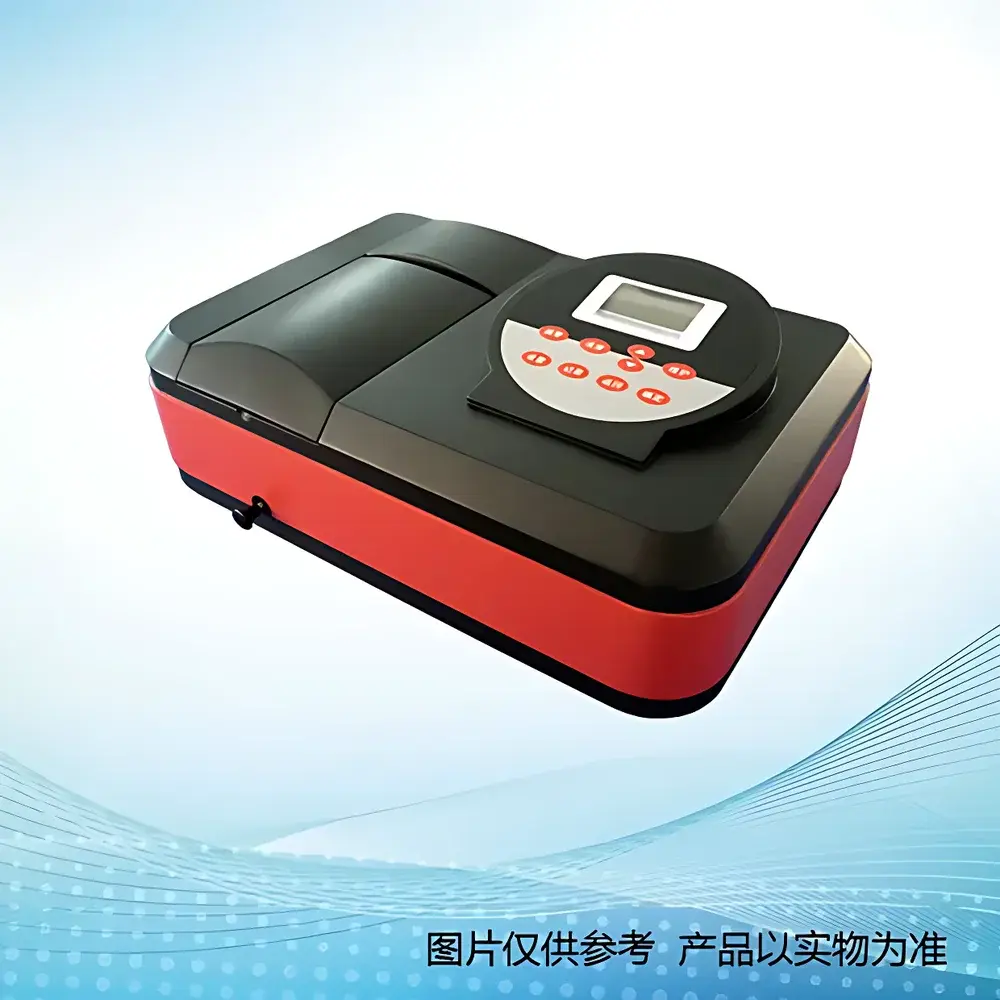
Jiada Xiaotianshe GDYS-401M Laboratory Water Quality Analyzer
| Brand | Jiada Xiaotianshe |
|---|---|
| Origin | Jilin, China |
| Manufacturer Type | Direct Manufacturer |
| Region of Origin | Domestic (China) |
| Model | GDYS-401M |
| Price Range | USD 4,200 – 7,000 |
| Instrument Type | Benchtop Laboratory Water Quality Analyzer |
| Target Analytes | Total Nitrogen (TN), Total Phosphorus (TP), Chemical Oxygen Demand (COD), Ammonia Nitrogen (NH₃-N) |
| Wavelength Range | 200–1000 nm |
| Spectral Bandwidth | 2 nm |
| Wavelength Accuracy | ±1 nm |
| Wavelength Repeatability | 0.2 nm |
| Photometric Accuracy | ±0.5% T |
| Photometric Repeatability | 0.2% T |
| Baseline Stability | 0.002 A/h |
| Stray Light | ≤0.05% T |
| Data Interface | USB |
| Light Sources | Imported Deuterium Lamp & Tungsten Halogen Lamp |
| Power Supply | AC 220 V ±10% |
| Operating Temperature | 0–50 °C |
Overview
The Jiada Xiaotianshe GDYS-401M is a benchtop laboratory water quality analyzer engineered for precise, rapid quantification of four critical water quality parameters—Total Nitrogen (TN), Total Phosphorus (TP), Chemical Oxygen Demand (COD), and Ammonia Nitrogen (NH₃-N)—in surface water, groundwater, municipal wastewater, and industrial effluents. It operates on the principle of ultraviolet-visible (UV-Vis) spectrophotometry, utilizing standardized colorimetric reactions to convert analyte concentration into measurable absorbance signals. The instrument integrates dual light sources (deuterium lamp for UV range and tungsten halogen lamp for visible range) to ensure full spectral coverage from 200 nm to 1000 nm, enabling compliance with multiple national standard methods—including GB/T 11893–1989 (TP), GB/T 11894–1989 (TN), HJ 399–2007 (COD), and HJ 535–2009 (NH₃-N). Its optical architecture delivers high photometric reproducibility (±0.2% T) and wavelength fidelity (±1 nm), supporting method-validated data acquisition in regulated laboratory environments.
Key Features
- Pre-programmed, factory-calibrated working curves aligned with Chinese National Standards (GB and HJ series), eliminating routine standard solution preparation.
- Dedicated single-use reagent kits for TN, TP, COD, and NH₃-N—minimizing analyst error, reducing hands-on time, and enhancing inter-laboratory reproducibility.
- Integrated zero-point calibration protocol: only one blank measurement required prior to sample analysis, streamlining workflow without compromising traceability.
- Full-spectrum UV-Vis spectrophotometer with 2 nm spectral bandwidth, optimized for narrow-band absorption peaks of common chromophores (e.g., molybdenum blue for phosphorus, indophenol blue for ammonia).
- High-stability optical platform with drift <0.002 A/h at 500 nm, ensuring reliable multi-hour batch analysis under ambient lab conditions (0–50 °C).
- USB interface for raw absorbance data export, compatible with LIMS integration and offline validation reporting.
Sample Compatibility & Compliance
The GDYS-401M accepts clarified liquid samples within standard 10 mm pathlength cuvettes (glass or quartz). It supports direct analysis of filtered or centrifuged aqueous matrices without dilution for most municipal and low-turbidity industrial effluents. For high-COD or high-salinity samples, optional dilution protocols are embedded in the firmware per GB/T 15451–2006 guidance. While designed to meet domestic regulatory requirements (e.g., Ministry of Ecology and Environment of China), its photometric performance aligns with ISO 7027 (turbidity), ISO 6060 (COD), and ASTM D1253 (residual chlorine interference mitigation). The system supports GLP-compliant operation through timestamped measurement logs and user-accessible calibration history—though native 21 CFR Part 11 audit trail functionality requires external LIMS linkage.
Software & Data Management
The onboard firmware provides a localized Chinese GUI with intuitive navigation, real-time absorbance display, and immediate concentration readout in standard units (mg/L as N or P, mg/L O₂ for COD). Users may create custom calibration curves using up to 8 standard points, storing up to 200 method profiles. Raw spectral data (wavelength vs. %T) and measurement metadata (date/time, operator ID, cuvette ID) are exportable via USB to CSV format. No proprietary software installation is required; exported files are natively readable in Excel, R, or Python-based QA/QC pipelines. Firmware updates are delivered via USB flash drive and validated against SHA-256 checksums.
Applications
- Regulatory compliance monitoring for wastewater treatment plants (WWTPs) discharging to municipal sewer systems or natural water bodies.
- Environmental field labs conducting routine surveillance of eutrophication indicators (TN/TP) in lakes and reservoirs.
- Industrial QC laboratories verifying pretreatment efficiency for electroplating, textile dyeing, and food processing effluents.
- Educational institutions performing undergraduate analytical chemistry experiments on spectrophotometric quantification and method validation.
- Third-party testing labs requiring traceable, standards-aligned data for CNAS (China National Accreditation Service) accreditation documentation.
FAQ
Does the GDYS-401M comply with international standards such as ISO or ASTM?
It implements reaction chemistries and photometric protocols consistent with ISO 6060 (COD), ISO 11905-1 (TN), and ASTM D3867 (ammonia), though formal certification requires independent lab validation.
Can the instrument measure additional parameters beyond TN, TP, COD, and NH₃-N?
No—its optical design and preloaded methods are fixed to these four analytes. Expansion requires hardware modification not supported by the manufacturer.
Is the reagent kit compatible with other spectrophotometers?
Reagents are formulation-optimized for GDYS-401M’s timing, temperature, and detection algorithms; cross-platform use is not validated and may compromise accuracy.
What maintenance is required for long-term photometric stability?
Annual lamp replacement (deuterium and tungsten) and quarterly baseline verification using certified neutral density filters are recommended per IEC 61000-4-3 guidelines.
How is data integrity ensured during power interruption?
All measurements are buffered in non-volatile memory; unsaved results persist through AC loss and resume upon reboot without corruption.
Related Products







