
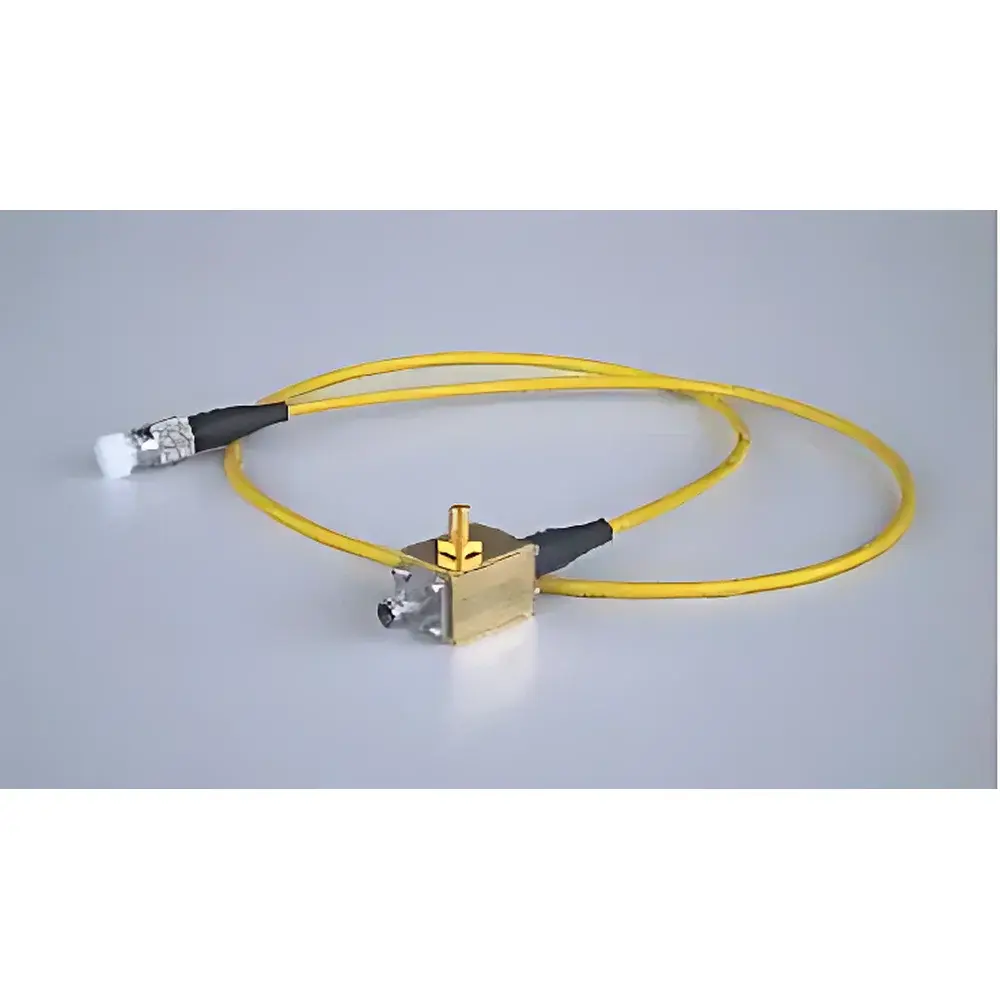
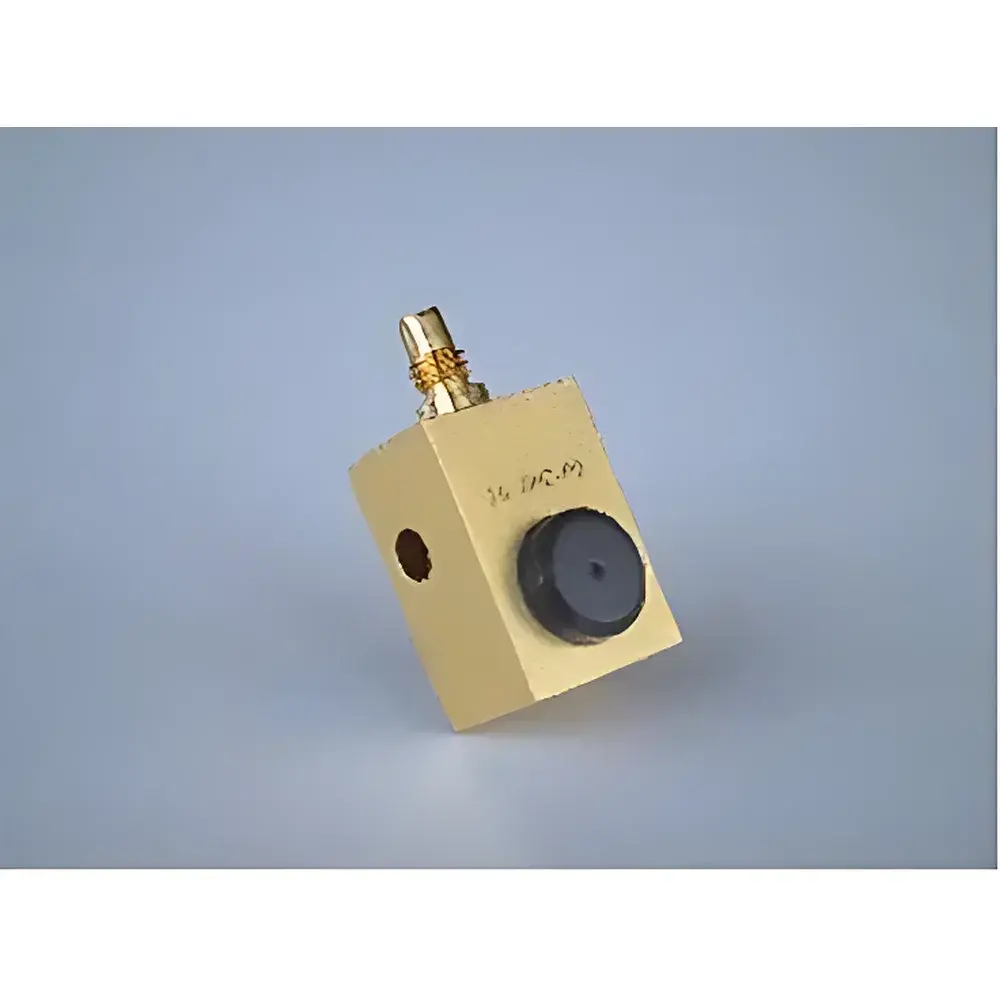
MSM UltraFast Photodetector Series by A.L.S. GmbH
| Brand | A.L.S. GmbH / Advanced Laser Diode Systems |
|---|---|
| Origin | Germany |
| Model | MSM UltraFast-20 / UltraFast-35 |
| Bandwidth | DC–20 GHz / DC–35 GHz |
| Wavelength Range | 400–1600 nm |
| Detector Structure | Metal–Semiconductor–Metal (MSM) |
| Capacitance | Low |
| Series Impedance | Low |
| Active Area | Optimized for High-Speed Operation |
| Bias Voltage | 6 V (typ.) |
| Output Interface | 50 Ω RF coaxial |
| Compliance | RoHS, CE |
| Mounting Options | SM-fiber-coupled (UltraFast-20/35 SM) and free-space (UltraFast-20/35 FS) with integrated focusing lens |
Overview
The MSM UltraFast Photodetector Series—comprising the UltraFast-20 and UltraFast-35 models—is a high-bandwidth, low-noise photodetection platform engineered for time-resolved optical characterization in advanced photonics laboratories and industrial R&D environments. Based on the metal–semiconductor–metal (MSM) architecture, these detectors leverage intrinsic advantages including ultra-low junction capacitance, minimal series resistance, and a large yet optimized active area—enabling exceptional temporal fidelity and high responsivity across a broad spectral range (400–1600 nm). Unlike conventional PIN or avalanche photodiodes, the MSM geometry eliminates carrier diffusion delays and suppresses pulse ringing through symmetric electrode design and tailored semiconductor doping profiles. This results in clean, non-oscillatory impulse responses critical for accurate time-domain analysis of femtosecond-scale optical pulses. The detectors operate under low DC bias (typically +6 V), ensuring compatibility with standard 50 Ω RF measurement infrastructure—including high-bandwidth real-time oscilloscopes (up to 50 GHz), bit-error-rate testers, and microwave spectrum analyzers.
Key Features
- Two bandwidth-graded variants: UltraFast-20 (DC–20 GHz) and UltraFast-35 (DC–35 GHz), both supporting DC-coupled operation for precise baseline recovery in transient measurements.
- Monolithic MSM structure fabricated using high-purity GaAs or InGaAs epitaxial layers, enabling sub-10 ps electrical rise times and flat frequency response up to cutoff.
- Low intrinsic noise floor (< 10 pA/√Hz typical) achieved via optimized interdigitated electrode geometry and low-dark-current semiconductor processing.
- Two mechanical configurations: SM-fiber-coupled (UltraFast-20/35 SM) with FC/APC interface for integration into fiber-optic testbenches; and free-space (UltraFast-20/35 FS) variant equipped with an integrated aspheric focusing lens to minimize spot overfill and maximize coupling efficiency.
- RoHS-compliant and CE-marked construction, designed for long-term stability under continuous operation in controlled lab environments.
Sample Compatibility & Compliance
The MSM UltraFast series is compatible with a wide range of pulsed and modulated light sources, including mode-locked lasers (e.g., PiLas PLL081Q, 810 nm, 12 ps FWHM), gain-switched laser diodes, and high-repetition-rate single-photon emitters. Its flat spectral responsivity supports characterization of broadband sources such as supercontinuum generators and tunable OPOs. For regulatory alignment, the detectors meet IEC 61326-1 (EMC for laboratory equipment) and IEC 61000-4-x immunity standards. While not certified for medical or safety-critical applications, their design adheres to GLP-aligned documentation practices—traceable calibration data, serial-numbered device logs, and full material declarations are available upon request for audit readiness.
Software & Data Management
These photodetectors operate as analog front-ends and do not include embedded firmware or onboard digitization. Integration occurs via industry-standard RF interfaces (SMA or K-type connectors), enabling seamless connection to third-party acquisition systems. When used with oscilloscopes supporting IEEE 1788.1-compliant timebase synchronization (e.g., Keysight Infiniium UXR series), users can implement automated jitter analysis, eye diagram generation (e.g., at 20 Gb/s), and Fourier-domain transfer function extraction. Post-processing workflows commonly employ MATLAB, Python (SciPy/NumPy), or LabVIEW-based scripts for deconvolution, impulse response reconstruction, and noise spectral density estimation. Device-specific S-parameter files (Touchstone format) are provided for SPICE and ADS modeling in high-speed optoelectronic circuit simulation.
Applications
- Time-domain characterization of ultrafast laser pulses (e.g., measuring pulse width, chirp, and pedestal content via autocorrelation or FROG validation).
- Bit-error-rate testing and eye-diagram analysis in 25G/50G PAM4 optical interconnect development.
- Frequency response mapping of electro-absorption modulators (EAMs) and Mach–Zehnder modulators (MZMs) in coherent transceiver design.
- Photonic integrated circuit (PIC) testing, including on-wafer probing of silicon photonics modulators and detectors.
- THz generation and detection setups where optical rectification or photoconductive switching requires sub-10-ps temporal resolution.
FAQ
What is the recommended termination impedance for optimal bandwidth performance?
A matched 50 Ω load is required at the detector output to prevent signal reflections and preserve high-frequency fidelity. Use only calibrated 50 Ω coaxial cables and terminations rated ≥ 40 GHz.
Can the UltraFast-35 be used with free-space beams without external optics?
Yes—the UltraFast-35 FS variant includes a factory-aligned aspheric lens optimized for collimated input beams with diameters between 0.8 mm and 2.0 mm. Overfilling beyond this range degrades spatial uniformity and effective bandwidth.
Is DC coupling supported across the full bandwidth?
Yes. Both UltraFast-20 and UltraFast-35 offer true DC-coupled operation, enabling accurate measurement of slow modulation envelopes, low-frequency drift, and baseline shifts in pump-probe experiments.
Are calibration certificates traceable to national metrology institutes available?
Traceable responsivity calibration (NIST-traceable reference detectors) and S-parameter characterization are offered as optional services with documented uncertainty budgets per ISO/IEC 17025 guidelines.
What is the maximum average optical power the detector can handle without saturation or damage?
The maximum safe average power is ≤ 1 mW for continuous-wave illumination and ≤ 10 µJ/cm² per pulse for pulsed operation (assuming 12 ps pulses and repetition rates < 100 MHz). Exceeding these limits may induce thermal nonlinearity or permanent degradation of the MSM contacts.





