
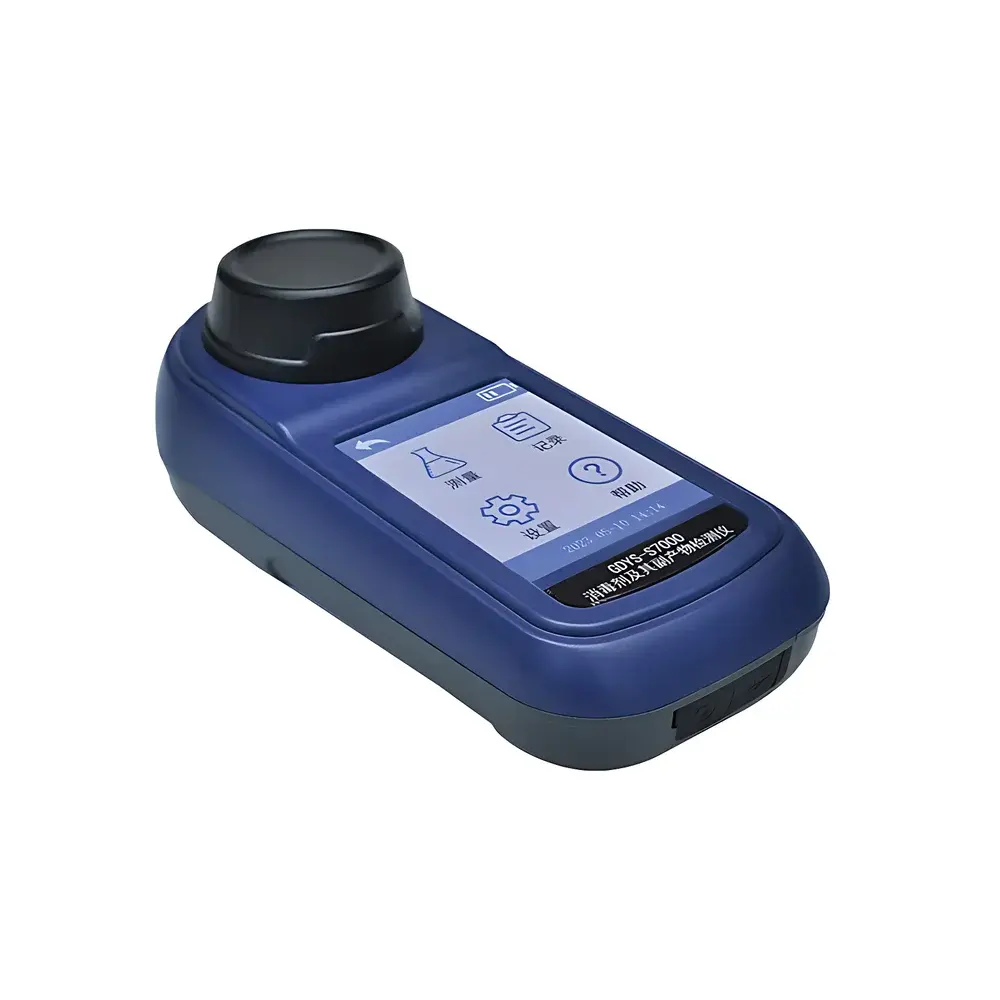
GDYS-S7000 Disinfectant and By-Product Analyzer by Jilin University Little Swan
| Brand | Jilin University Little Swan |
|---|---|
| Origin | Changchun, Jilin, China |
| Model | GDYS-S7000 |
| Instrument Type | Portable Colorimetric Water Quality Analyzer |
| Dimensions | 85 mm × 200 mm × 95 mm |
| Display | Full-color TFT Touchscreen |
| Power | Rechargeable Lithium-ion Battery |
| Weight | <1000 g |
| Detection Parameters | Free Chlorine, Total Chlorine, Chlorine Dioxide, Ozone, Formaldehyde, Chlorite, Available Chlorine |
| Calibration | Pre-stored Multi-point Calibration Curves |
| Connectivity | Bluetooth-enabled for Thermal Printer Integration |
| Sample Cell | Optimized Long-Path Cuvette Design |
| Reagents | Pre-formulated, Single-use Solid/Powdered Reagent Kits |
Overview
The GDYS-S7000 Disinfectant and By-Product Analyzer is a field-deployable, microprocessor-controlled colorimetric instrument engineered for rapid, on-site quantification of critical disinfectants and their regulated oxidation by-products in drinking water, distribution systems, and wastewater treatment effluents. It operates on the principle of spectrophotometric absorbance measurement at optimized wavelengths—automatically selected based on the target analyte—within a fixed-pathlength optical cell. The system employs standardized colorimetric reaction chemistries compliant with EPA Methods 334.0 (free/total chlorine), 337.0 (chlorine dioxide), 376.1 (ozone), and APHA Standard Methods 4500-Cl G, 4500-O₃ B, and 4500-CH₂O B. Designed for routine compliance monitoring, it supports regulatory reporting under national drinking water standards—including China’s GB 5749–2022—and aligns with WHO Guidelines for Drinking-water Quality regarding residual disinfectant management and chlorite control.
Key Features
- Compact, ergonomic form factor (85 × 200 × 95 mm) with integrated full-color TFT touchscreen interface for intuitive menu navigation and real-time result visualization.
- Long-path optical cuvette design enhances sensitivity and lowers detection limits for low-concentration analytes such as chlorite and ozone without requiring sample preconcentration.
- Pre-loaded calibration curves for seven parameters eliminate manual standard preparation; each curve is validated against NIST-traceable reference materials and conforms to ISO/IEC 17025 traceability requirements.
- Proprietary single-dose reagent kits minimize operator handling error, reduce chemical waste, and ensure stoichiometric consistency across batches—critical for inter-laboratory reproducibility.
- Onboard rechargeable lithium-ion battery provides ≥8 hours of continuous operation under typical field conditions, supporting >200 sequential measurements per charge.
- Bluetooth 4.2 module enables secure, cable-free pairing with certified thermal printers for immediate hard-copy documentation—a requirement for GLP-compliant field audits and chain-of-custody records.
Sample Compatibility & Compliance
The GDYS-S7000 accepts clarified aqueous samples with turbidity <5 NTU and suspended solids <10 mg/L. It is validated for use with tap water, groundwater, surface water, swimming pool water, and secondary treated effluent. All analytical protocols adhere to internationally recognized method principles: chlorine species via DPD oxidation, chlorine dioxide via chlorophenol red reduction, ozone via indigo trisulfonate decolorization, formaldehyde via acetylacetone condensation (Hantzsch reaction), and chlorite via iodometric titration adaptation. The instrument meets electromagnetic compatibility (EMC) requirements per IEC 61326-1 and carries CE marking for portable instrumentation. Its firmware architecture supports audit trails and user-access logging, facilitating alignment with ISO/IEC 17025 clause 7.7 (result reporting) and enabling partial compliance with FDA 21 CFR Part 11 when paired with validated printer drivers and secure Bluetooth pairing.
Software & Data Management
Instrument firmware includes embedded data storage for up to 1,000 test records, each timestamped, geotagged (via optional external GPS module), and annotated with operator ID, sample ID, and environmental metadata (e.g., ambient temperature). Export options include CSV via USB-C or Bluetooth to Windows/macOS platforms. No proprietary desktop software is required; raw absorbance values and calculated concentrations are accessible in plain-text format for integration into LIMS environments. Firmware updates are delivered via signed binary packages to ensure integrity and version control—essential for maintaining validated status during regulatory inspections.
Applications
- Routine verification of disinfectant residuals at water treatment plant exit points and within distribution networks.
- Monitoring chlorite accumulation in chlorine dioxide-treated systems to ensure compliance with maximum contaminant levels (MCLs) specified in GB 5749–2022 and US EPA Stage 2 Disinfectants and Disinfection Byproducts Rule (DBPR).
- Emergency response screening following infrastructure failure or contamination events—enabling rapid triage decisions without laboratory turnaround delay.
- Third-party certification testing for municipal utilities and bottled water facilities seeking ISO 22000 or HACCP-aligned process validation.
- Epidemiological field studies conducted by CDC-affiliated laboratories assessing disinfection efficacy and by-product formation kinetics under variable pH and organic load conditions.
FAQ
Does the GDYS-S7000 require daily recalibration?
No. The instrument uses factory-verified, non-drifting calibration curves stored in protected memory; recalibration is only necessary after firmware updates or if physical damage to the optical path is suspected.
Can reagent kits be sourced from third-party suppliers?
No. Only Jilin University Little Swan–validated reagent lots are guaranteed to deliver accurate stoichiometry and interference-free reactions; substitution invalidates method compliance and voids regulatory acceptability.
Is the device suitable for seawater or high-salinity samples?
Not without pretreatment. High chloride (>500 mg/L) interferes with chlorine dioxide and chlorite assays; dilution or ion-selective removal is required prior to analysis.
What is the measurement uncertainty for free chlorine at 0.2 mg/L?
Based on internal validation per ISO 5725-2, expanded uncertainty (k=2) is ±0.03 mg/L under controlled lab conditions and ±0.05 mg/L in field use with trained operators.
Does the analyzer support multi-language UI?
Yes. Firmware v2.4+ includes English, Chinese, and Spanish language options selectable via system settings.
Related Products







