
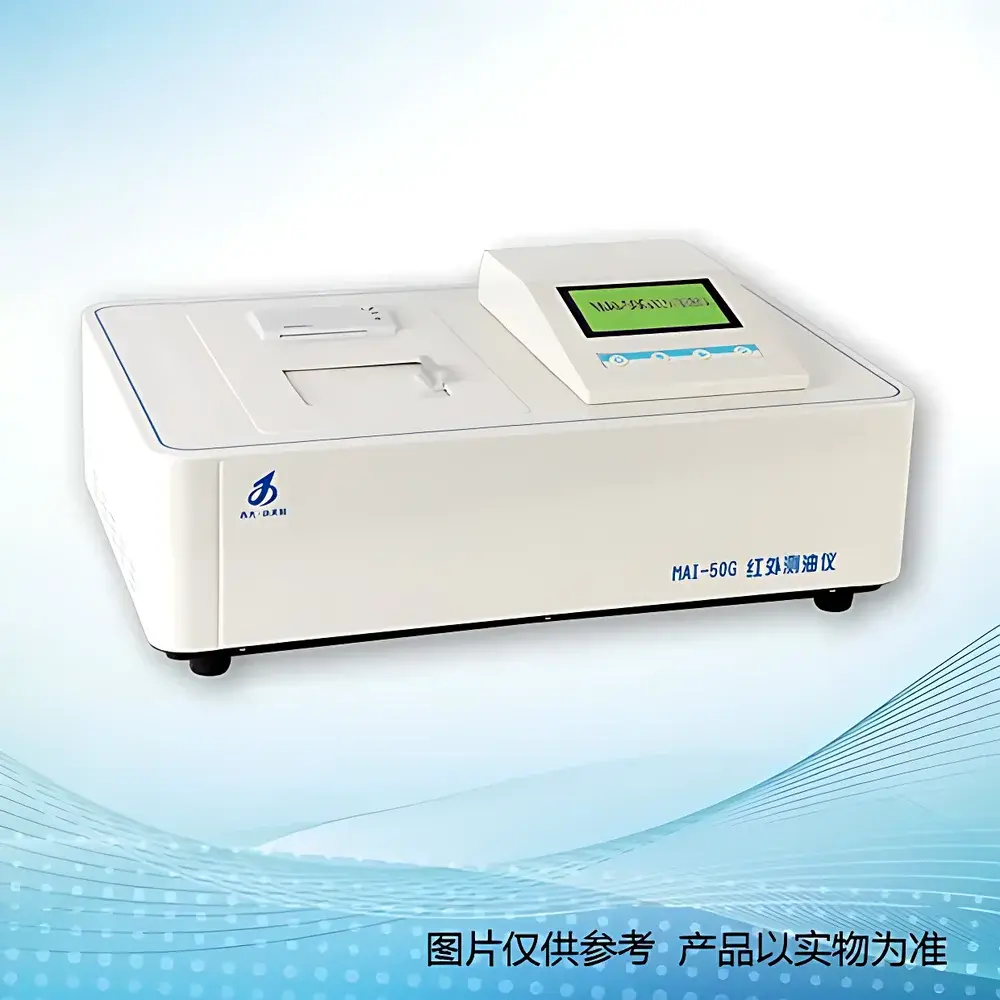
Jilin University Xiaotian’e MAI-50G Infrared Oil Content Analyzer for Third-Party Environmental Testing
| Brand | Jilin University Xiaotian'e |
|---|---|
| Origin | Jilin, China |
| Manufacturer Type | Direct Manufacturer |
| Regional Category | Domestic (China) |
| Model | MAI-50G |
| Price Range | USD 1,400–7,000 |
| Instrument Type | Benchtop Laboratory Analyzer |
| Measurement Principle | Infrared Spectrophotometry (Dual-Wavelength Absorption at C–H Stretching Bands) |
| Measurement Range | 0.0–80.0 mg/L |
| Detection Limit | 0.2 mg/L |
| Accuracy | ≤1.5% RSD (at 10 mg/L) |
| Wavenumber Range | 3400–2400 cm⁻¹ |
| Absorbance Range | 0.0000–2.0000 Abs |
| Wavenumber Accuracy | ±2 cm⁻¹ |
| Wavenumber Repeatability | ±2 cm⁻¹ |
| Baseline Drift | ≤±0.005 Abs / 30 min |
| Operating Temperature | 5–35 °C |
| Linearity Correlation Coefficient | R > 0.999 |
| Power Supply | AC 220 V ±10%, 50–60 Hz |
Overview
The Jilin University Xiaotian’e MAI-50G Infrared Oil Content Analyzer is a dedicated benchtop instrument engineered for precise quantification of hydrocarbon-based oils—including mineral oil, animal and vegetable oils, and total petroleum hydrocarbons (TPH)—in aqueous and semi-solid environmental matrices. It operates on the principle of infrared spectrophotometry, specifically measuring absorbance at characteristic C–H stretching vibration bands near 2930 cm⁻¹ (asymmetric CH₂), 2960 cm⁻¹ (asymmetric CH₃), and 2870 cm⁻¹ (symmetric CH₃), in accordance with the foundational methodology of GB/T 16488–1996. This dual- or triple-wavelength algorithm enables selective discrimination between aliphatic and aromatic contributions, supporting accurate determination of both extractable and total oil content in compliance with standard regulatory workflows for third-party environmental laboratories.
Key Features
- Compliance-ready optical architecture calibrated to national standard GB/T 16488–1996, facilitating direct integration into accredited testing protocols
- Integrated microprocessor control system with embedded real-time data acquisition, eliminating dependency on external PCs for routine operation
- High-contrast monochrome LCD display with full Chinese menu navigation and intuitive human-machine interface (HMI)
- Dual-channel analog-to-digital conversion with 16-bit resolution ensures stable baseline performance and low-noise signal processing
- Automated zero-point correction and background subtraction routines minimize operator-induced variability
- Onboard data management supports measurement logging, statistical analysis (mean, SD, RSD), and thermal printing without auxiliary software
- Robust mechanical design optimized for continuous use in ISO/IEC 17025-accredited laboratory environments
Sample Compatibility & Compliance
The MAI-50G is validated for use with liquid-phase samples including surface water, groundwater, municipal wastewater, industrial effluents, and solvent extracts from soil or wipe samples. With appropriate extraction (e.g., using CCl₄ or tetrachloroethylene per standard methods), it quantifies total extractable hydrocarbons (TEH) and differentiated oil fractions. While primarily aligned with Chinese national standards, its spectral methodology is functionally compatible with EPA Method 1664A (for n-hexane extractable material) and ISO 9377-2:2000 (petroleum hydrocarbons in water), provided wavelength alignment and calibration traceability are verified. Instrument documentation supports GLP-compliant recordkeeping, and audit trails for calibration events, user logins, and result exports can be manually archived for internal QA review.
Software & Data Management
The analyzer embeds firmware-level functionality for method setup, calibration curve generation (up to 6-point linear or quadratic regression), sample measurement, and report generation. All spectral data, calibration parameters, and measurement records are stored in non-volatile memory with timestamping. USB port enables export of CSV-formatted datasets for post-processing in Excel or LIMS-compatible platforms. Though no proprietary PC software is bundled, the device supports RS-232 serial communication for remote command execution and automated data streaming—enabling integration into centralized laboratory information management systems (LIMS) under controlled validation. Firmware updates are delivered via USB flash drive, maintaining version control and revision history in accordance with ISO/IEC 17025 clause 5.6.
Applications
- Regulatory monitoring of discharge permits under China’s《Environmental Protection Law》and local water quality standards (e.g., GB 3838–2002)
- Third-party verification testing for environmental impact assessments (EIAs) and pollution source declarations
- Quality control of pretreatment efficiency in oil-water separation units at municipal and industrial wastewater treatment plants
- Field-deployable lab support for emergency response to oil spills, where rapid TPH screening informs containment decisions
- Research-grade quantification of biodegradation kinetics in simulated aquatic microcosms
- Supporting ISO 14001 internal audits through documented, repeatable oil-in-water measurement capability
FAQ
Does the MAI-50G comply with international standards such as ISO or ASTM?
The instrument implements infrared absorption principles consistent with ISO 9377-2 and ASTM D7066, though formal certification requires site-specific method validation per ISO/IEC 17025.
Can it measure oil in solid or semi-solid matrices like soil or sludge?
Yes—when coupled with standardized solvent extraction (e.g., ultrasonic-assisted CCl₄ extraction per HJ 637–2018), the MAI-50G quantifies extractable oil content in solids.
Is the instrument suitable for unattended operation in a 24/7 testing lab?
It supports continuous operation within specified ambient conditions (5–35 °C, <80% RH), but lacks automated sample introduction; manual loading and extraction remain required.
How is traceability of calibration maintained?
Calibration is performed using certified reference materials (CRMs) traceable to NIM (National Institute of Metrology, China); certificate numbers and dates are manually logged in the onboard audit record.
What maintenance is required to ensure long-term accuracy?
Annual verification of wavenumber accuracy and photometric linearity using NIST-traceable polystyrene film and neutral density filters is recommended; optical path cleaning every 3 months prevents dust-induced drift.
Related Products







