
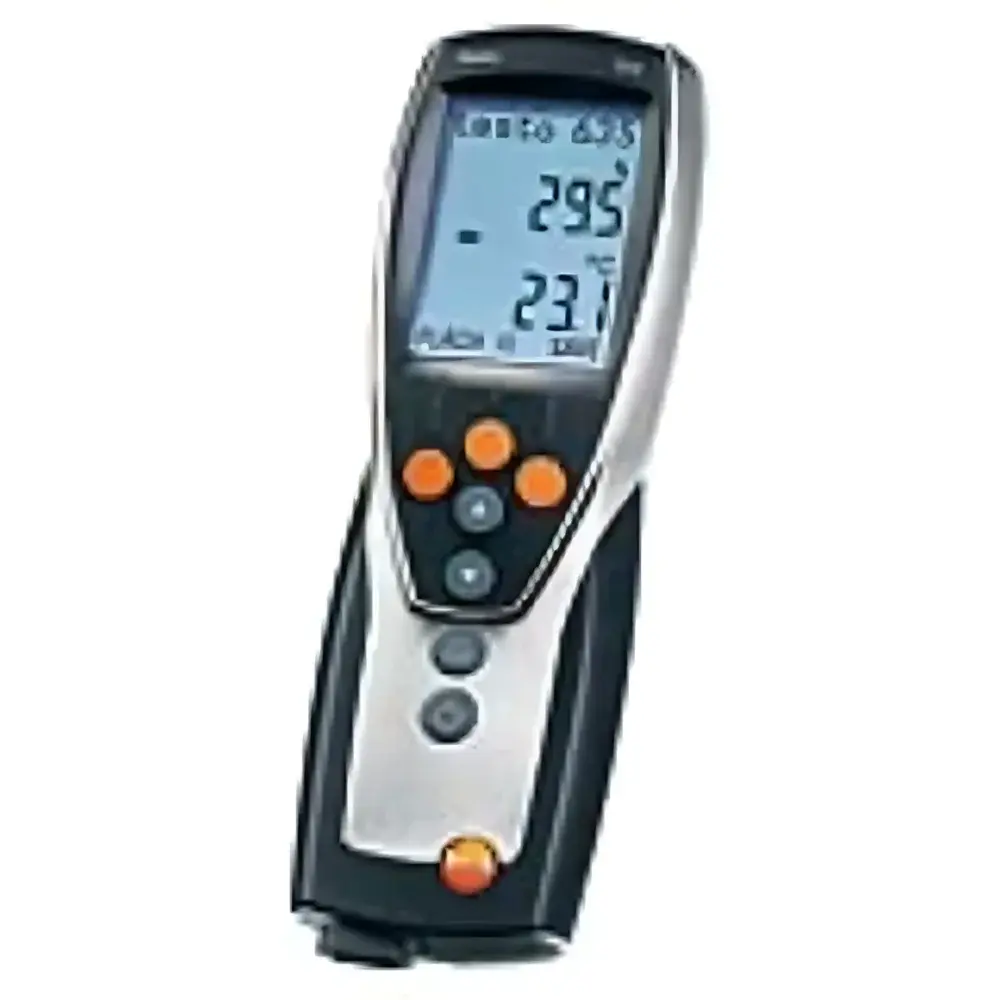
testo 635-1/2 Thermo-Hygrometer with Dual Probe Input and Pressure Dew Point Capability
| Brand | testo |
|---|---|
| Origin | Germany |
| Model | 0563 6352 |
| Instrument Type | Thermo-Hygrometer |
| Key Measurement Capabilities | Relative Humidity, Air Temperature, Surface Temperature, Center Temperature, Absolute Pressure, Pressure Dew Point, Calculated Dew Point, Dew Point Difference, Moisture Content (via probe), U-value (via optional calculation module) |
| Display | Backlit LCD with Max/Min/Avg Logging |
| Data Storage | Up to 10,000 readings |
| Interface | USB (PC connectivity), Optional IR Printer Support |
| Enclosure | ABS/TPE/Metal |
| Weight | 428 g |
| Dimensions | 220 × 74 × 46 mm |
| Operating Temperature | −20 °C to +50 °C |
| Battery | Alkaline, ~200 h lifetime |
| Storage Temperature | −30 °C to +70 °C |
Overview
The testo 635-1/2 thermo-hygrometer is a precision-engineered handheld instrument designed for simultaneous, high-fidelity environmental monitoring in industrial, commercial, and institutional settings. Built upon testo’s legacy of metrological rigor, the device operates on dual-sensor input architecture—supporting concurrent connection of two interchangeable probes—to enable real-time correlation of temperature, relative humidity, absolute pressure, and derived thermodynamic parameters including dew point, dew point difference, and moisture content. Its core measurement methodology integrates NTC thermistors (for air/surface temperature), capacitive polymer humidity sensors (IEC 60751-compliant calibration traceability), and piezoresistive absolute pressure transducers. This multi-parameter fusion allows quantitative assessment of condensation risk, thermal bridging, and hygrothermal performance—critical for HVAC commissioning, compressed air quality verification (ISO 8573-1 Class 2–4 compliance), museum climate control, cold chain validation, and building envelope diagnostics.
Key Features
- Dual-probe interface enabling simultaneous acquisition from two independent sensors—e.g., one humidity/temperature probe and one pressure dew point probe—without manual switching or recalibration.
- On-device calculation of dew point, dew point difference (between air and surface), and specific humidity/moisture content using psychrometric algorithms compliant with ASHRAE Fundamentals (Chapter 1) and ISO 16730-1.
- Backlit high-contrast LCD display with intuitive navigation; shows real-time values alongside user-selectable max/min/average statistics over defined intervals.
- Ruggedized housing combining ABS polymer, TPE elastomer bumpers, and metal-reinforced mounting points—rated for drop resistance up to 1 m (IEC 60529 IP54 equivalent for dust/water ingress protection).
- Extended data logging capacity: internal memory stores up to 10,000 timestamped measurements, organized by customizable location tags and user-defined measurement programs.
- USB interface for direct PC synchronization; compatible with testo’s official software suite supporting GLP/GMP-compliant reporting, trend visualization, and audit-trail generation (21 CFR Part 11-ready when used with signed digital certificates).
Sample Compatibility & Compliance
The testo 635-1/2 interfaces exclusively with certified testo probe families—including Class A NTC sensors (DIN EN 60751), Type K thermocouples (IEC 60584-1), capacitive RH sensors (calibrated per ISO 17025-accredited procedures), and stainless-steel absolute pressure modules (0–2000 hPa full scale). It supports field deployment across diverse sample media: ambient indoor air, compressed air lines (oil-free and lubricated), chilled water piping surfaces, insulation layers, concrete substrates, archival storage enclosures, and server rack intakes. Regulatory alignment includes conformity with EU Directive 2014/30/EU (EMC), 2011/65/EU (RoHS), and essential requirements of the Measuring Instruments Directive (MID) for portable environmental meters. Calibration documentation follows ISO/IEC 17025 guidelines, with factory certificates traceable to PTB (Physikalisch-Technische Bundesanstalt).
Software & Data Management
Data export and analysis are facilitated via testo’s proprietary PC software, which imports .csv and native .tdf files through USB. The software enables spectral time-series plotting, statistical summary generation (mean, SD, CPK), automatic report templating (PDF/Excel), and metadata tagging (operator ID, location ID, project code). For regulated environments, optional digital signature modules support electronic record integrity per FDA 21 CFR Part 11 Annex 11 requirements. Field printing is supported via optional testo infrared thermal printer (model 0554 0010), offering configurable cycle intervals (1 min to 24 h) and header/footer customization—including company logo insertion and GLP-compliant footer fields (date/time, operator, probe serial number). All stored data retain full traceability: each reading embeds probe identification, sensor type, calibration due date, and environmental context flags.
Applications
- Compressed air system qualification: pressure dew point verification against ISO 8573-1 purity classes for pharmaceutical, food processing, and electronics manufacturing.
- Building physics diagnostics: detection of interstitial condensation risk via dew point difference mapping across façade assemblies and roof structures.
- Cultural heritage preservation: continuous monitoring of microclimates in museums, archives, and conservation labs to maintain RH stability within ±5 %RH tolerance bands.
- Pharmaceutical warehouse validation: temperature/humidity uniformity mapping per WHO TRS 961 Annex 9 and EU GDP Chapter 9 requirements.
- Data center thermal management: hotspot identification using surface temperature differentials and dew point margin analysis to prevent condensation on cooling coils or server intakes.
- Industrial hygiene assessments: quantification of thermal comfort indices (PMV/PPD) and mold growth probability thresholds per VDI 2089 and ASHRAE Standard 55.
FAQ
Does the testo 635-1/2 require mandatory annual recalibration?
No mandatory annual recalibration is stipulated by regulation; however, testo recommends biannual verification against NIST-traceable references for applications requiring ISO/IEC 17025 compliance or GxP adherence.
Can the device calculate U-values directly?
U-value calculation is not performed onboard; however, exported temperature gradient and surface emissivity data can be imported into third-party building physics tools (e.g., Therm, WUFI) for dynamic U-value derivation.
Is the IR printer compatible with non-testo thermal paper?
Only testo-certified thermal paper (ref. 0554 0011) ensures consistent print density, archival stability (>10 years), and chemical resistance to UV and plasticizer migration.
What is the maximum sampling interval for continuous logging?
The shortest programmable logging interval is 1 second; maximum duration per session is constrained only by available memory (10,000 entries) and battery life.
Are probe calibration certificates included with purchase?
Factory calibration certificates (with uncertainty budgets) are provided for all bundled probes; field-serviceable probes may be recalibrated at testo-accredited service centers with ISO/IEC 17025 scope accreditation.



