
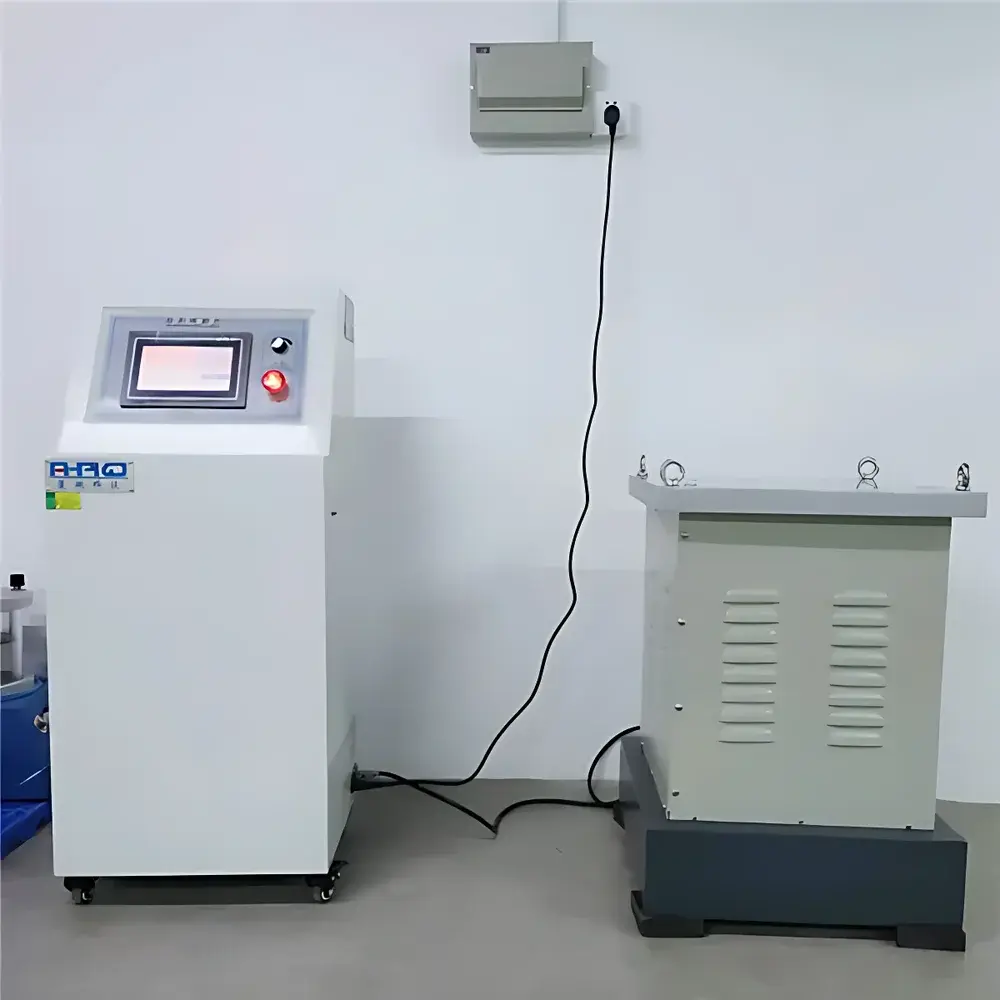
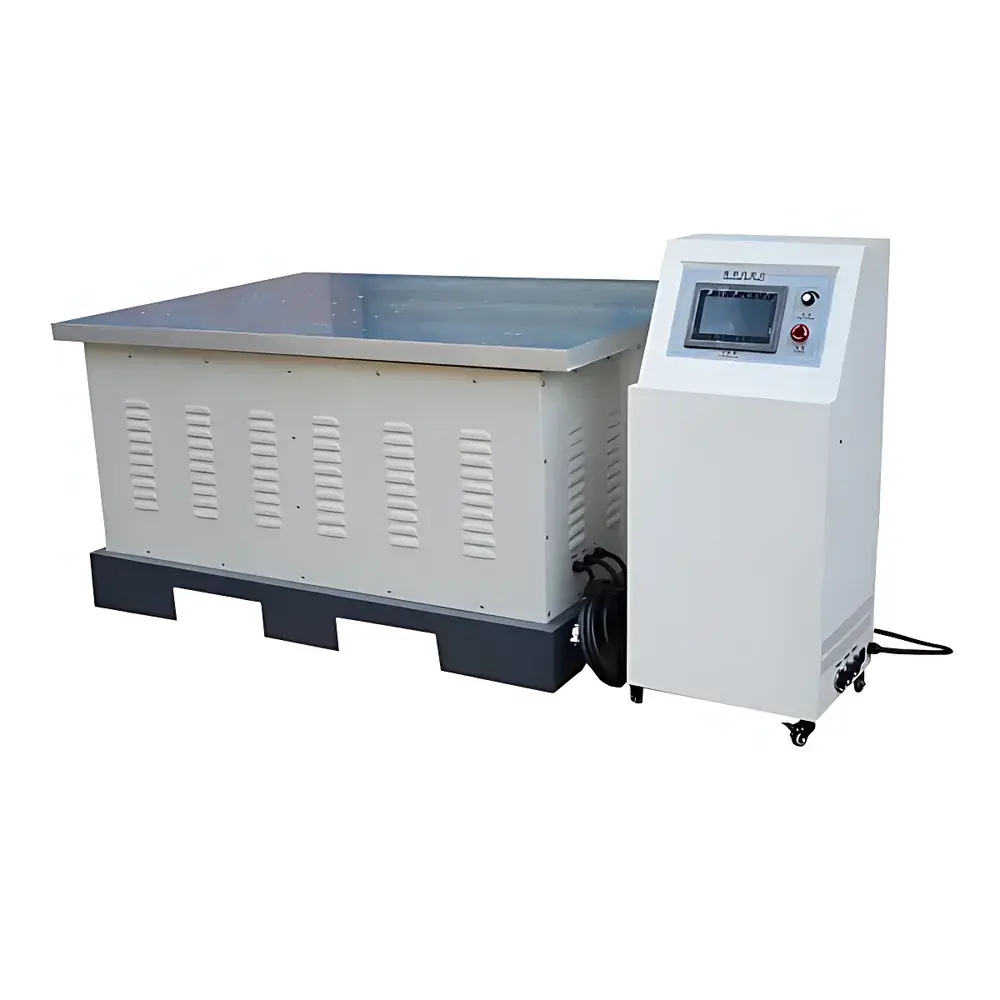
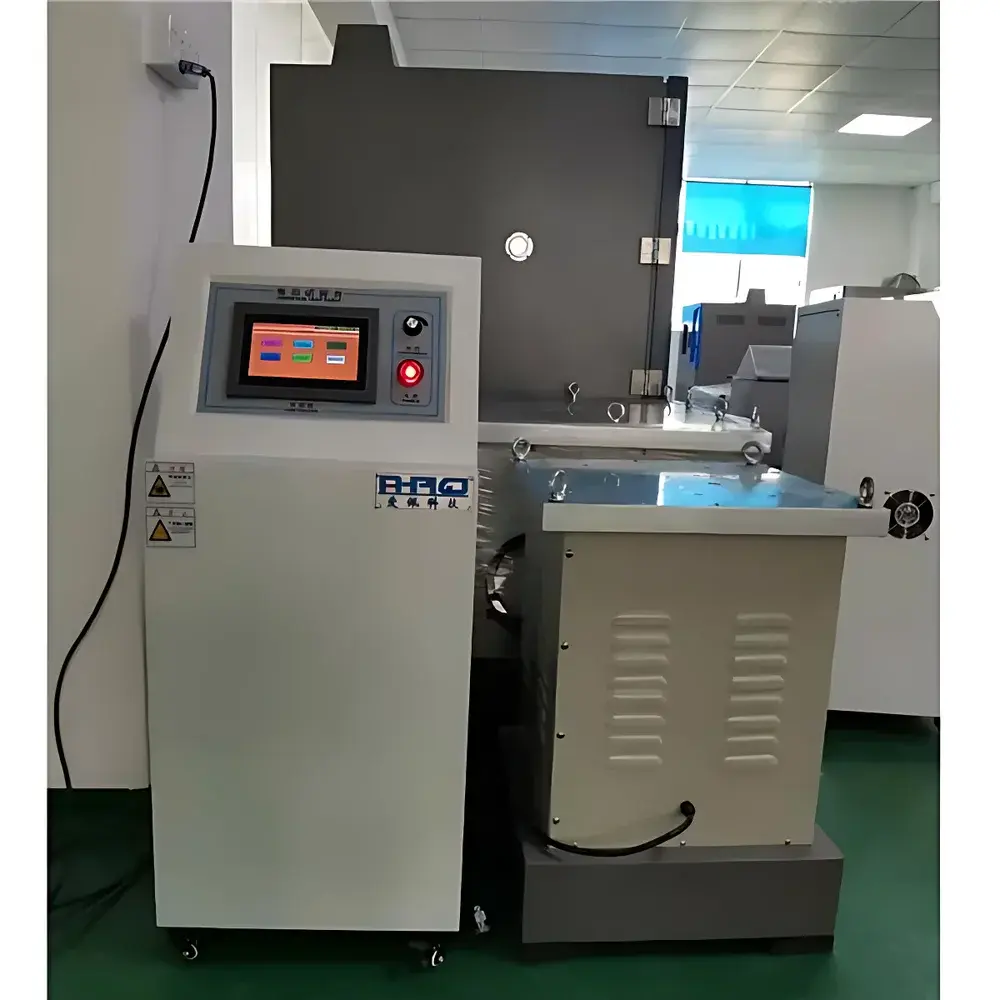
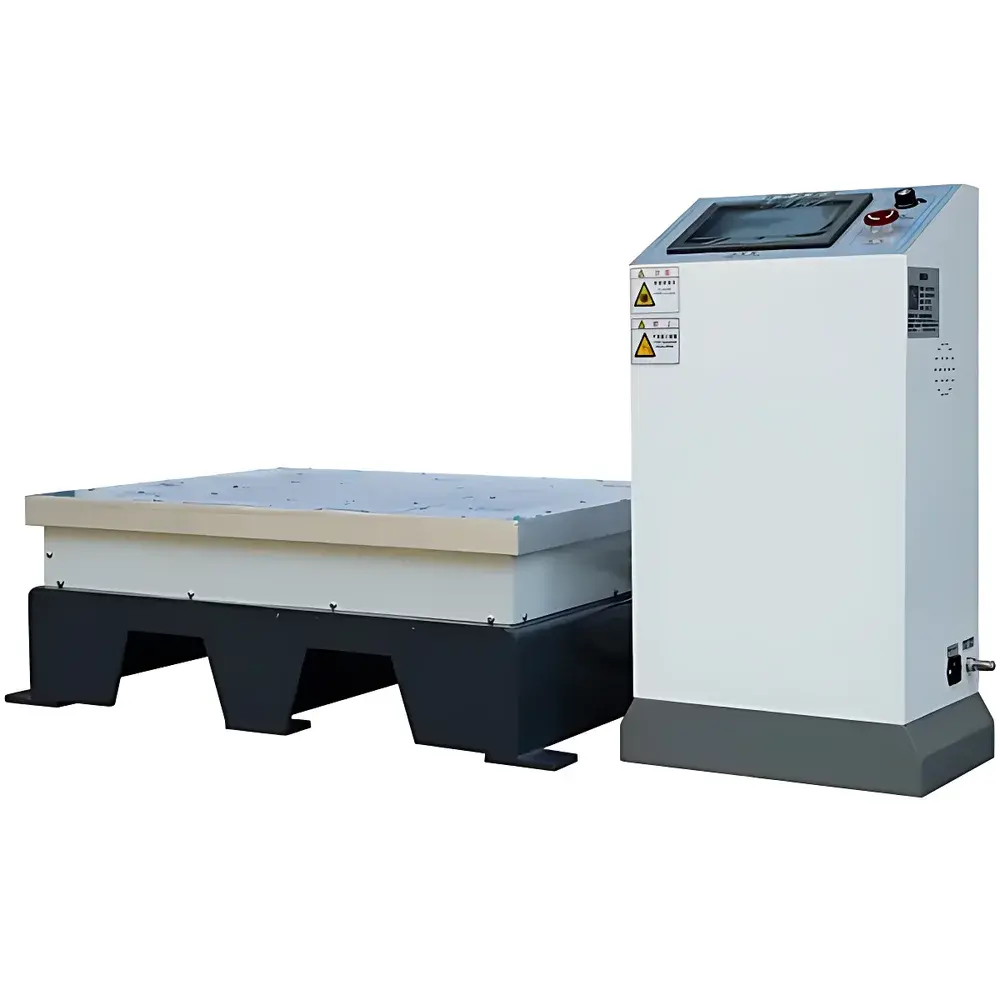
Apkji AP-ZD-50XYZ Electromagnetic Triaxial Vibration Test System
| Brand | Apkji |
|---|---|
| Origin | Guangdong, China |
| Manufacturer Type | OEM Manufacturer |
| Model | AP-ZD-50XYZ |
| Frequency Range | 5–600 Hz |
| Max Load Capacity | 100 kg |
| Acceleration | 20 g |
| Amplitude | 0–5 mm (requires optional accelerometer for real-time display) |
| Vibration Axes | X, Y, Z (simultaneous triaxial excitation) |
| Waveform | Sinusoidal |
| Control Interface | Industrial-grade color touchscreen HMI |
| Power Supply | 220 V / 50 Hz ±5% |
| Power Consumption | 3.5 kVA |
| Cooling Method | Forced-air cooling |
| Compliance Standards | ISO 2247, ISO 13355, IEC 60068-2-6, ASTM D999, ASTM D4728, ASTM D3580, GB/T 4857, GB/T 2423 |
Overview
The Apkji AP-ZD-50XYZ Electromagnetic Triaxial Vibration Test System is an engineered solution for controlled mechanical vibration simulation in product reliability and structural integrity validation. Based on electromagnetic excitation principles—where a moving coil interacts with a static magnetic field to generate precise, repeatable inertial forces—the system delivers high-fidelity sinusoidal motion across three orthogonal axes (X, Y, Z) simultaneously. Unlike electrodynamic shakers limited to single-axis operation or hydraulic systems requiring complex infrastructure, this platform integrates compact electromagnetic actuation with advanced digital control architecture to support early fault detection, design verification, and transport simulation per international environmental test standards. It is widely deployed in aerospace component qualification, automotive ECU durability assessment, consumer electronics drop-and-vibration resilience testing, and military-grade packaging validation—serving as a critical tool in Design for Reliability (DfR) workflows and pre-compliance screening prior to formal certification.
Key Features
- Triaxial simultaneous vibration capability (X+Y+Z) with phase-synchronized excitation, ensuring realistic multi-directional stress application without mechanical coupling artifacts.
- Programmable frequency sweep (logarithmic, linear, stepped), fixed-frequency dwell, resonance search, and random vibration modes—all compliant with IEC 60068-2-64 for broadband excitation profiles.
- Electronically adjustable amplitude (0–5 mm peak-to-peak) with closed-loop feedback enabled via optional piezoelectric accelerometers for traceable displacement calibration.
- Integrated anti-electromagnetic-interference circuitry isolates the control logic from high-current drive stages, eliminating signal drift and ensuring long-term frequency stability (<±0.1 Hz accuracy over 100-hour continuous operation).
- Four-point synchronous excitation mechanism ensures uniform modal distribution across the 500 mm × 500 mm stainless-steel test table—validated by laser Doppler vibrometry per ISO 10816-3.
- Industrial HMI with 7-inch capacitive touchscreen provides real-time graphical display of frequency spectra, time-domain waveforms, and active test program status—including live curve plotting during sweep execution.
Sample Compatibility & Compliance
The AP-ZD-50XYZ accommodates test specimens up to 100 kg mass with center-of-gravity height ≤150 mm above the table surface. Its rigid aluminum-alloy frame and precision-machined mounting interface support ISO 5344-compliant fixture integration. The system meets regulatory requirements for vibration test documentation under GLP and GMP environments, including audit-ready test logs with timestamped parameter records, user authentication, and electronic signature support. All operational modes align with mandatory clauses of ASTM D999 (shipboard container simulation), ISO 2247 (fixed-frequency vertical vibration of packed goods), and IEC 60068-2-6 (sinusoidal vibration testing of electrotechnical products). Optional PC-based software enables full 21 CFR Part 11 compliance for pharmaceutical and medical device manufacturers requiring electronic record integrity.
Software & Data Management
The proprietary UTM-Z023 control software—developed in-house using CIMS+FCS architecture—operates on deterministic real-time Linux kernel extensions to guarantee sub-millisecond command latency. It supports dual-mode operation: standalone HMI control and networked PC supervision via Ethernet TCP/IP. Data acquisition includes synchronized acceleration, velocity, displacement, and drive current traces at configurable sampling rates (up to 51.2 kHz). Export formats include CSV, MATLAB (.mat), and universal HDF5 for third-party analysis in MATLAB, Python (SciPy), or NI DIAdem. Audit trails capture all parameter changes, operator IDs, and session start/stop events—retained for ≥10 years with automated backup to NAS or cloud storage. Firmware updates are delivered remotely with SHA-256 verified package integrity checks.
Applications
- Aerospace: Qualification of avionics enclosures, satellite subsystems, and UAV components against MIL-STD-810H Method 514.8 vibration profiles.
- Automotive: Validation of infotainment modules, ADAS sensors, and battery management systems per LV-124 and GMW14872 specifications.
- Consumer Electronics: Structural fatigue assessment of smartphones, wearables, and IoT gateways under simulated transit conditions (ASTM D4728 Class B random vibration).
- Packaging Engineering: Performance evaluation of corrugated shipping containers, palletized unit loads, and temperature-controlled logistics solutions per ISTA 3A and ISO 13355.
- Industrial Equipment: Endurance testing of industrial controllers, motor drives, and robotic end-effectors subjected to factory-floor vibrational environments.
FAQ
Does the system support real-time closed-loop amplitude control?
Yes—when equipped with optional IEPE-type accelerometers and calibrated charge amplifiers, the system performs real-time amplitude regulation with ±1.5% linearity across the full 5–600 Hz range.
Can test programs be exported and shared between multiple units?
Yes—UTM-Z023 uses XML-based program files compatible across all AP-ZD series instruments, enabling standardized test method replication across global R&D labs.
Is the controller compatible with external data acquisition systems?
Yes—via analog voltage outputs (±10 V) for acceleration, velocity, and displacement signals, plus TTL-triggered digital I/O for synchronization with high-speed cameras or oscilloscopes.
What maintenance intervals are recommended for sustained metrological accuracy?
We recommend biannual calibration verification using NIST-traceable reference accelerometers and annual inspection of voice-coil alignment and suspension integrity per Apkji Service Bulletin SB-VIB-2023.
Does the system meet CE marking requirements for EMC and safety?
Yes—the AP-ZD-50XYZ carries full CE marking under Directive 2014/30/EU (EMC) and 2014/35/EU (LVD), with test reports available upon request.



