
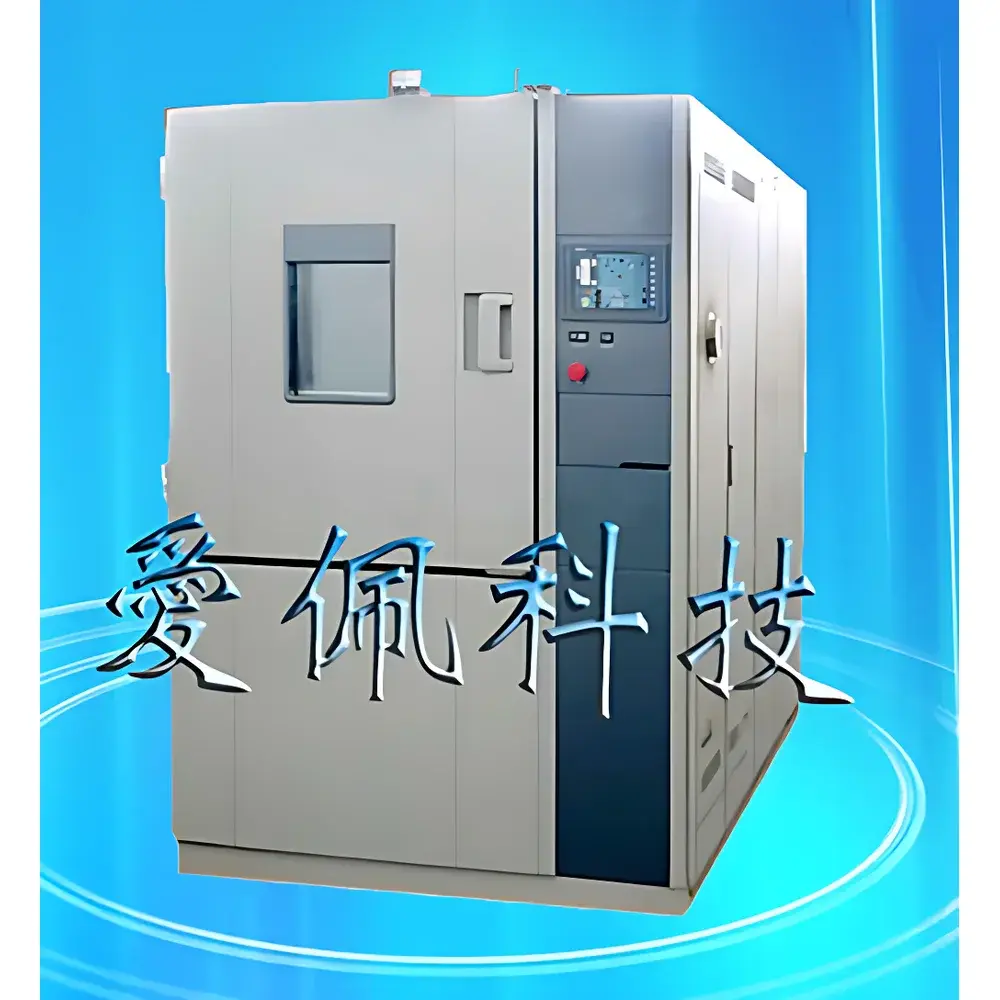
AP-KS-225 Linear Rapid Temperature Cycling Chamber (Manufactured by Aipei Technology / APKJ)
| Brand | Aipei Technology / APKJ |
|---|---|
| Origin | Guangdong, China |
| Manufacturer Type | Direct Manufacturer |
| Country of Origin | China |
| Model | AP-KS-225 |
| Pricing | Upon Request |
Overview
The AP-KS-225 Linear Rapid Temperature Cycling Chamber is an engineered environmental test system designed for precise, programmable thermal stress profiling in reliability validation and accelerated life testing of electronic components, PCB assemblies, semiconductor devices, and automotive electronics. It operates on a linear ramp-and-soak thermal control principle—enabling user-defined, constant-rate temperature transitions (e.g., ±3 °C/min, ±5 °C/min, or custom profiles) between preset high- and low-temperature setpoints. Unlike conventional thermal chambers with fixed heating/cooling rates, the AP-KS-225 delivers traceable, repeatable linear thermal gradients essential for Temperature Cycling Test (TCT) per JEDEC JESD22-A104, IPC-9701, and MIL-STD-810H Method 503.4. Its integrated chamber architecture supports both steady-state thermal exposure and dynamic thermal cycling under controlled air circulation, making it suitable for applications ranging from HALT/HASS pre-screening to qualification-level environmental stress screening (ESS).
Key Features
- Linear ramp rate control: Programmable temperature transition rates (e.g., 1–10 °C/min), fully adjustable via embedded controller; ramp linearity maintained within ±0.3 °C/min tolerance across full operating range.
- Modular monocoque construction: Tool-free access panels, boltless interior assembly, and front-serviceable components reduce maintenance downtime and simplify calibration verification.
- Dual-seal observation window: Tempered double-glazed viewport with anti-fog heating element and silicone gasketing ensures optical clarity and thermal integrity during extreme cycling.
- High-efficiency dual-loop air circulation: Top-mounted dual centrifugal blowers (redundant configuration) drive laminar airflow at ≥1.2 m/s across work volume; uniformity maintained at ±1.5 °C (at 100 L load).
- Industrial-grade refrigeration: Hermetically sealed scroll compressor (imported), R404A/R23 cascade system, and copper-aluminum finned evaporator ensure stable sub-zero operation down to –70 °C with rapid recovery after door opening.
- Corrosion-resistant chamber interior: Electropolished SUS304 stainless steel working chamber (seam-welded, passivated), non-porous surface compliant with ISO 14644-1 Class 8 cleanroom handling requirements.
Sample Compatibility & Compliance
The AP-KS-225 accommodates standard test fixtures including DUT trays, thermal interface material (TIM) sample holders, and PCB racks up to 450 mm × 450 mm × 450 mm (W×D×H). It supports non-standard payload configurations via optional mounting rails and internal power feedthroughs (up to 240 VAC/10 A). The chamber meets structural and operational requirements for IEC 60068-2-1 (Cold), IEC 60068-2-2 (Dry Heat), and IEC 60068-2-14 (Change of Temperature). Its control firmware and data logging architecture are compatible with GLP/GMP audit trails when paired with optional external validation packages. While not certified to UL/CSA as a standalone appliance, it complies with EN 61000-6-2 (immunity) and EN 61000-6-4 (emissions) for laboratory installation environments.
Software & Data Management
The chamber integrates a 7-inch resistive touchscreen HMI running embedded Linux-based control firmware with real-time PID tuning and multi-segment profile scheduling. Standard USB-C and RS485 interfaces enable connection to host PCs for remote monitoring and data export (CSV, XML). Optional Ethernet/Wi-Fi module supports Modbus TCP and OPC UA protocols for integration into MES or LabVantage systems. All temperature logs include timestamp, setpoint, actual chamber reading, ramp rate deviation, and alarm history—retained for ≥30 days onboard. Audit trail functionality (user login, parameter changes, cycle start/stop events) satisfies FDA 21 CFR Part 11 requirements when used with validated third-party software extensions.
Applications
- Temperature cycling qualification per JEDEC JESD22-A104D (–65 °C to +150 °C, 1000 cycles)
- Electronic component burn-in and early-life failure screening (ESS)
- Thermal fatigue evaluation of solder joints, wire bonds, and encapsulants
- Material coefficient of thermal expansion (CTE) characterization support
- Pre-compliance testing for automotive AEC-Q200 stress categories
- Research-grade thermal aging studies in polymer, battery, and optoelectronic materials
FAQ
What temperature range does the AP-KS-225 support?
Standard configuration: –70 °C to +180 °C. Extended ranges (e.g., –80 °C or +200 °C) available upon non-standard customization.
Can ramp rates be validated and documented per ISO/IEC 17025?
Yes—when used with NIST-traceable thermocouple probes and calibrated DAQ systems, ramp linearity and thermal uniformity can be verified and reported per ISO 17025 Annex A.3.
Is the chamber suitable for humidity-enabled thermal cycling?
No—the AP-KS-225 is a dry-air thermal cycling chamber. For combined temperature/humidity profiles, refer to the AP-KSH series.
Does the system support automated test sequencing across multiple chambers?
Yes—via optional centralized control software (AP-TCMS), enabling synchronized multi-chamber profiles and cross-unit data aggregation.
What is the typical lead time for non-standard configurations?
12–16 weeks from PO confirmation, depending on complexity of mechanical and control modifications.



