
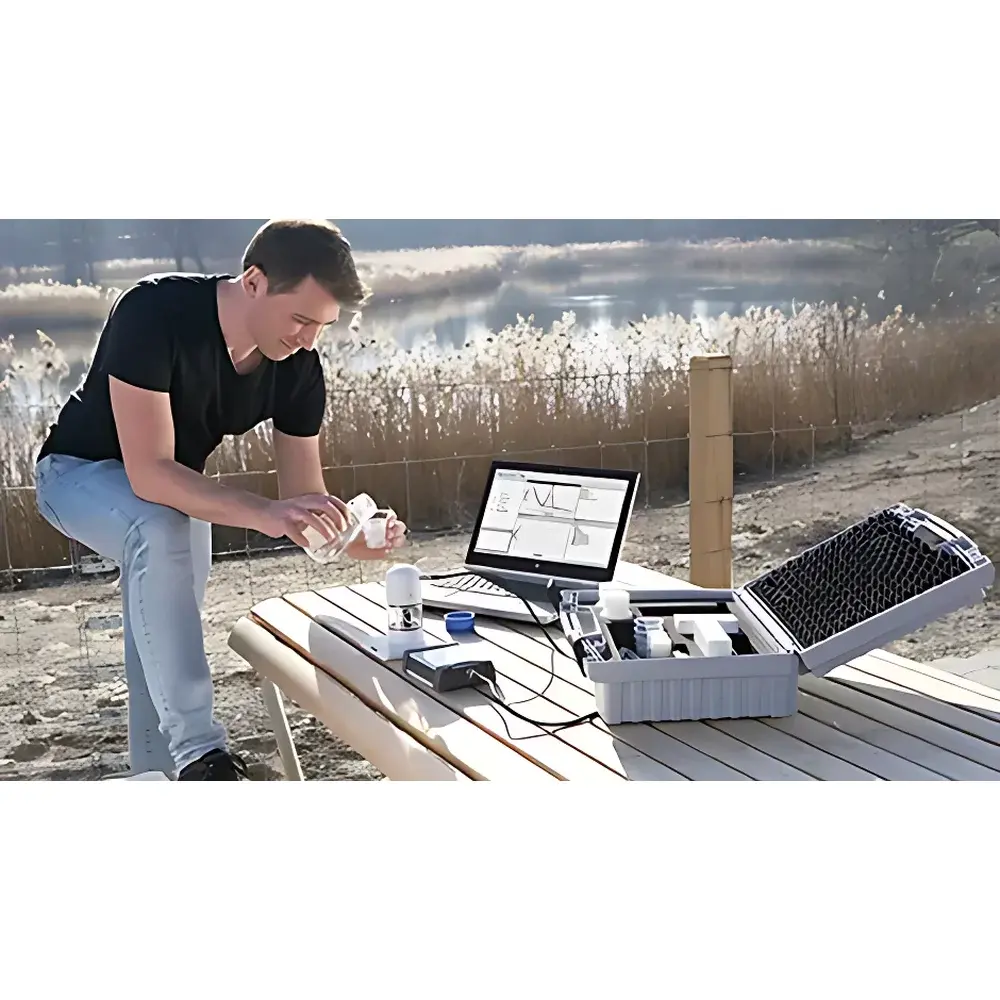
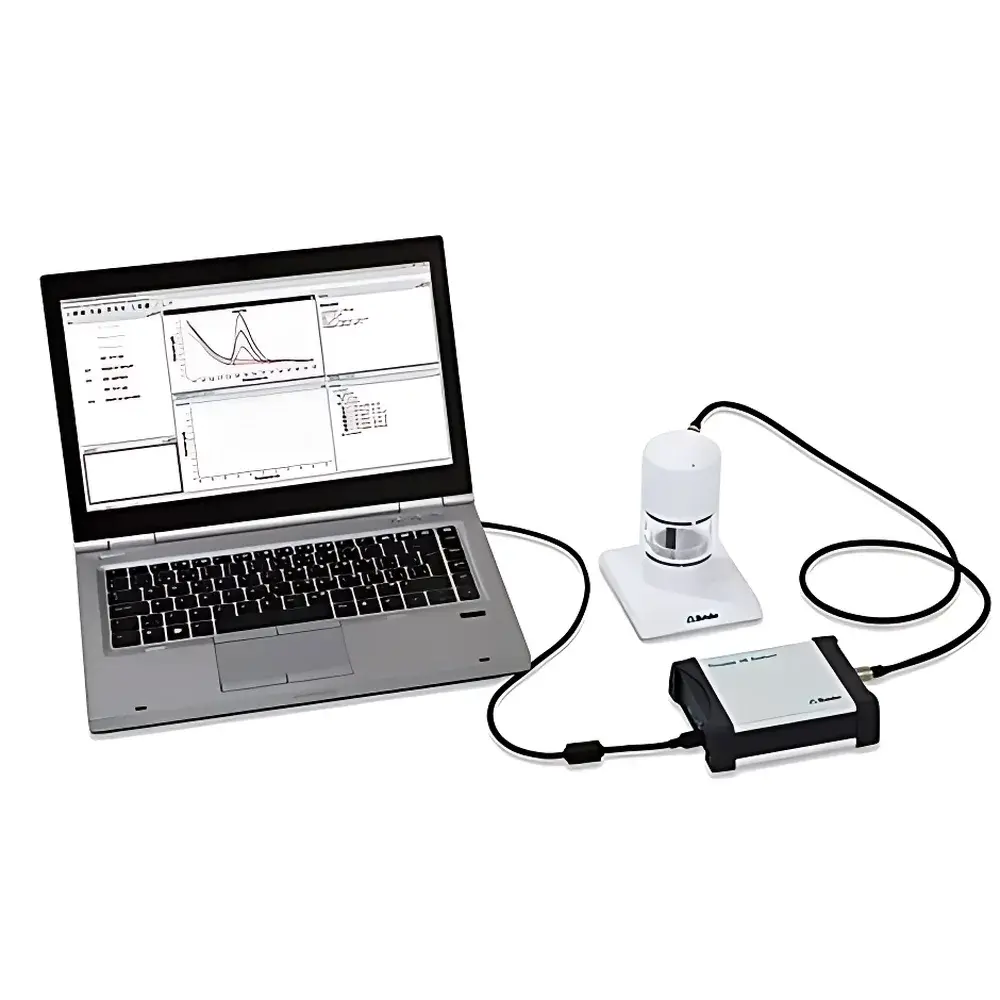
Metrohm 946 Portable Voltammetric Analyzer for Heavy Metals in Water
| Brand | Metrohm |
|---|---|
| Origin | Switzerland |
| Manufacturer | Metrohm AG |
| Instrument Type | Portable |
| Detection Principle | Anodic Stripping Voltammetry (ASV) |
| Detectable Metals | As, Hg, Cu, Pb, Cd, Zn, Fe, Ni, Co, Mn, Bi, Sb, Tl, Cr, Se, Te |
| Analysis Time | <5 minutes per sample |
| Current Range Accuracy | ±0.025% |
| Potential Resolution | ±0.2 mV |
| Electrode Options | scTRACE Gold electrode or disposable screen-printed electrodes (SPE) |
| Power Supply | Rechargeable Li-ion battery |
| Compliance | Designed to meet WHO drinking water guideline requirements for heavy metals |
| Software | Integrated VA software with pre-validated ASTM/ISO-aligned methods |
Overview
The Metrohm 946 Portable Voltammetric Analyzer is a field-deployable electrochemical instrument engineered for rapid, on-site quantification of trace-level heavy metals in aqueous matrices. Based on the well-established principle of anodic stripping voltammetry (ASV), the system enables sensitive and selective detection of up to 16 elements—including As(III), Hg(II), Cu(II), Pb(II), Cd(II), Zn(II), Ni(II), Co(II), Mn(II), Bi(III), Sb(III), Tl(I), Cr(III), Se(IV), and Te(IV)—directly in environmental, municipal, and industrial water samples. Unlike benchtop ICP-MS or AAS systems requiring laboratory infrastructure, the 946 delivers laboratory-grade data at the point of sampling: no external power, no gas supply, and no fume hood required. Its compact, ruggedized design—enclosed in a custom transport case with integrated reagent holders, electrode storage, and a high-capacity lithium-ion battery—ensures operational readiness under variable field conditions. The analyzer complies with measurement performance expectations aligned with WHO Guidelines for Drinking-water Quality and supports method development consistent with ASTM D3559 (for Pb), ASTM D5173 (for Cd, Cu, Pb, Zn), and ISO 11969 (electrochemical determination of heavy metals in water).
Key Features
- True portability: Fully self-contained unit with integrated battery (up to 10 hours continuous operation), lightweight chassis (<3.2 kg), and IP54-rated enclosure for dust/moisture resistance
- Dual-electrode flexibility: Interchangeable scTRACE Gold solid-state working electrode (optimized for broad linear dynamic range and long-term stability) and disposable screen-printed electrodes (SPEs) with pre-deposited bismuth or mercury films for cost-sensitive, high-throughput screening
- Plug-and-play electrode interface: Smart connector system ensures automatic electrode recognition, calibration parameter loading, and electrical contact verification—no manual configuration required
- Precision electrochemistry: Potentiostat with ±0.2 mV potential resolution and current measurement accuracy of ±0.025% across 10 pA–10 mA range, enabling sub-pptr detection limits (e.g., 0.05 µg/L for Pb and Cd in deionized water)
- Pre-validated method library: Embedded software includes over 25 application-specific ASV protocols, each configured with optimized deposition time, scan rate, pulse amplitude, and background correction algorithms
Sample Compatibility & Compliance
The 946 analyzer accepts untreated or minimally filtered (0.45 µm) liquid samples—including surface water, groundwater, seawater, wastewater effluents, leachates, and potable water—with minimal pretreatment (pH adjustment and supporting electrolyte addition only). It accommodates sample volumes from 10 to 50 mL and operates effectively across salinities up to 35 g/L (seawater equivalent). All analytical procedures adhere to principles outlined in ISO/IEC 17025 for testing laboratories; method validation reports include documented linearity (R² ≥ 0.999), repeatability (RSD ≤ 3.5% at 10× LOD), and spike recovery (85–115% across matrix types). The system supports GLP-compliant data handling through audit-trail-enabled software, meeting FDA 21 CFR Part 11 requirements for electronic records and signatures when used with optional secure user authentication.
Software & Data Management
The dedicated VA Control software runs natively on Windows-based tablets or laptops connected via USB-C. It provides real-time voltammogram visualization, automated peak identification using derivative-based algorithms, and quantitative analysis via standard addition or external calibration. All raw data (current vs. potential curves), processed results, metadata (operator ID, GPS coordinates, timestamp, electrode lot number), and QC parameters are stored in encrypted .vad files compliant with ISO 27001 information security standards. Export options include CSV, PDF analytical reports, and direct integration into LIMS via ODBC drivers. Firmware updates and method libraries are distributed through Metrohm’s secure customer portal—no internet connection required during field use.
Applications
- Environmental monitoring: Rapid assessment of metal contamination in rivers, lakes, aquifers, and soil pore water; compliance verification against EU Water Framework Directive (WFD) and US EPA Region 10 criteria
- Municipal water safety: On-the-spot verification of finished drinking water quality, especially following distribution system disturbances or source water events
- Industrial discharge control: Real-time monitoring of effluent streams from electroplating, mining, battery recycling, and semiconductor manufacturing facilities
- Forensic toxicology: Field-based screening of biological fluids or environmental evidence for heavy metal poisoning investigations
- Food & beverage safety: Screening of mineral waters, vinegars, soy sauces, and infant formula for regulated contaminants per Codex Alimentarius standards
FAQ
What sample preparation is required prior to analysis?
Minimal preparation: adjust pH to 4.0–4.5 using acetate buffer, add supporting electrolyte (e.g., 0.01 M KCl), and optionally filter through a 0.45 µm membrane if particulates are present.
Can the instrument quantify multiple metals simultaneously?
Yes—multi-element ASV allows simultaneous detection of up to 8 metals in a single run (e.g., Cd, Pb, Cu, Zn, Tl, In, Bi, Sb), depending on peak separation and matrix interferences.
How often must electrodes be replaced or recalibrated?
scTRACE Gold electrodes typically last >500 measurements with routine cleaning; SPEs are single-use. Calibration is performed before each batch using certified multi-element standards traceable to NIST SRMs.
Is method validation documentation available?
Yes—Metrohm provides full validation packages per ISO/IEC 17025, including LOQ/LOD studies, robustness testing, and inter-laboratory comparison reports upon request.
Does the system support regulatory reporting formats?
Yes—PDF reports include instrument ID, analyst signature, uncertainty estimation per GUM, and compliance statements referencing WHO, EPA, or EU directives as selected by the user.
Related Products







