
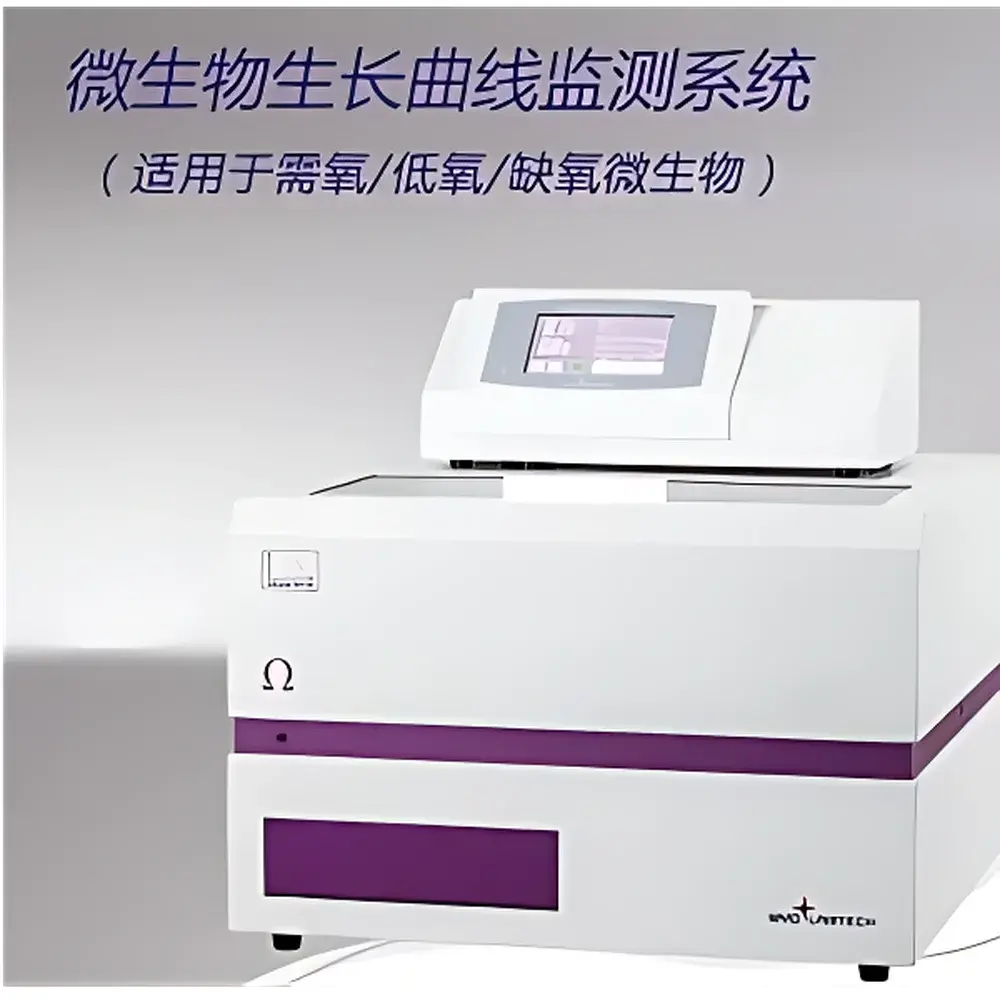
BMG LABTECH Micro-GCM omega Microorganism Growth Curve Monitoring System
| Brand | BMG LABTECH |
|---|---|
| Origin | Germany |
| Model | Micro-GCM omega |
| Detection Modes | Absorbance (220–1000 nm), Fluorescence (up to 8 channels), Luminescence |
| Temperature Control | Ambient +4 °C to 45 °C (optional up to 65 °C), ±0.1 °C accuracy, sandwich dual-zone heating |
| Humidity Control | Compatible with specialized breathable, anti-evaporation microplate sealing films |
| Gas Control | Atmospheric Control Unit (ACU) for independent or coupled regulation of O₂ (0.1–20%) and CO₂ (0.1–20%) |
| Shaking | Linear, orbital, or dual-orbital |
| Detection Speed | <1 second per well for full-spectrum absorbance (220–1000 nm) |
| Plate Formats | 6–384-well microplates |
| Software | Preconfigured assay templates, kinetic data acquisition, GLP-compliant audit trail, EC₅₀/IC₅₀ fitting, 4-parameter logistic regression, standard curve generation |
| Automation | Dual high-precision injectors (min. 3 µL injection volume, dead volume <30 µL, up to 4 injections/well with simultaneous read) |
Overview
The BMG LABTECH Micro-GCM omega is a fully integrated, automated microplate-based system engineered for real-time, label-free monitoring of microbial growth kinetics and parallel metabolic activity under precisely controlled environmental conditions. Unlike conventional optical density (OD)-based endpoint assays or manual sampling workflows, the Micro-GCM omega applies continuous, non-invasive photometric and fluorometric detection within sealed microplates—eliminating contamination risk, minimizing operator intervention, and preserving physiological relevance across extended incubation periods (hours to days). Its core measurement principle relies on high-speed, wavelength-flexible absorbance spectroscopy (220–1000 nm) to quantify biomass accumulation (e.g., OD600) and metabolite-specific absorbance shifts, complemented by multi-channel fluorescence and ultrasensitive luminescence detection for reporter gene expression and ATP-based viability assessment. The system is purpose-built for applications requiring dynamic response profiling under modulated temperature, gas composition, humidity, and pharmacological stimuli—making it essential for mechanistic microbiology, antimicrobial susceptibility testing (AST), bioprocess optimization, and host-microbe interaction studies.
Key Features
- Dual-zone thermal architecture: Independent top and bottom heating elements maintain uniform thermal gradients (top setpoint +0.5 °C above base) to suppress condensation and evaporation during prolonged incubations; temperature range spans ambient +4 °C to 45 °C (extendable to 65 °C with optional module), with stability ±0.1 °C.
- Atmospheric Control Unit (ACU): Programmable regulation of O₂ (0.1–20%) and CO₂ (0.1–20%) in single- or dual-gas mode, enabling precise simulation of aerobic, microaerophilic, and anaerobic environments—critical for gut microbiota, Campylobacter, or obligate anaerobe cultivation.
- Triple-mode shaking system: Selectable linear, orbital, or proprietary dual-orbital motion; speed tunable 100–1100 rpm; programmable onset timing and duration; engineered to prevent cell sedimentation while minimizing shear stress on sensitive cultures.
- Ultra-rapid full-spectrum absorbance: Patented optics acquire complete 220–1000 nm spectra in <1 second per well—enabling high-temporal-resolution OD kinetics, endotoxin quantification (via ratio-metric 260/320 nm or 280/340 nm analysis), and background-corrected metabolite tracking without wavelength selection delays.
- 8-channel fluorescence detection: Simultaneous excitation/emission scanning across GFP, YFP, RFP, mCherry, and other common reporter fluorophores—supporting multiplexed transcriptional or translational reporter assays in live cultures.
- High-sensitivity luminescence: Optimized for luciferase-based gene expression and ATP quantification in 384-well format, delivering low-coefficient-of-variation (<3% CV) readings at sub-femtomole levels.
Sample Compatibility & Compliance
The Micro-GCM omega supports standard ANSI/SLAS-format microplates (6–384-well), including clear-bottom, black-wall, and white-wall variants. It is compatible with commercially available gas-permeable, optically transparent sealing films designed to minimize evaporation while maintaining O₂/CO₂ exchange—validated for >72-hour uninterrupted assays. All hardware and firmware comply with IEC 61000-6-3 (EMC) and IEC 61010-1 (safety) standards. The onboard software supports 21 CFR Part 11 compliance via electronic signatures, role-based access control, and immutable audit trails—ensuring data integrity for GLP/GMP-regulated workflows such as pharmaceutical AST, vaccine potency testing, or biologics process characterization.
Software & Data Management
The integrated Micro-GCM Control and Analysis Suite provides preconfigured protocols for growth curve modeling (logistic, Gompertz, Baranyi), dose-response analysis (EC₅₀/IC₅₀), four-parameter logistic (4PL) curve fitting, and kinetic parameter extraction (lag phase, μmax, doubling time). Raw data are stored in vendor-neutral .csv and .xlsx formats; time-series datasets support export to MATLAB, Python (Pandas), or GraphPad Prism. Audit logs record all user actions, parameter changes, and instrument events with timestamps and operator IDs. Remote monitoring via secure HTTPS interface enables off-site experiment supervision without compromising data security.
Applications
- Antimicrobial susceptibility testing (AST) under physiologically relevant O₂/CO₂ gradients—supporting CLSI and EUCAST guideline alignment.
- Time-resolved analysis of bacterial endotoxin release kinetics using dual-wavelength absorbance ratios.
- Real-time monitoring of promoter activity in synthetic biology constructs via fluorescent protein reporters.
- Metabolic phenotyping of clinical isolates or engineered strains across carbon/nitrogen sources, pH gradients, or osmotic stressors.
- Bioreactor inoculum development and fermentation seed train optimization via parallel OD/fluorescence/luminescence tracking.
- Host-pathogen interaction modeling using co-culture systems in compartmentalized plates with differential gas control.
FAQ
Does the Micro-GCM omega support anaerobic cultivation?
Yes—the integrated Atmospheric Control Unit (ACU) enables stable O₂ concentrations as low as 0.1%, validated for strict anaerobes including Bifidobacterium and Faecalibacterium prausnitzii.
Can absorbance and fluorescence be measured simultaneously in kinetic mode?
No—detection modes operate sequentially per cycle, but the system executes rapid interleaved measurements (e.g., OD → fluorescence → luminescence) with user-defined intervals, preserving temporal resolution for multi-parametric profiling.
Is the system compatible with custom microplate formats or non-standard well geometries?
It accepts only ANSI/SLAS-compliant plates; non-standard footprints or irregular well spacing will not engage the optical path or shaking mechanism reliably.
What regulatory documentation is provided for FDA-submitted studies?
A comprehensive validation package—including IQ/OQ/PQ protocols, calibration certificates, and 21 CFR Part 11 configuration reports—is supplied upon request for regulated submissions.
How does the dual-orbital shaking differ from standard orbital motion?
Dual-orbital combines two concentric circular motions at distinct frequencies and amplitudes, generating multidirectional fluid displacement that prevents pelleting in viscous or high-density cultures while maintaining low centrifugal force (<100 × g).



