
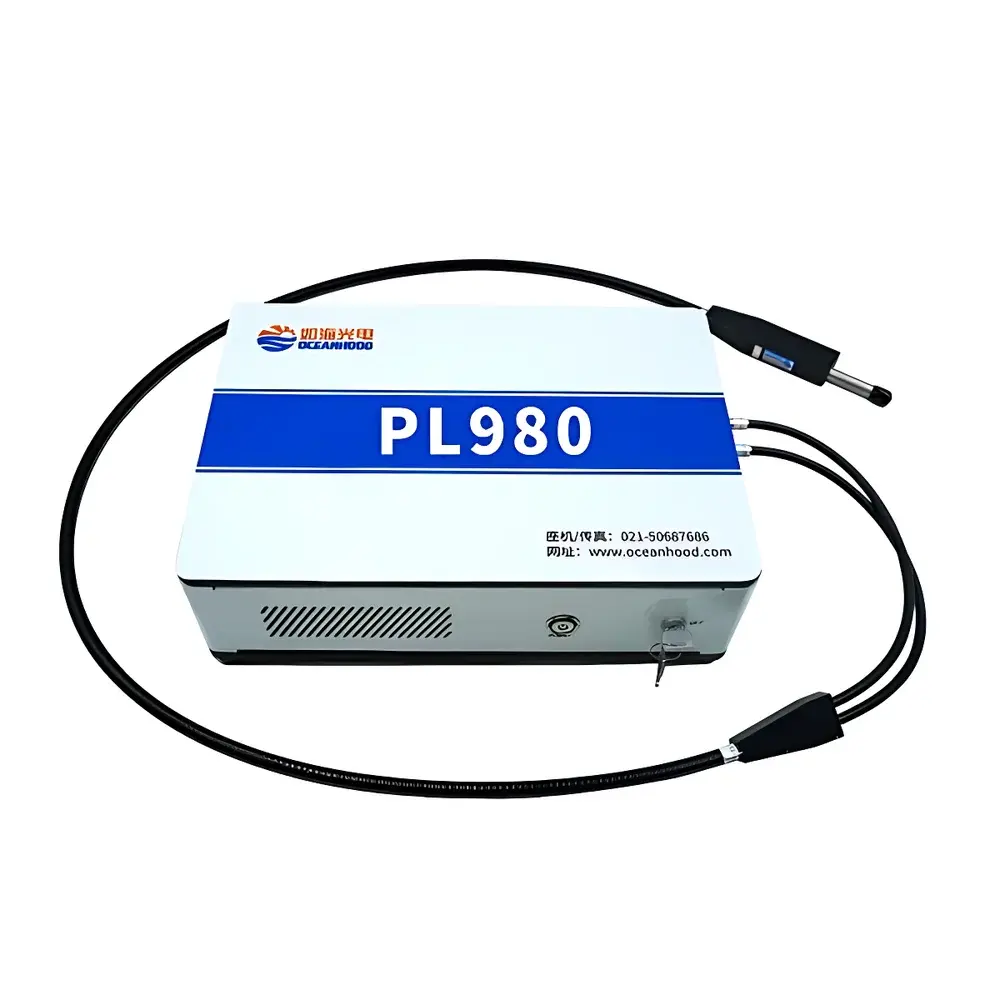
Ruihai Photonics PL980 NIR-II Fluorescence Spectroscopy System
| Brand | Ruihai Photonics (Oceanhood) |
|---|---|
| Origin | Shanghai, China |
| Manufacturer Type | OEM Manufacturer |
| Region of Origin | Domestic (China) |
| Model | PL980 |
| Instrument Type | Steady-State & Time-Resolved Fluorescence Spectrometer |
| Spectral Resolution | ~4 nm @ 25 µm slit |
| Wavelength Accuracy | ≤3% peak-to-peak (@ 2 hrs) |
| Excitation Wavelength | 976 ± 3 nm, Linewidth < 0.2 nm |
| Laser Power Stability | ≤3% P-P (@ 2 hrs) |
| Laser Lifetime | 10,000 hrs |
| Output Power Range | 0–500 mW adjustable |
| Optical Density (OD) of Notch Filter | OD8 |
| Probe Working Distance | 7.5 mm |
| Probe Fiber Length | ~1.5 m |
| Operating Temperature | 0–40 °C |
| Operating Humidity | 5–80% RH |
| Excitation Fiber Core | 105 µm VIS-NIR |
| Emission Collection Fiber Core | 200 µm VIS-NIR |
| Spectral Range | 1000–1700 nm |
Overview
The Ruihai Photonics PL980 NIR-II Fluorescence Spectroscopy System is a purpose-engineered optical platform designed for quantitative steady-state and time-resolved fluorescence measurements in the second near-infrared window (NIR-II, 1000–1700 nm). It leverages a stabilized 976 nm diode laser excitation source coupled with high-throughput fiber-optic probe geometry and a calibrated InGaAs-based spectrometer to enable sensitive, reproducible detection of low-intensity NIR-II emitters—including PbS quantum dots, rare-earth-doped nanoparticles, single-walled carbon nanotubes, and organic fluorophores engineered for deep-tissue or high-scattering media applications. Unlike conventional 90° orthogonal fluorescence detection geometries, the PL980 implements an optimized co-linear excitation–collection architecture with integrated OD8 notch filtering, achieving up to two orders of magnitude improvement in signal-to-background ratio under identical experimental conditions. Its modular design supports integration into gloveboxes, environmental chambers, or custom optical tables while maintaining thermal and mechanical stability over extended acquisition periods (>2 hours), as verified by ≤3% peak-to-peak laser power drift.
Key Features
- Extended spectral coverage from 1000 nm to 1700 nm, fully encompassing the biologically favorable NIR-IIa (1300–1400 nm) and NIR-IIb (1500–1700 nm) sub-bands
- High-fidelity excitation delivery via 105 µm core multimode VIS-NIR fiber, with spectral purity maintained by <0.2 nm linewidth and ±3 nm center wavelength tolerance
- Efficient emission collection using 200 µm core VIS-NIR fiber, optimized for InGaAs detector quantum efficiency across the full operational range
- Real-time background suppression enabled by OD8 ultra-steep-edge notch filter, minimizing Rayleigh and Raman scattering contributions
- Configurable laser output (0–500 mW) with active power stabilization circuitry ensuring ≤3% P-P fluctuation over 2-hour continuous operation
- Robust probe assembly with fixed 7.5 mm working distance and 1.5 m armored fiber tether, suitable for benchtop, in-situ, or flow-cell configurations
Sample Compatibility & Compliance
The PL980 system accommodates liquid, colloidal, thin-film, and solid-state samples mounted in standard quartz cuvettes (10 mm path), capillaries, or custom sample holders. Its optical design complies with ISO 17025-relevant calibration traceability principles for spectroscopic instrumentation; wavelength scale is factory-calibrated against NIST-traceable rare-earth oxide emission lines (e.g., Holmium Oxide), and photometric response is characterized using calibrated tungsten-halogen and blackbody sources. The system meets CE marking requirements for electromagnetic compatibility (EN 61326-1) and safety (EN 61010-1). For regulated environments—including GLP-compliant material characterization labs or preclinical imaging core facilities—the hardware architecture supports audit-ready metadata logging when paired with compliant software (see Software & Data Management section).
Software & Data Management
The system operates under Ruihai’s proprietary SpectraControl v3.x platform, a Windows-based application supporting synchronized laser triggering, spectrometer integration, and multi-parameter acquisition scripting. All raw spectra are saved in HDF5 format with embedded metadata—including timestamp, integration time, laser power setting, ambient temperature/humidity, and calibration coefficients—ensuring FAIR (Findable, Accessible, Interoperable, Reusable) data handling. Export options include CSV, ASCII, and MATLAB-compatible .mat files. Optional FDA 21 CFR Part 11 compliance packages are available, providing electronic signature enforcement, role-based user access control, and immutable audit trails for instrument parameter changes and data exports. Batch processing modules support automated peak deconvolution, lifetime fitting (for time-resolved mode), and spectral unmixing using non-negative matrix factorization (NMF).
Applications
- Quantitative photoluminescence quantum yield (PLQY) determination of NIR-II nanomaterials per ASTM E1948 guidelines
- In-process monitoring of nanoparticle synthesis kinetics in flow reactors via real-time emission tracking
- Stability assessment of bioconjugated probes under accelerated aging (temperature/humidity cycling)
- Optical property benchmarking for semiconductor quantum dots targeting SWIR photodetectors or optical communications
- Preclinical contrast agent screening in murine models, including biodistribution and clearance kinetics via spectral unmixing
- Quality control of NIR-II-emitting dyes in polymer matrices for anti-counterfeiting taggants
FAQ
Is the PL980 compatible with time-resolved fluorescence measurements?
Yes—the system supports gated detection and TCSPC (time-correlated single-photon counting) modes when integrated with optional pulsed laser drivers and fast-gating InGaAs detectors.
Can the excitation wavelength be modified beyond 976 nm?
Standard configuration uses a fixed 976 nm laser; however, OEM customization is available for alternate pump wavelengths (e.g., 808 nm, 1064 nm) subject to optical redesign and filter recalibration.
What calibration standards are supplied with the system?
Each unit ships with NIST-traceable Holmium Oxide and Didymium glass filters for wavelength verification, plus a calibrated photodiode for relative irradiance validation.
Does the system support vacuum or inert-atmosphere operation?
The optical probe and fiber interface are hermetically sealed and rated for operation inside nitrogen-purged gloveboxes; optional vacuum-compatible flange mounts are available upon request.
How is spectral resolution validated across the 1000–1700 nm range?
Resolution is measured empirically using atomic emission lines from calibrated hollow-cathode lamps (e.g., Ar, Kr) and confirmed at three points: 1064 nm, 1310 nm, and 1550 nm—each meeting the specified ~4 nm @ 25 µm slit tolerance.






