
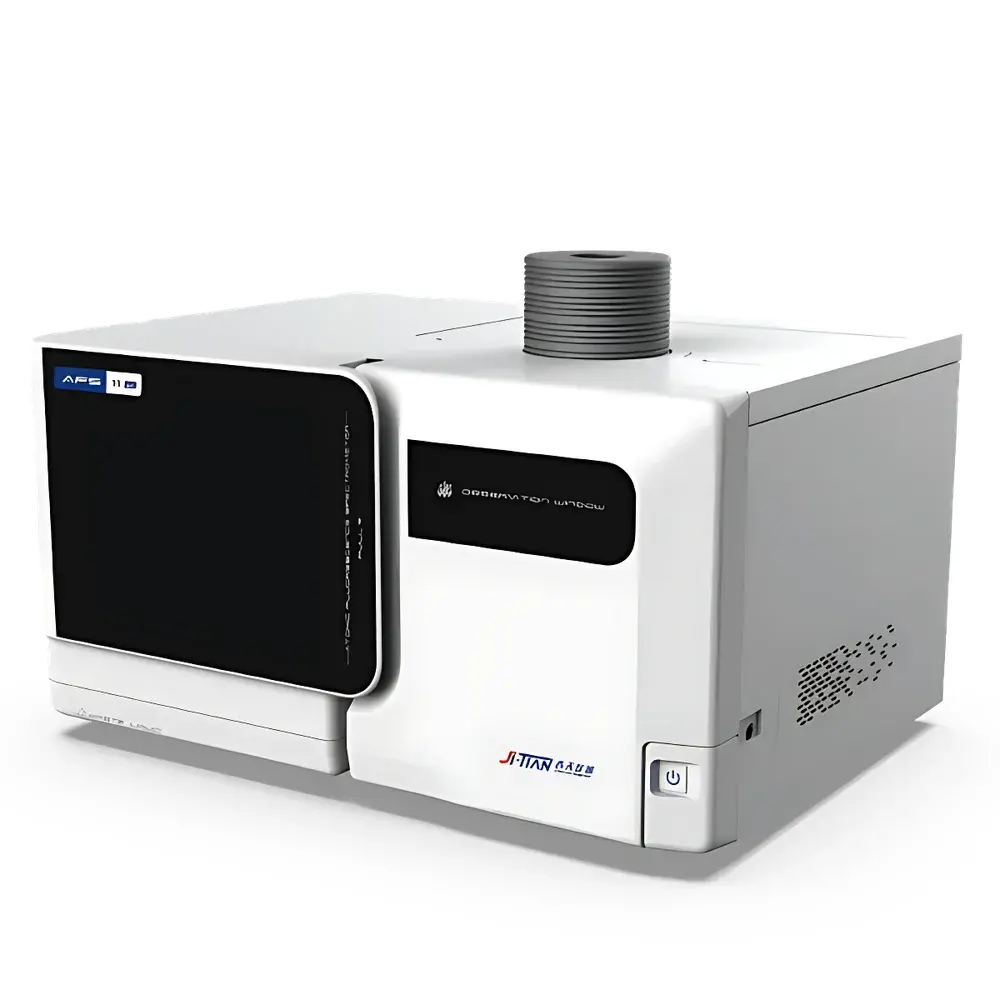
Titan Instruments AFS-11B Atomic Fluorescence Spectrometer
| Brand | Titan Instruments |
|---|---|
| Origin | Beijing, China |
| Manufacturer Type | Authorized Distributor |
| Product Origin | Domestic (China) |
| Model | AFS-11B |
| Pricing | Available Upon Request |
Overview
The Titan Instruments AFS-11B Atomic Fluorescence Spectrometer is a high-performance, multi-channel analytical instrument engineered for trace-level quantification of hydride-forming elements—including arsenic (As), mercury (Hg), selenium (Se), antimony (Sb), bismuth (Bi), lead (Pb), tin (Sn), tellurium (Te), cadmium (Cd), and zinc (Zn)—in liquid samples. It operates on the principle of atomic fluorescence spectroscopy (AFS), where analyte atoms—generated in situ via hydride generation or cold vapor atomic fluorescence—are excited by a high-intensity, element-specific hollow cathode lamp (HCL) or electrodeless discharge lamp (EDL). The resulting fluorescence emission at characteristic wavelengths is detected with high signal-to-noise ratio using a low-noise photomultiplier tube (PMT) and optimized optical path design. The AFS-11B is designed to meet the stringent sensitivity, precision, and reproducibility requirements of modern regulatory laboratories conducting routine analysis under ISO/IEC 17025, USP , EPA Method 1631/200.9, and GB/T 223.74–2022 frameworks.
Key Features
- Multi-Channel Sequential Injection Hydride Generation System: Dual independent syringe pumps enable precise, pulse-free delivery of sample, carrier solution, and reducing agent (e.g., NaBH4), ensuring consistent reaction kinetics and minimizing memory effects.
- Integrated Peristaltic Pump Module: Six-roller, compact pump head with uniform pressure block design delivers stable flow rates across all reagent lines; synchronized carrier replenishment eliminates flow interruption during sequential analysis.
- Drift Compensation & Quality Control Protocols: Built-in soft drift correction algorithm dynamically adjusts baseline and gain based on internal reference signals; QCP (Quality Control Protocol) supports automated bracketing standards, duplicate analysis, and real-time recovery calculation per batch.
- Bubble Suppression Architecture: Dual-injection manifold with dedicated degassing zone and gas-liquid separator minimizes air entrapment in the hydride generation stream—critical for Hg and Se stability.
- Intelligent Lamp Management: Automatic lamp ignition and spectral identification via embedded EEPROM recognition; dual-channel lamp activation enables simultaneous or alternating excitation for As/Hg or Se/Bi pairs.
- Adaptive Hardware Calibration: Optional eccentricity-compensating lamp holder with infinite-angle adjustment accommodates variable focal offsets across commercial HCLs and EDLs without mechanical realignment.
Sample Compatibility & Compliance
The AFS-11B accepts aqueous digests prepared by microwave-assisted acid digestion (HNO3/H2O2), hotplate digestion, or alkaline leaching—compatible with EPA 3050B, ISO 11466, and GB 5009.11–2014 protocols. Sample introduction supports discrete vial loading (up to 120 positions), continuous flow, or direct coupling to autosamplers with ICP-compatible trays. Instrument firmware and software architecture support audit trail logging, electronic signatures, and user role-based access control aligned with FDA 21 CFR Part 11 and GLP/GMP documentation requirements.
Software & Data Management
Titan AFS Control Suite v3.x provides full workflow automation—from method setup and calibration curve generation (linear, quadratic, or weighted least-squares) to real-time dual-channel spectral overlay and post-run validation reports. The interface includes guided method wizard, customizable report templates (PDF/Excel export), drag-and-drop sample queue configuration, and batch-level metadata tagging (e.g., analyst ID, digestion lot, instrument calibration status). All data files are stored in encrypted SQLite format with immutable timestamps and change history; system logs record every hardware event, parameter modification, and user login session.
Applications
The AFS-11B is routinely deployed in food safety labs for As speciation screening in rice and seafood; environmental monitoring agencies for Hg quantification in wastewater and sediment pore water; pharmaceutical QC units verifying elemental impurities per ICH Q3D; clinical toxicology departments measuring urinary Se in nutritional studies; and academic research facilities investigating redox-dependent metal bioavailability in soil-plant systems. Its modular architecture also supports future integration with HPLC for As(III)/As(V)/MMA/DMA separation prior to online detection.
FAQ
Does the AFS-11B comply with ISO/IEC 17025 method validation requirements?
Yes—the system supports full validation documentation including LOD/LOQ determination, linearity assessment (r² ≥ 0.999 over 3 orders of magnitude), intermediate precision testing, and spike recovery studies across matrix-matched standards.
Can the instrument be upgraded for hyphenated speciation analysis?
Yes—dedicated RS-232 and TTL-trigger ports are pre-installed for seamless synchronization with HPLC systems; optional UV photochemical reactor and post-column derivatization modules are available for As, Hg, and Se species separation.
What maintenance intervals are recommended for the quartz atomizer and PMT detector?
Quartz T-tube atomizer cleaning is advised after every 200 injections or when signal intensity drops >15%; PMT high-voltage calibration is performed automatically during warm-up and may be manually verified quarterly using certified reference material NIST SRM 3133.
Is remote diagnostics supported?
Yes—secure TLS-encrypted remote access is enabled via optional Titan Remote Support License, allowing authorized service engineers to monitor operational parameters, retrieve error logs, and execute firmware updates without physical presence.





