
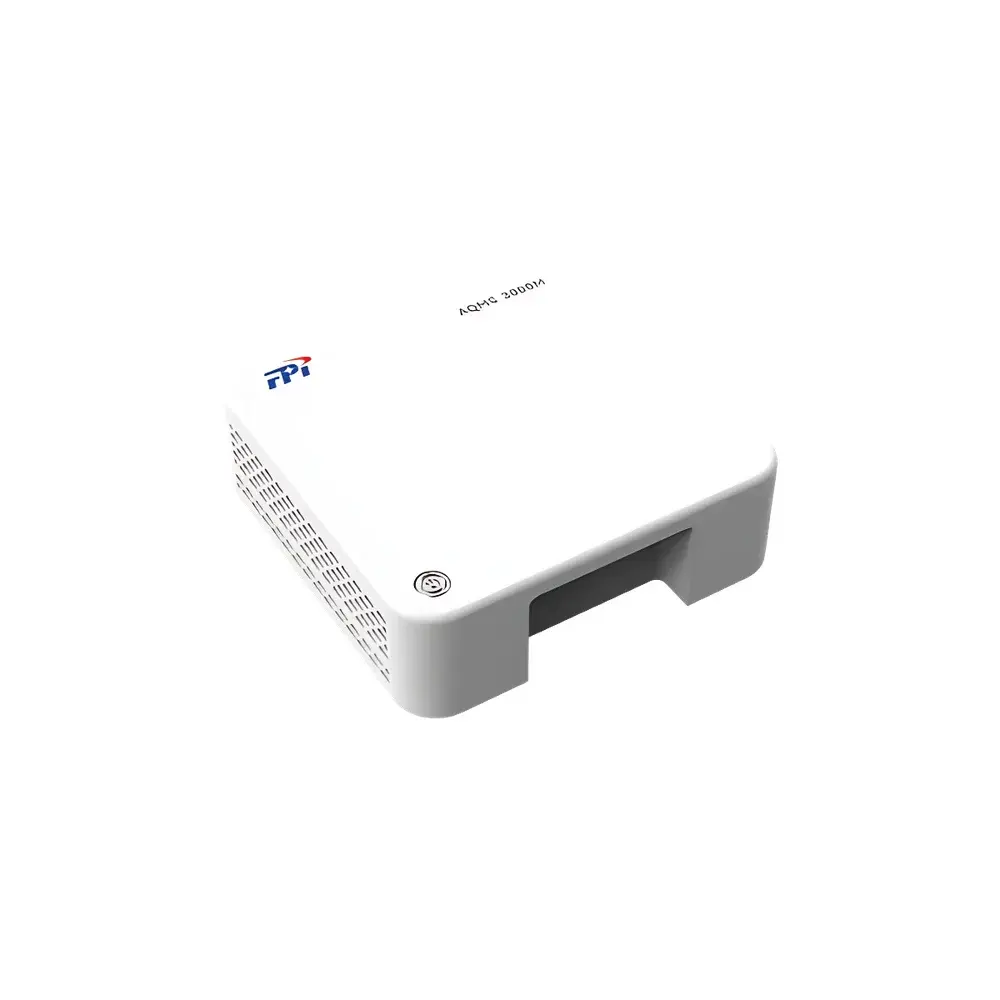
EXPEC AQMS-3000M Indoor Air Quality Monitoring System
| Brand | EXPEC (Pubu Technology) |
|---|---|
| Origin | Zhejiang, China |
| Manufacturer Type | Authorized Distributor |
| Country of Manufacture | China |
| Model | AQMS-3000M |
| Pricing | Available Upon Request |
Overview
The EXPEC AQMS-3000M Indoor Air Quality Monitoring System is an integrated, real-time environmental sensing platform engineered for continuous, multi-parameter assessment of indoor air conditions in mission-critical public and industrial spaces. Built upon a modular sensor architecture, the system applies standardized electrochemical, NDIR (Non-Dispersive Infrared), and optical scattering measurement principles to quantify key air quality indicators—including particulate matter (PM2.5, PM10), carbon dioxide (CO2), formaldehyde (HCHO), total volatile organic compounds (TVOC), temperature, and relative humidity. Its design adheres to foundational air quality evaluation frameworks defined in ISO 16000-23 (indoor air—determination of formaldehyde), ISO 7726 (ergonomics of the thermal environment—instruments for measuring physical quantities), and ASHRAE Standard 62.1 (Ventilation for Acceptable Indoor Air Quality). The AQMS-3000M serves not only as a compliance verification tool but also as a foundational data layer for intelligent building management systems (BMS), enabling evidence-based decisions on ventilation efficiency, occupant exposure risk, and HVAC optimization.
Key Features
- Modular sensor configuration: Users select and deploy only the required analyte modules—e.g., CO2/HCHO/PM or TVOC/temperature/humidity—ensuring scalability and cost-effective deployment across heterogeneous sites.
- Multi-protocol communication architecture: Native support for Ethernet (LAN), RS-485 (Modbus RTU), and IEEE 802.11 b/g/n Wi-Fi enables seamless integration into legacy infrastructure or cloud-connected IoT ecosystems without gateway dependency.
- Real-time actuator interface: Digital output channels (dry contact and 0–10 V analog) allow direct interoperability with mechanical ventilation units, HEPA filtration systems, and audible/visual alarm panels—facilitating closed-loop IAQ control per pre-defined threshold logic.
- Ruggedized enclosure: IP54-rated housing with internal temperature compensation ensures stable operation under variable ambient conditions (10–40 °C, 20–90% RH non-condensing), suitable for unconditioned concourses, loading docks, and industrial perimeter zones.
- Embedded data logging: Onboard SD card storage (up to 32 GB) retains high-resolution time-series data (1-minute intervals) for ≥12 months, supporting retrospective analysis and audit readiness.
Sample Compatibility & Compliance
The AQMS-3000M is validated for continuous sampling of ambient indoor air in non-explosive, non-corrosive environments. It complies with CE marking requirements under the EMC Directive 2014/30/EU and RoHS Directive 2011/65/EU. Sensor modules undergo factory calibration traceable to NIM (National Institute of Metrology, China) reference standards. While not certified to UL 2075 or EN 50131 for life-safety alarm applications, its output signals meet the input specifications of third-party BMS controllers compliant with BACnet MS/TP or Modbus TCP protocols. For occupational health monitoring, the system supports alignment with OSHA PELs and ACGIH TLVs via configurable alert thresholds and reporting templates.
Software & Data Management
The system operates with EXPEC’s proprietary IAQ Manager software (v3.2+), deployed on Windows-based local servers or private cloud instances. The software provides role-based access control (RBAC), automated report generation (PDF/CSV), and configurable dashboards with geospatial mapping for multi-node deployments. Audit trails record all configuration changes, calibration events, and user logins—supporting GLP-aligned documentation practices. Data export conforms to ISO/IEC 17025-compliant metadata tagging (including sensor ID, calibration date, uncertainty estimates), and optional add-ons enable FDA 21 CFR Part 11 compliance through electronic signature workflows and immutable log archiving.
Applications
- Airports and mass transit hubs: Continuous monitoring of terminal concourses, baggage claim areas, and boarding gates to verify ventilation adequacy during peak passenger throughput and support post-pandemic health resilience planning.
- Commercial retail complexes: Zone-level IAQ profiling across food courts, anchor stores, and atrium spaces to correlate CO2 buildup with occupancy density and inform demand-controlled ventilation (DCV) strategies.
- Industrial facilities with VOC-emitting processes: Deployment at facility perimeters and administrative zones to detect fugitive emissions of formaldehyde or aromatic hydrocarbons from coating, adhesion, or composite manufacturing lines.
- Educational and healthcare institutions: Long-term trend analysis of classroom or waiting-room air quality to assess mitigation efficacy of air purification retrofits and inform preventive maintenance scheduling.
FAQ
What calibration interval is recommended for field operation?
Annual recalibration is advised for all sensor modules; particulate sensors require biannual zero-checks in low-dust environments. Calibration certificates include expanded uncertainty values per ISO/IEC 17025.
Can the system operate independently without network connectivity?
Yes—the AQMS-3000M maintains full local data acquisition, threshold-based relay activation, and onboard logging even during network outages. All buffered data synchronizes automatically upon connection restoration.
Is remote firmware update supported?
Firmware updates are delivered via secure HTTPS push through IAQ Manager; each update package includes SHA-256 checksums and version rollback capability.
Does the system meet GDPR or HIPAA data handling requirements?
While the hardware does not store personally identifiable information (PII), the IAQ Manager software supports pseudonymized data export and encrypted database backups—enabling institutional IT departments to configure compliant hosting and retention policies.
Related Products







