
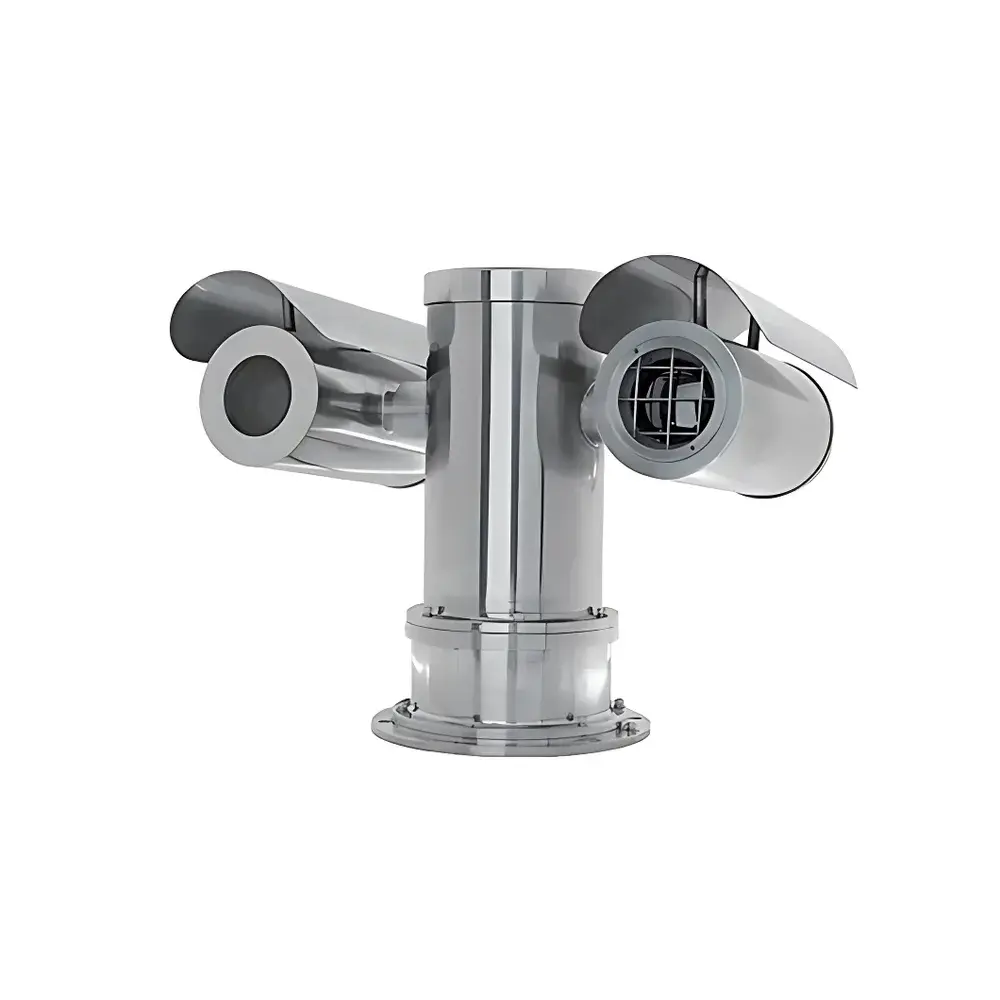
EXPEC 1850-E Intrinsically Safe Dual-Spectrum Surveillance System
| Brand | FPI (Focus Photonics Inc.) |
|---|---|
| Origin | Zhejiang, China |
| Manufacturer Type | OEM/ODM Manufacturer |
| Regional Classification | Domestic (PRC) |
| Model | EXPEC 1850-E |
| Detection Principle | Simultaneous Visible-Light Imaging + Uncooled Microbolometer-Based Thermal Imaging |
| Enclosure Rating | Ex d IIC T6 Gb / Ex tb IIIC T80°C Db (IEC 60079-0, -1, -31) |
| Mounting | Integrated 360° Pan-Tilt-Zoom (PTZ) Intrinsically Safe Panoramic Turret |
| Optical Interface | Standardized BNC + RJ45 + RS485 |
| Communication Protocols | Pelco-D, Pelco-P, ONVIF Profile S |
| Environmental Rating | IP66, -40°C to +60°C operational |
| Power Supply | 24 VDC (intrinsically safe circuit design) |
| Alarm Output | Relay contact (NO/NC), configurable thermal threshold triggers |
| Image Overlay | Real-time temperature heatmap superimposed on visible image |
| Data Output | H.265/H.264 dual-stream encoding, radiometric JPEG sequence export |
| Compliance | GB 3836.1–2021, GB 3836.4–2021, IEC 60079-11, UL 60079-11 Ed.7, ATEX Directive 2014/34/EU |
Overview
The EXPEC 1850-E is an intrinsically safe, dual-spectrum surveillance system engineered for continuous, real-time monitoring in hazardous locations where flammable gases, vapors, or combustible dusts may be present. It integrates uncooled microbolometer-based long-wave infrared (LWIR) thermal imaging with high-resolution visible-light imaging into a single ruggedized platform housed within a certified explosion-proof enclosure. Unlike conventional thermal cameras requiring external processing units, the EXPEC 1850-E embeds real-time radiometric analysis and intelligent thermal event detection directly on-board—eliminating latency and reducing integration complexity. Its core measurement principle relies on passive infrared radiation detection across the 8–14 µm spectral band, enabling non-contact surface temperature estimation without emissivity calibration dependency for alarm-level detection. Designed for Zone 1/21 and Division 1 environments per IEC 60079 and NEC 500/505 standards, the system operates continuously under extreme ambient conditions—from arctic cold to desert heat—while maintaining optical clarity through smoke, fog, light rain, and total darkness.
Key Features
- Intrinsically safe architecture compliant with IEC 60079-11 (Ed.7), ATEX 2014/34/EU, and GB 3836.4–2021 for Group IIC and IIIC atmospheres
- Integrated 360° pan-tilt-zoom turret with mechanical auto-tracking and wiper-equipped optical dome for all-weather reliability
- Dual-stream H.265/H.264 video encoding supporting simultaneous visible and thermal feeds at full resolution
- Embedded thermal analytics engine featuring adaptive thresholding, region-of-interest (ROI) masking, and multi-level temperature alarm prioritization
- Standardized industrial interfaces: BNC (analog video), RJ45 (IP network), RS485 (serial control), and dry-contact relay outputs
- ONVIF Profile S conformance ensures seamless integration with third-party VMS platforms including Milestone XProtect, Genetec Security Center, and Avigilon Control Center
- Zero-lux operation enabled by thermally fused imaging—no supplemental illumination required
Sample Compatibility & Compliance
The EXPEC 1850-E is validated for deployment in Class I, Division 1 (Groups B, C, D) and Class II, Division 1 (Groups E, F, G) hazardous locations per NEC Article 500, as well as Zone 0/1/2 (gas) and Zone 20/21/22 (dust) per IEC 60079 series. Its optical path is optimized for hydrocarbon-rich environments typical of refineries, LNG terminals, petrochemical storage farms, and offshore platforms. The system meets electromagnetic compatibility (EMC) requirements under IEC 61000-6-2 (immunity) and IEC 61000-6-4 (emissions), and supports audit-ready logging for GLP/GMP-aligned process safety management systems. All firmware updates and configuration changes are traceable via secure TLS 1.2 encrypted channels, satisfying data integrity requirements under ISO/IEC 17025 Clause 7.7 and FDA 21 CFR Part 11 Annex 11 principles.
Software & Data Management
The device runs a hardened Linux-based embedded OS with deterministic real-time scheduling for thermal analytics. Configuration and diagnostics are accessible via web GUI (HTTPS), CLI (SSH), or SNMPv3. Radiometric metadata—including pixel-wise temperature estimates, alarm timestamps, and environmental compensation parameters—is embedded in every JPEG frame and exported in CSV-compatible format for trend analysis. Optional FPI SmartView™ Server software provides centralized fleet management, historical thermal trending, and automated report generation aligned with API RP 540 and NFPA 70E inspection workflows. Audit logs retain user actions, firmware versions, and calibration history for minimum 180 days—supporting internal QA audits and regulatory inspections.
Applications
- Continuous perimeter and tank farm surveillance in oil & gas upstream, midstream, and downstream facilities
- Early-stage fire detection and hot-spot identification in flare stacks, compressor stations, and vapor recovery units
- Thermal integrity verification of insulated piping, pressure vessels, and catalyst beds during turnaround planning
- Real-time situational awareness for HAZMAT response teams during chemical spill containment operations
- 24/7 monitoring of battery energy storage systems (BESS) and hydrogen refueling infrastructure where spark ignition risk exists
- Compliance-driven monitoring for OSHA 1910.119 Process Safety Management (PSM) elements including mechanical integrity and incident investigation
FAQ
Is the EXPEC 1850-E certified for use in Zone 0 hazardous areas?
No—this model is rated for Zone 1 and Zone 2 (gas) and Zone 21 and Zone 22 (dust) per IEC 60079-0 and IEC 60079-31. Zone 0 certification requires additional encapsulation and is not supported.
Does the system support remote firmware updates over insecure networks?
Firmware updates require mutual TLS authentication and signed package verification; HTTP or unencrypted FTP transfers are disabled by default and cannot be enabled.
Can temperature measurements be exported in SI units only?
Yes—radiometric data is natively output in degrees Celsius (°C) with optional Kelvin (K) conversion via configuration; Fahrenheit is not supported in compliance mode.
What is the maximum recommended cable run length for RS485 control?
Up to 1,200 meters using shielded twisted-pair (STP) cable meeting EIA/TIA-485-A specifications, with proper termination and grounding per IEC 61000-6-2.
Is ONVIF Profile T supported for advanced analytics interoperability?
No—only Profile S is implemented to ensure deterministic streaming behavior and thermal metadata fidelity; Profile T features are intentionally excluded to maintain intrinsic safety boundaries.





