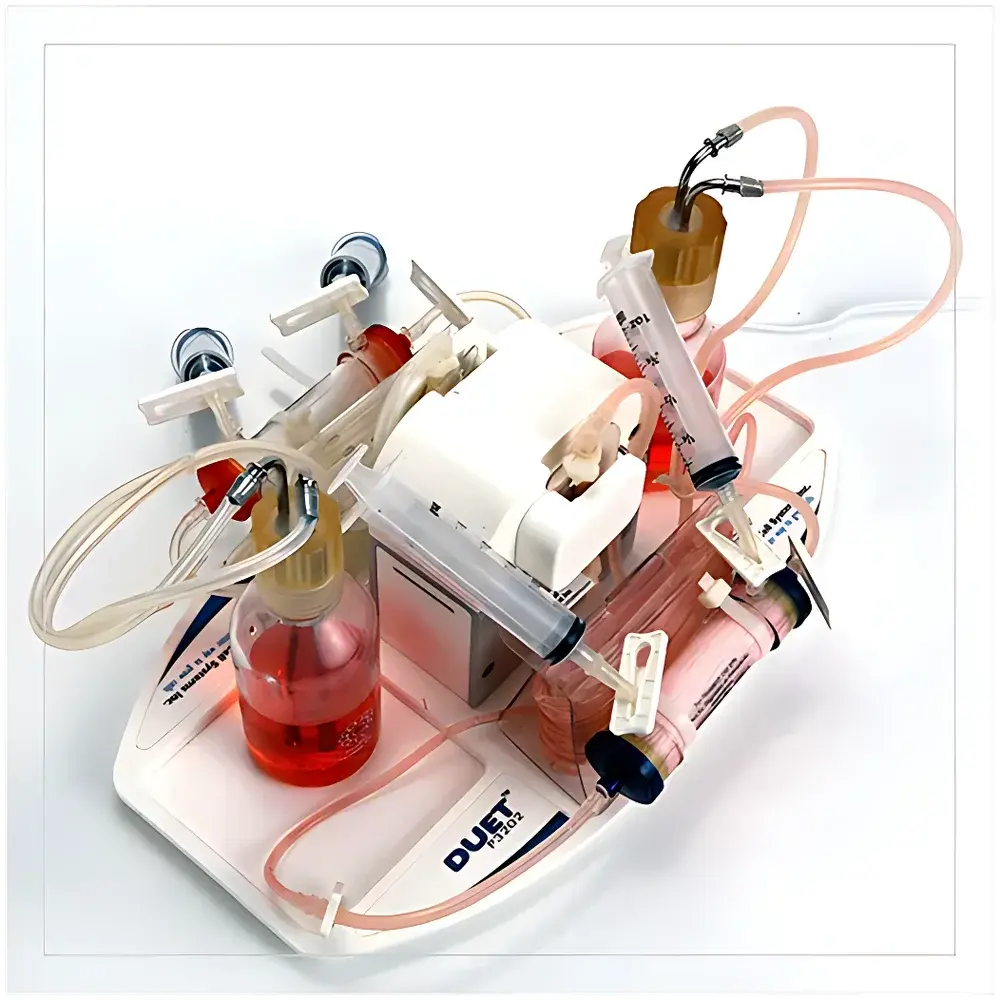
FiberCell Systems P3202 Hollow Fiber Bioreactor System
| Brand | FiberCell Systems |
|---|---|
| Origin | USA |
| Manufacturer Type | Authorized Distributor |
| Origin Category | Imported |
| Model | P3202 |
| Housing Material | Polysulfone |
| Configuration | Duet Pump + Cartridge-Based Closed Perfusion System |
Overview
The FiberCell Systems P3202 Hollow Fiber Bioreactor System is an engineered, closed-loop perfusion platform designed to replicate key physiological parameters of the in vivo microenvironment for long-term, high-density mammalian or microbial cell culture. Operating on the principle of convective mass transfer across semi-permeable hollow fiber membranes, the system establishes a spatially segregated extracellular space (ECS) where cells adhere and proliferate—either intraluminally or extraluminally—while culture medium continuously perfuses through the fiber lumens. Each polysulfone fiber (inner diameter ≈ 200 µm) functions as a biomimetic capillary, enabling selective diffusion of nutrients (e.g., glucose), metabolic waste (e.g., lactate), and gases while retaining cells and large secreted biomolecules—including monoclonal antibodies, exosomes, and post-translationally modified glycoproteins—within the ECS. This architecture supports sustained cell densities up to 1 × 10⁸ cells/mL and enables continuous culture durations exceeding three months without passaging, thereby preserving native phenotypic stability, functional metabolism, and secretory fidelity.
Key Features
- Polysulfone-based hollow fiber cartridges with validated biocompatibility and low non-specific protein binding
- Dual-channel Duet Pump providing precise, pulseless, bidirectional perfusion control for optimal shear management and uniform nutrient distribution
- Modular cartridge system: scalable from Small (S), Medium (M), to Large (L) formats—enabling process development, pilot-scale production, and GMP-aligned manufacturing
- Integrated reservoir caps with sterile vent filters and sampling ports compliant with ISO 56002 and USP <71> sterility testing requirements
- Reduced serum dependency: compatible with chemically defined, serum-free media formulations including CDM-HD (High-Density Chemically Defined Medium)
- No enzymatic dissociation required: eliminates trypsin-induced stress, maintaining epithelial integrity and reducing apoptosis rates by >40% versus monolayer systems
- Continuous waste removal: real-time clearance of inhibitory metabolites (e.g., ammonia, lactate) and autocrine/paracrine factors that trigger senescence
Sample Compatibility & Compliance
The P3202 system accommodates adherent and suspension cell lines—including CHO-K1, HEK293, hybridomas, primary human hepatocytes, mesenchymal stem cells (MSCs), and certain bacterial strains—without genetic modification or surface coating. Cartridge membrane cutoffs (MWCO) range from 10–500 kDa, supporting applications from recombinant protein expression to exosome enrichment. All wetted components comply with USP Class VI biological safety standards and are certified endotoxin-free (<0.25 EU/mL). The closed architecture meets FDA 21 CFR Part 11 requirements for electronic records when paired with validated data acquisition software; system validation packages support IQ/OQ/PQ execution per ASTM E2500 and ISO 13485 frameworks. As a NASA-certified platform for ISS-based experiments, it fulfills stringent vibration, pressure, and sterility specifications for spaceflight-qualified life science hardware.
Software & Data Management
While the P3202 operates as a hardware-dominant platform requiring minimal embedded software, its pump interface supports analog/digital I/O integration with third-party SCADA and LIMS systems (e.g., DeltaV, LabWare). Flow rate logs, pressure transducer outputs, and temperature sensor readings (via optional external probes) can be time-stamped and archived with audit-trail functionality. When deployed under GLP or GMP conditions, raw sensor data files are generated in .csv format with immutable metadata headers—including operator ID, calibration timestamp, and instrument serial number—to satisfy ALCOA+ principles. Firmware updates follow controlled change management protocols aligned with ICH Q9 risk assessment guidelines.
Applications
- High-yield production of therapeutic proteins and monoclonal antibodies under serum-free, scalable conditions
- Long-term functional studies of primary human cells—particularly neurons, cardiomyocytes, and pancreatic islets—where phenotypic drift compromises assay validity
- Exosome and extracellular vesicle isolation with 10–100× concentration enhancement over static culture methods
- Toxicology screening using metabolically active hepatic spheroids maintained for >90 days
- Vaccine antigen production (e.g., viral vector amplification in suspension-adapted HEK293 cells)
- Biomanufacturing process intensification: replaces multiple roller bottles or stacked-layer bioreactors with single-unit operation
FAQ
What is the typical cell density achievable in the P3202 system?
Cell densities routinely reach 1 × 10⁸ viable cells/mL in the extracellular space, sustained over multi-week to multi-month runs depending on cell type and medium formulation.
Can the system operate under serum-free conditions?
Yes—validated with CDM-HD and other chemically defined media; no adaptation phase required for most standard lines.
How is sterility maintained during extended operation?
All fluid paths are pre-sterilized via gamma irradiation; the closed-loop design eliminates open transfers, and reservoir caps integrate 0.22 µm hydrophobic vent filters meeting ISO 11140-1 Class 3 requirements.
Is the P3202 suitable for GMP manufacturing?
Yes—cartridges and pumps carry full traceability documentation (CoA, CoC, material certifications); system qualification support materials are provided for regulatory submissions.
What maintenance is required between runs?
Cartridges are single-use; pumps require quarterly calibration verification and annual preventive maintenance per manufacturer SOPs—no cleaning-in-place (CIP) or sterilization-in-place (SIP) steps needed.
Related Products