
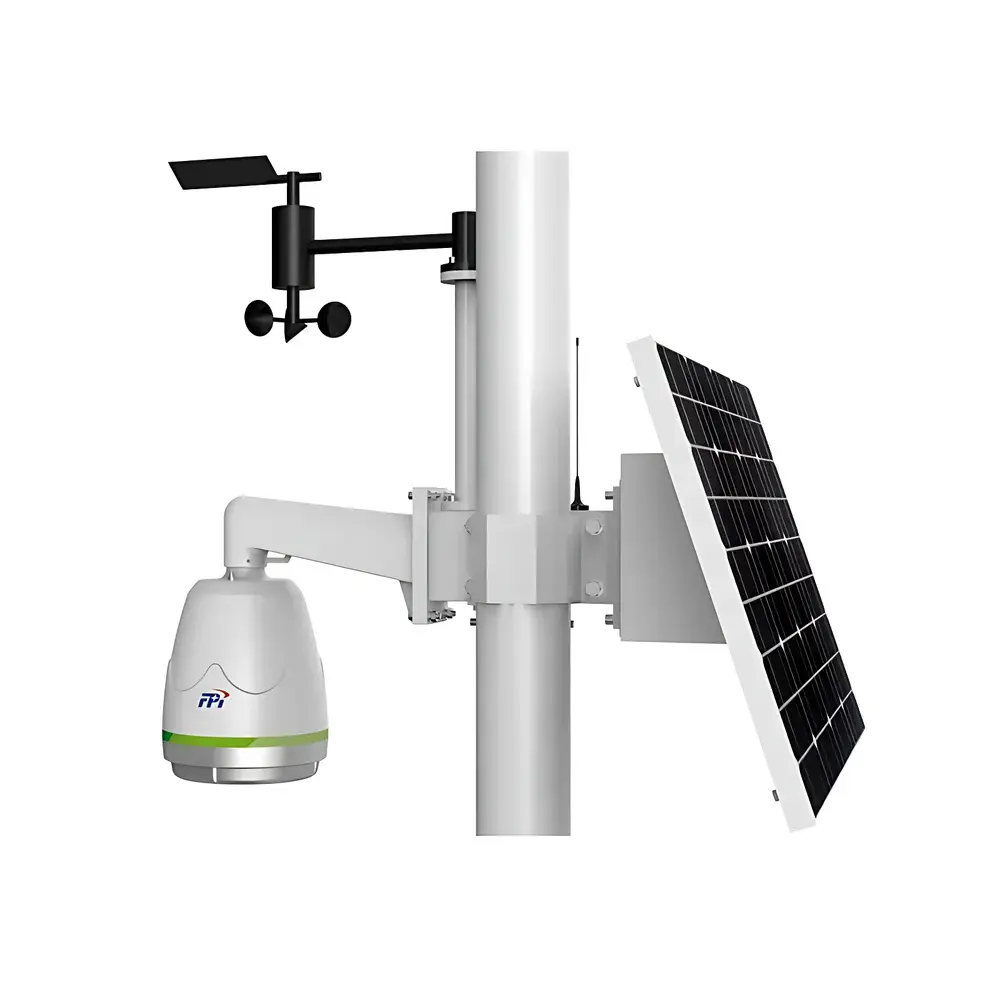
FPI AQMS-3000 Compact Ambient Air Quality Monitoring System
| Brand | FPI (Focus Photonics Inc.) |
|---|---|
| Origin | Zhejiang, China |
| Manufacturer | Yes |
| Country of Origin | China |
| Model | AQMS-3000 |
| Pricing | Available upon request |
Overview
The FPI AQMS-3000 Compact Ambient Air Quality Monitoring System is an integrated, low-footprint environmental monitoring platform engineered for high-density, spatially resolved ambient air surveillance. Designed in alignment with China’s State Council Office Guidelines on Ecological and Environmental Monitoring Network Construction, the AQMS-3000 implements a grid-based deployment strategy to overcome the limitations of conventional national reference stations—namely, sparse spatial coverage, high capital and operational expenditures, and insufficient temporal resolution. Unlike traditional point-source monitoring systems that rely on extrapolation, the AQMS-3000 enables true microscale atmospheric characterization through simultaneous, real-time measurement of gaseous pollutants, particulate matter, and meteorological parameters. Its core measurement architecture employs electrochemical sensors for SO2, NO2, CO, and O3; laser scattering photometry for PM2.5 and PM10; and capacitive/hot-film sensing for temperature, relative humidity, wind speed, and wind direction. All modules operate under synchronized time-stamping and are calibrated against traceable reference standards to ensure metrological integrity across distributed networks.
Key Features
- Modular multi-parameter detection: Simultaneous acquisition of SO2, NO2, CO, O3, PM2.5, PM10, temperature, humidity, wind speed, and wind direction;
- Flexible configuration: Sensor modules support field-selectable expansion and recombination to meet site-specific regulatory or research requirements;
- Advanced calibration framework: Integrated PreCalTM (factory pre-calibration), FieldCalTM (in-situ two-point calibration), and OnTheFlyTM (portable on-site verification) protocols—augmented by dynamic cross-interference compensation and real-time temperature/humidity correction algorithms;
- Robust sampling system: Pump-driven aspiration with <15-second gas exchange time; dual-stage particulate and hydrophobic filtration to protect sensor integrity and extend service life;
- Intelligent power management: Solar-rechargeable battery pack with adaptive sleep/wake cycling, enabling >30 days of continuous operation without grid connection;
- Autonomous geolocation: GNSS-assisted automatic coordinate acquisition and network topology mapping during commissioning and firmware updates;
- Wireless telemetry: Dual-mode 4G LTE cellular uplink and Bluetooth 5.0 local interface for remote diagnostics, parameter adjustment, and firmware deployment.
Sample Compatibility & Compliance
The AQMS-3000 is validated for outdoor ambient air sampling under ISO 12039 (gaseous pollutants), ISO 13271 (PM measurement), and EN 14625 (O3 analyzers). Its sensor response characteristics conform to the performance criteria outlined in China’s HJ 653–2013 and HJ 93–2013 technical specifications for ambient air quality monitoring instruments. While not certified to EPA EQOA or EU MCERTS tiers, the system meets functional equivalency benchmarks for screening-level compliance, source apportionment support, and early-warning applications. All data logging adheres to GLP-aligned audit trails, including timestamped calibration logs, sensor health diagnostics, and environmental condition metadata—enabling traceability required for regulatory reporting frameworks such as China’s “Blue Sky Defense Campaign” performance evaluation protocols.
Software & Data Management
Data from the AQMS-3000 is transmitted via MQTT/HTTPS to FPI’s secure cloud platform, which supports ISO/IEC 27001-compliant storage, role-based access control, and automated API integration with municipal environmental information systems (EIS). The platform delivers GIS-enabled visualization with real-time layering of concentration heatmaps, temporal trend dashboards, and cross-site correlation matrices. Advanced analytics include backward trajectory modeling (HYSPLIT integration), receptor modeling-ready export formats (e.g., CSV with UTC timestamps and QA/QC flags), and customizable alert rules based on exceedance thresholds, rate-of-change anomalies, or diurnal pattern deviations. Firmware updates are delivered over-the-air with cryptographic signature verification and rollback capability—minimizing field intervention while maintaining version-controlled deployment integrity.
Applications
- Urban micro-zoning: High-resolution monitoring across residential neighborhoods, school zones, and hospital perimeters to assess localized exposure gradients;
- Industrial boundary monitoring: Continuous fence-line surveillance at chemical plants, steel mills, and waste treatment facilities for compliance verification and fugitive emission detection;
- Transport corridor assessment: Roadside deployment along arterial highways and tunnel exits to quantify traffic-related NOx and PM spikes;
- Agricultural and open-source emission tracking: Monitoring ammonia (NH3–optional add-on), VOCs (via PID module), and coarse PM near livestock operations or biomass burning zones;
- Inter-city transport pathway analysis: Strategic placement along regional wind corridors to quantify transboundary pollutant flux and validate dispersion model outputs;
- Indoor-outdoor linkage studies: Adapted deployment in building lobbies, ventilation intakes, and green-roof interfaces to characterize infiltration dynamics and HVAC efficiency.
FAQ
What regulatory standards does the AQMS-3000 comply with?
It conforms to Chinese national standards HJ 653–2013 (SO2/NO2/CO/O3) and HJ 93–2013 (PM), and aligns with ISO 12039 and ISO 13271 for measurement methodology.
Can the system operate independently without grid power?
Yes—the integrated solar-charged battery system supports uninterrupted operation for ≥30 days under typical insolation conditions in eastern China.
Is remote calibration possible without physical access?
FieldCalTM enables two-point span calibration remotely via the cloud platform; OnTheFlyTM requires portable gas standards but eliminates sensor removal.
How is data security ensured during wireless transmission?
All 4G communications use TLS 1.2+ encryption; device authentication employs X.509 certificates; and cloud storage complies with ISO/IEC 27001 controls.
Does the system support third-party GIS or ERP integration?
Yes—RESTful APIs and standardized JSON/CSV exports enable seamless integration with ArcGIS, QGIS, SAP EHS, or custom municipal environmental dashboards.







