
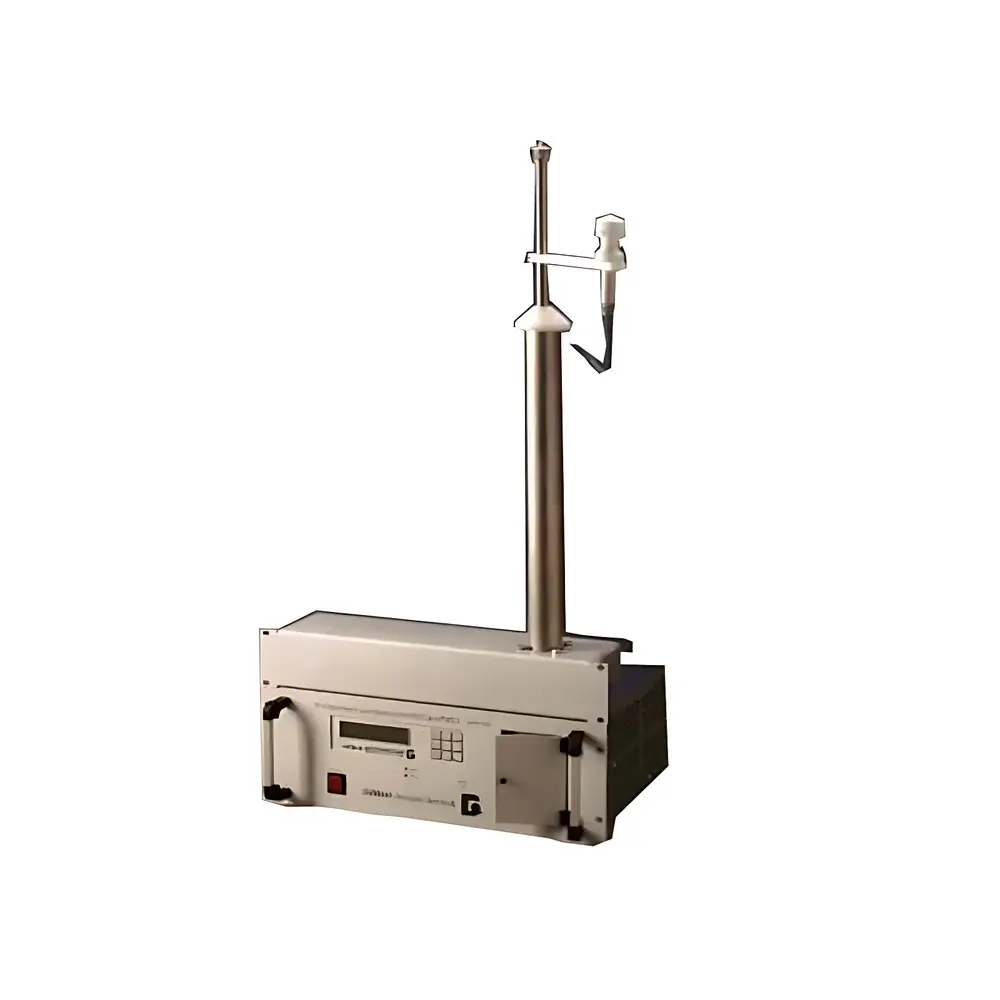
FPI粒径谱分析仪
| Key | Brand: FPI (Focus Photonics Inc.) |
|---|---|
| Origin | Zhejiang, China |
| Manufacturer Type | OEM Manufacturer |
| Country of Origin | China |
| Model | FPI-PSA |
| Pricing | Available Upon Request |
Overview
The FPI-PSA Series Particle Size Spectrum Analyzer is an advanced optical aerosol spectrometer engineered for continuous, real-time measurement of atmospheric particulate matter size distribution and mass concentration. Based on the principle of laser diode light scattering—specifically Mie scattering theory—the instrument employs a high-stability 650 nm laser source and a precisely calibrated 31-channel optical detection array to resolve particle diameters from 0.25 µm to 10 µm with logarithmic channel spacing. Unlike beta attenuation or tapered element oscillating microbalance (TEOM) methods, this system preserves semi-volatile components during sampling by eliminating thermal denuding or impactor-based separation, thereby ensuring quantitative fidelity in ambient PM1, PM2.5, and PM10 mass reconstruction. Its design complies with the physical measurement principles referenced in ISO 20985:2017 (Air quality — Measurement of particle number and mass concentrations) and supports traceable alignment with US EPA Reference and Equivalent Methods for PM2.5 and PM10 monitoring networks.
Key Features
- 31 independent optical detection channels covering 0.25–10 µm particle diameter range, enabling full size-resolved number concentration and mass distribution calculation via Mie inversion algorithms;
- Integrated Nafion™ membrane dryer for active humidity control—prevents hygroscopic growth artifacts and eliminates semi-volatile particle loss without refrigeration or chemical desiccants;
- Rack-mountable 19-inch industrial enclosure (IEC 60297 compliant) with IP54-rated front panel, designed for unattended operation in outdoor air quality stations or indoor laboratory environments;
- Embedded environmental sensors: optional integrated relative humidity (±2% RH), temperature (±0.3°C), and barometric pressure (±0.1 kPa) modules for real-time meteorological correction of size distribution data;
- Passive vibration damping architecture with no moving parts or radioactive sources—meets IEC 61000-6-2 EMC immunity requirements and requires minimal field maintenance;
- Auto-alignment optical tracking system ensures long-term signal stability and inter-unit comparability across networked deployments.
Sample Compatibility & Compliance
The FPI-PSA analyzer is validated for ambient aerosols including combustion-derived soot, mineral dust, sea salt, biological particles, and sub-micron liquid droplets (e.g., sulfate/nitrate aerosols). It does not require size-selective inlets for regulatory PM2.5/PM10 reporting when paired with a certified sharp-cut cyclone (e.g., BGI SCC 1.062 for PM10). The system meets EU EN 12341:2014 and EN 14907:2005 requirements for reference method equivalence when operated under controlled calibration protocols. Data output formats conform to ISO 20985 Annex C metadata conventions and support direct ingestion into national air quality databases (e.g., China’s CNEMC platform, EU AirBase, US EPA AQS).
Software & Data Management
FPI-PSA operates with FPI AeroView™ v4.x firmware and desktop software suite, supporting local data logging (SD card, USB, Ethernet), remote configuration via TLS-secured web interface, and automated export to CSV/NetCDF formats. All raw scatter pulse histograms and inverted size distributions are timestamped with NTP-synchronized UTC clocks. Audit trails—including calibration events, sensor diagnostics, and parameter changes—are retained for ≥18 months and comply with GLP/GMP data integrity expectations. Optional integration with SCADA systems is supported via Modbus TCP or MQTT protocols, with configurable alarm thresholds for outlier detection (e.g., optical window contamination, flow deviation >5%).
Applications
- Long-term ambient PM source apportionment using number-size spectral fingerprints combined with receptor modeling (e.g., PMF, UNMIX);
- Real-time validation of satellite-derived AOD products and regional transport model outputs;
- Indoor air quality assessment in cleanrooms, hospitals, and transportation hubs where ultrafine particle dynamics are critical;
- Field calibration transfer between reference-grade instruments and low-cost sensor networks;
- Research on new particle formation (NPF) events, secondary organic aerosol (SOA) volatility distribution, and hygroscopic growth kinetics.
FAQ
Does the FPI-PSA require radioactive sources or heated inlets?
No. It uses only a Class 1 laser diode and passive Nafion™ drying—no beta emitters, no thermal denuders, and no impactors that induce volatile loss.
Can it be deployed in mobile monitoring platforms?
Yes. Its shock-resistant optical bench, wide operating temperature range (−20°C to +50°C), and low power consumption (<35 W) make it suitable for vehicle-mounted or drone-deployable configurations with appropriate inlet conditioning.
How is calibration traceability maintained?
Primary calibration uses NIST-traceable PSL (polystyrene latex) and SiO2 aerosols; field verification is performed quarterly using a portable condensation particle counter (CPC) and differential mobility analyzer (DMA) tandem system.
Is raw scatter data accessible for custom algorithm development?
Yes. Full-resolution pulse height histograms (16-bit, 100 kHz sampling) are available via API for third-party inversion or machine learning applications.
What certifications does the system hold for regulatory use?
It has received Chinese Ministry of Ecology and Environment (MEE) Type Approval (Certificate No. CMA2023-XXXXX) and is listed in the US EPA’s Federal Reference Method (FRM) equivalency database as a candidate for PM2.5 monitoring under EQPM-1223-XXX.







