
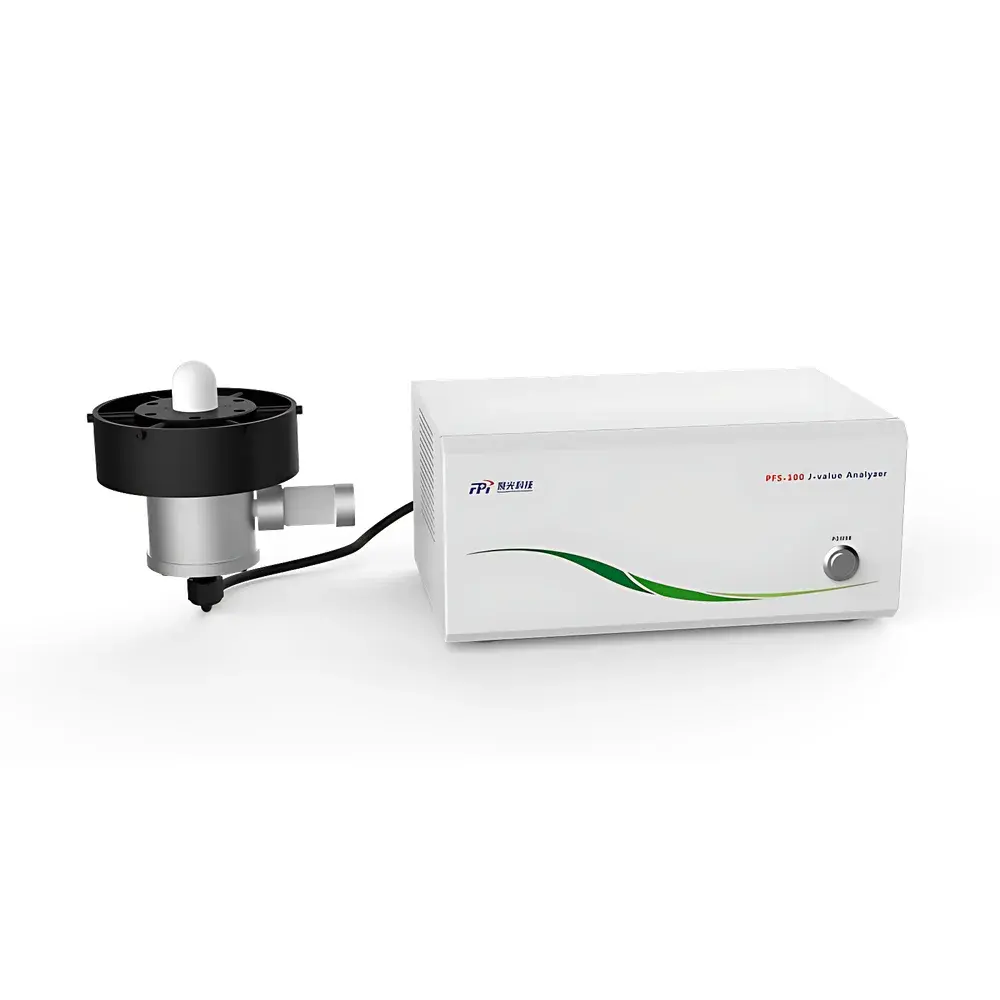
FPI PFS-100 Photolysis Spectroradiometer
| Brand | FPI (Focus Photonics Inc.) |
|---|---|
| Model | PFS-100 |
| Type | Online Multicomponent Photolysis Rate Analyzer |
| Measurement Principle | Actinic Flux-Based Spectral Radiometry |
| Optical Path | Quartz Collector + UV-VIS Optical Fiber Coupling |
| Detector | Thermoelectrically Cooled CCD Array |
| Spectral Range | 280–450 nm (configurable) |
| Spectral Resolution | ≤0.5 nm (FWHM) |
| Calibration Traceability | NIST-traceable actinic flux calibration |
| Data Output | Real-time J-value time series (s⁻¹) for O¹D, NO₂, OH, HONO, HCHO, and other photolabile species |
| Compliance | Designed per ISO 17025 laboratory practice guidelines |
Overview
The FPI PFS-100 Photolysis Spectroradiometer is an online, field-deployable instrument engineered for the continuous, quantitative measurement of actinic flux (Fλ) in the solar ultraviolet–visible spectrum (280–450 nm), enabling direct calculation of photolysis rate constants (J-values) for key atmospheric photochemical species. Unlike conventional broadband radiometers or filter-based photometers, the PFS-100 employs high-resolution spectral radiometry grounded in fundamental photochemical actinometry. It captures hemispherical solar irradiance using a cosine-corrected quartz diffuser, transmits light via low-OH optical fiber to a thermoelectrically cooled CCD spectrometer, and converts raw spectral counts into absolute actinic flux units (μW cm⁻² nm⁻¹) using pre-deployment NIST-traceable calibration coefficients. The instrument computes J-values in real time by numerically integrating Fλ × σ(λ) × φ(λ) across wavelength, where σ(λ) denotes molecular absorption cross-sections and φ(λ) represents quantum yields—both sourced from evaluated databases (e.g., JPL Publication 19-5, IUPAC recommendations). This first-principles approach ensures metrological rigor and eliminates reliance on empirical proxies or indirect modeling assumptions.
Key Features
- Thermoelectrically cooled back-illuminated CCD detector with >3000:1 dynamic range and <5 e⁻ RMS read noise, enabling high signal-to-noise ratio (SNR) acquisition under variable solar conditions
- Optimized optical train featuring fused silica collimators, holographic grating (1200 g/mm), and UV-enhanced coatings for minimal stray light (<0.05% at 300 nm)
- Configurable integration times (10 ms to 10 s) with automated exposure optimization to maintain detector linearity across diurnal cycles
- Onboard industrial PC running Linux-based firmware with embedded J-value computation engine compliant with IUPAC-recommended photolysis parameterizations
- Integrated GPS-synchronized timestamping and environmental monitoring (ambient temperature, pressure, relative humidity) for atmospheric correction
- Modular mechanical design with IP65-rated enclosure, passive thermal stabilization, and field-serviceable optical alignment
Sample Compatibility & Compliance
The PFS-100 operates as an ambient air interface instrument—no sample extraction, dilution, or chemical conversion is required. It measures extraterrestrial and tropospheric actinic flux directly, making it compatible with all photolabile trace gases whose absorption and quantum yield spectra fall within its calibrated spectral window. Validated J-value outputs include but are not limited to: J(O¹D), J(NO₂), J(OH) via HONO photolysis, J(HONO), J(HCHO), and J(HO₂) via formaldehyde secondary pathways. The system adheres to ISO/IEC 17025:2017 requirements for calibration validity and measurement uncertainty estimation. All spectral calibrations are performed in accordance with ASTM E275-22 (Standard Practice for Calibration of Spectroradiometers) and traceable to NIST Standard Reference Materials (SRMs) 2065 and 2066. Data integrity meets FDA 21 CFR Part 11 criteria when deployed with optional audit-trail-enabled software configuration.
Software & Data Management
The PFS-100 ships with FPI’s Photolysis Analysis Suite (PAS v3.2), a validated Windows/Linux-compatible application supporting real-time visualization, batch reprocessing, and export in CF-netCDF 4.0 format compliant with NASA’s Atmospheric Science Data Center (ASDC) metadata conventions. PAS includes built-in uncertainty propagation modules that quantify combined standard uncertainties for each J-value based on spectral noise, calibration drift, temperature-dependent detector response, and atmospheric transmission corrections (via concurrent AERONET or MFRSR inputs). Raw spectra and derived J-series are stored locally on redundant SSDs with SHA-256 checksum verification. Remote access is enabled via TLS 1.3-secured MQTT or SFTP protocols, supporting integration into national air quality networks (e.g., China’s CNEMC, U.S. EPA AIRNow, EU Copernicus Atmosphere Monitoring Service).
Applications
- Quantitative evaluation of tropospheric ozone production efficiency and radical budget closure in urban, rural, and marine boundary layers
- Validation of photolysis parameterizations in regional and global chemical transport models (e.g., CMAQ, GEOS-Chem, EMAC)
- Field intercomparison campaigns targeting J-value measurement harmonization across instrumentation platforms (e.g., filter radiometers, cavity-enhanced spectrometers)
- Long-term trend analysis of photochemical reactivity in response to emission control policies and climate variability
- Supporting regulatory compliance monitoring under frameworks requiring direct photolysis quantification (e.g., EU Directive 2008/50/EC Annex XI, U.S. EPA Guideline on Photochemical Modeling)
FAQ
What spectral range does the PFS-100 cover, and how is it calibrated?
The PFS-100 operates from 280 to 450 nm with <0.5 nm spectral resolution. Calibration is performed pre-deployment using NIST-traceable tungsten-halogen and deuterium lamps, with actinic flux scale established via absolute irradiance transfer from SRM 2065 (250–550 nm) and SRM 2066 (200–250 nm).
Can the PFS-100 measure J-values for species beyond those listed in the standard output?
Yes—users may import custom σ(λ) and φ(λ) datasets in HITRAN or JPL-formatted ASCII files to extend J-value computation to additional photolabile compounds, provided their absorption bands lie within the instrument’s spectral response.
Is the system suitable for unmanned, remote-site operation?
Yes—the PFS-100 is designed for unattended deployment up to 12 months with integrated power management (12–24 V DC input), passive thermal regulation, and watchdog-controlled firmware recovery. Optional solar charging and satellite telemetry packages are available.
How does the PFS-100 handle cloud-induced rapid irradiance fluctuations?
The system uses adaptive integration time selection and real-time SNR feedback to maintain optimal photon statistics across irradiance gradients exceeding 3 orders of magnitude, ensuring robust J-value continuity during partial cloud cover.
Does the instrument require periodic recalibration in the field?
No routine field recalibration is required. Stability testing shows <±1.2% drift in actinic flux sensitivity over 6 months under continuous operation. Annual factory recalibration is recommended for metrological assurance.







