
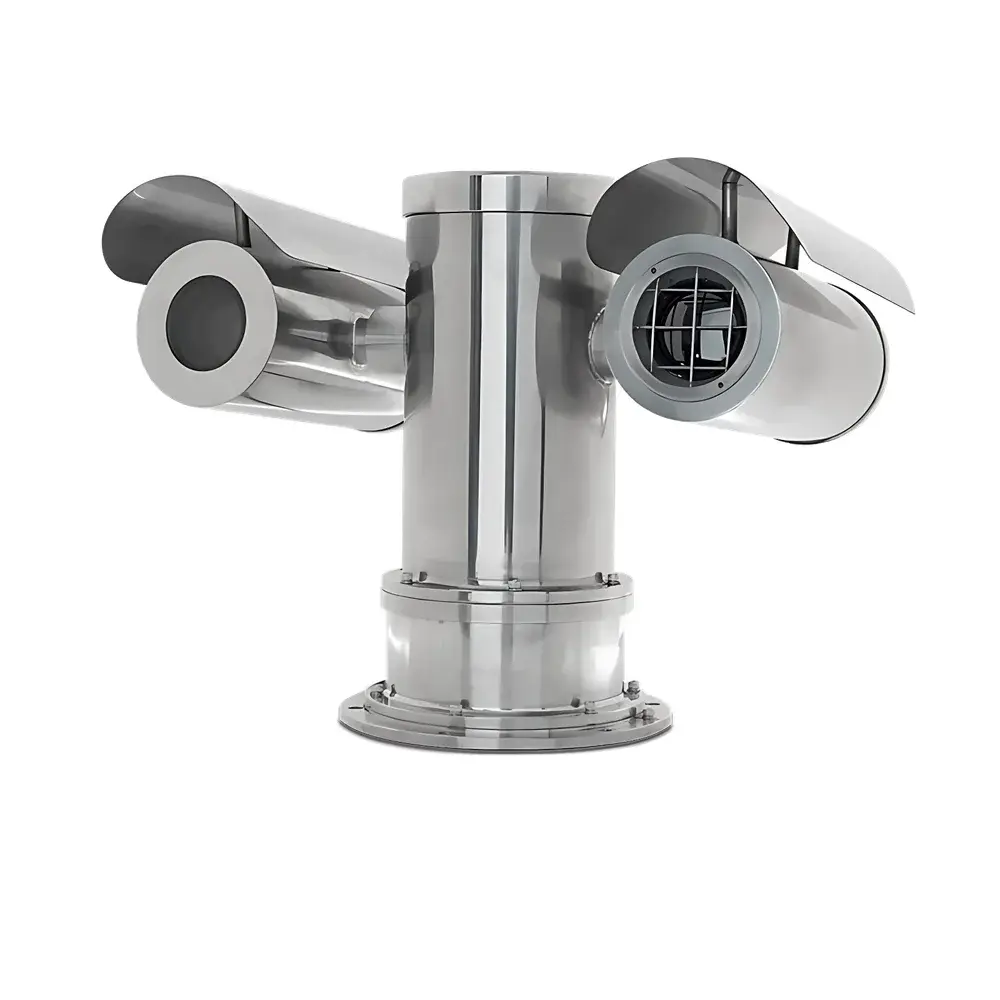
FPI IRV Series Intelligent Infrared Thermal Imaging Camera
| Brand | FPI |
|---|---|
| Origin | Zhejiang, China |
| Manufacturer Type | OEM Manufacturer |
| Product Origin | Domestic (China) |
| Model | IRV Series |
| Pricing | Available Upon Request |
| Spectral Response | Short-Wave Infrared (SWIR) |
| Detector Architecture | Scanning Focal Plane Array (FPA) |
| Primary Function | Non-Contact Temperature Measurement |
| Operating Principle | Uncooled Thermal Detection |
| Environmental Suitability | 24/7 Continuous Operation |
| Optical Design | Ruggedized Lens System for Industrial Environments |
| Compliance Basis | Designed to Support ISO 18434-1, ASTM E1934, and IEC 62906-5-2 Guidelines |
Overview
The FPI IRV Series Intelligent Infrared Thermal Imaging Camera is an industrial-grade, uncooled thermal imaging system engineered for reliable non-contact surface temperature monitoring in demanding process environments. Based on short-wave infrared (SWIR) spectral response and a scanning focal plane array (FPA) detector architecture, the IRV Series converts emitted infrared radiation—proportional to object surface temperature—into high-fidelity thermal video signals. Unlike cooled mid-wave (MWIR) or long-wave (LWIR) systems, the uncooled SWIR design eliminates cryogenic cooling requirements, enabling robust operation across wide ambient temperature ranges without thermal stabilization delays. The system adheres to fundamental radiometric principles defined in ISO 18434-1 (Condition monitoring and diagnostics of machines — Thermography) and supports quantitative thermographic analysis when calibrated against traceable blackbody references. Its optical path is sealed and purged-compatible, ensuring stable performance in dusty, humid, or chemically aggressive atmospheres typical of continuous-process industries.
Key Features
- Uncooled SWIR detection architecture ensures zero maintenance downtime associated with Stirling coolers or liquid nitrogen systems
- Ruggedized mechanical housing rated to IP65 ingress protection, suitable for mounting on fixed infrastructure or integration into mobile inspection platforms
- Multi-form factor deployment: handheld units for spot verification, fixed-mount online cameras for permanent process surveillance, and ROS-compatible interfaces for autonomous巡检 robots
- High dynamic range imaging optimized for scenes with extreme thermal contrast—e.g., furnace exteriors adjacent to ambient piping—without saturation or loss of low-emissivity detail
- Embedded real-time image enhancement algorithms including non-uniformity correction (NUC), temporal noise reduction, and adaptive histogram equalization
- Optical design incorporates anti-reflective coated germanium or chalcogenide lenses, selected per application-specific field-of-view (FOV) and minimum focus distance requirements
Sample Compatibility & Compliance
The IRV Series is compatible with surfaces exhibiting emissivity values ≥0.4, including oxidized metals, refractory linings, polymer-coated pipelines, and catalytic bed substrates. For low-emissivity targets (e.g., polished stainless steel or aluminum), optional emissivity mapping modules support pixel-wise correction using synchronized visible-light reference imagery. The system complies with electromagnetic compatibility standards IEC 61326-1 (industrial environment) and meets functional safety considerations aligned with IEC 61508 SIL 2 for use in safety-related monitoring loops. Data acquisition workflows are structured to support audit-ready documentation under GLP and GMP frameworks, including timestamped metadata embedding, user-access logging, and exportable radiometric data cubes (.seq or .tiff format with embedded calibration coefficients).
Software & Data Management
FPI’s proprietary ThermalVision Suite provides full control over camera configuration, real-time visualization, and post-acquisition analysis. The software supports multi-camera synchronization, alarm-triggered recording (via analog/digital I/O or Modbus TCP), and automated report generation compliant with ASTM E1934 Annex A1 guidelines. All thermal video streams include embedded EXIF-like metadata: detector temperature, lens ID, calibration timestamp, NUC cycle count, and user-defined process tags. For enterprise integration, RESTful API endpoints enable direct ingestion into MES (Manufacturing Execution Systems) and CMMS (Computerized Maintenance Management Systems). Audit trails—including parameter changes, user logins, and calibration events—are retained with SHA-256 hashing and configurable retention policies, satisfying FDA 21 CFR Part 11 electronic record requirements where applicable.
Applications
- Metallurgical furnaces: Continuous monitoring of refractory wear, slag line integrity, and electrode tip temperature gradients in electric arc furnaces (EAF)
- Petrochemical reformers and crackers: Detection of tube wall thinning, coke deposition hotspots, and burner flame pattern anomalies
- Chlor-alkali cell rooms: Identification of abnormal current leakage paths and diaphragm degradation via localized heating signatures
- Natural gas compressor stations: Bearing and seal temperature trending to predict mechanical failure modes per ISO 13374-2
- Fine chemical reactors: Verification of jacket temperature uniformity and exothermic reaction front propagation during batch synthesis
FAQ
Is the IRV Series suitable for quantitative temperature measurement?
Yes—when used with factory-applied calibration certificates traceable to NIM (National Institute of Metrology, China) and operated within specified ambient conditions, the IRV Series delivers radiometric accuracy conforming to ISO 18434-1 Class B requirements.
Can it be integrated into existing SCADA or DCS systems?
Yes—the camera supports Modbus TCP, OPC UA, and analog 4–20 mA output options for seamless integration with industrial control systems.
What is the recommended recalibration interval?
Annual recalibration is advised; however, field NUC cycles can be triggered manually or scheduled automatically based on detector temperature drift thresholds.
Does it support high-speed thermal event capture?
While not designed for microsecond transient capture, the IRV Series supports configurable frame rates up to 60 Hz for monitoring dynamic thermal processes such as valve actuation or pump startup sequences.
Are custom lens options available?
Yes—telecentric, wide-angle, and macro configurations are offered with M42 or C-mount interfaces to match specific installation geometries and spatial resolution needs.




