
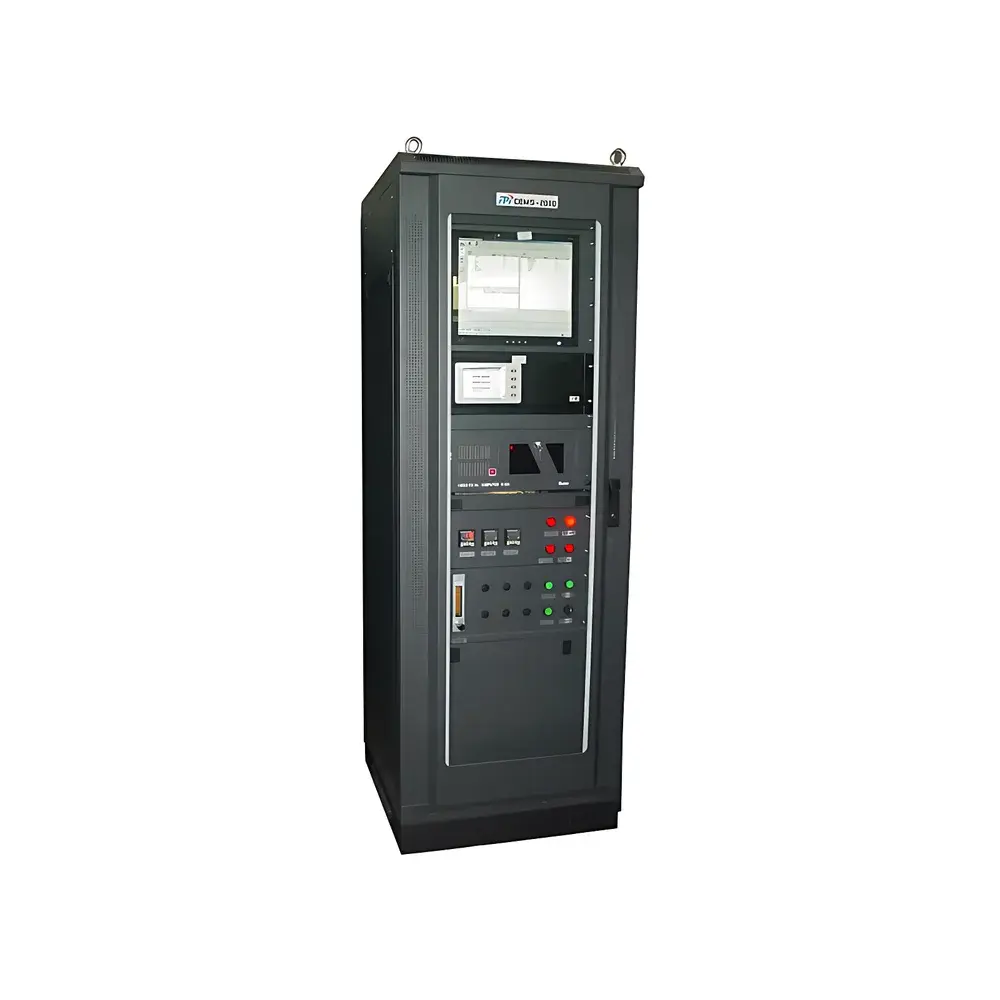
FPI CEMS-2000B Continuous Emission Monitoring System (CEMS)
| Brand | FPI |
|---|---|
| Origin | Zhejiang, China |
| Manufacturer Type | Original Equipment Manufacturer (OEM) |
| Country of Origin | China |
| Model | CEMS-2000B |
| Instrument Type | Flue Gas Continuous Emission Monitoring System |
| Measurement Accuracy | ≤ ±1% FS |
| Repeatability | ≤ ±0.5% FS/24h (Span Drift) |
| Response Time | ≤ 200 s |
| Stability | ≤ ±1% FS/24h (Zero Drift) |
| Measured Parameters | Gaseous Pollutants (SO₂, NO, NO₂, CO, CO₂, O₂), Particulate Matter (PM), Temperature, Pressure, Flow Velocity, Humidity |
Overview
The FPI CEMS-2000B Continuous Emission Monitoring System is a fully integrated, thermally conditioned extractive CEMS engineered for regulatory compliance and long-term operational reliability in coal-fired power plants and industrial combustion facilities. It operates on a dual-principle analytical architecture: Non-Dispersive Infrared (NDIR) spectroscopy for CO, CO₂, and NO; Non-Dispersive Ultraviolet (NDUV) absorption for SO₂ and NO₂; and electrochemical or paramagnetic sensing for O₂. The system employs full-stream heated sampling—maintaining gas temperature above the dew point throughout transport—to prevent condensation-induced analyte loss or adsorption. Critical to its performance in low-concentration SO₂ monitoring is the patented acid-enhanced condensation dehydration technology (Patent No. CN201410309049.5), which reduces SO₂ dissolution loss from ~20% to <1% by introducing a controlled acidic aqueous phase within the condenser. This enables trace-level sulfur dioxide quantification with high fidelity under high-humidity flue gas conditions typical of wet FGD outlet streams.
Key Features
- Thermally conditioned extractive sampling path with heated probe, heated line, and hot box enclosure—ensuring sample integrity from stack to analyzer.
- Dual-spectrum optical detection: NDUV for SO₂ and NO₂ (immune to H₂O vapor interference); NDIR for CO, CO₂, and NO (with H₂O compensation algorithms).
- Proprietary IntrinzX optical measurement platform—incorporating Fourier-transformed signal processing and active thermal stabilization of optical cells—to enhance sensitivity, extend linear dynamic range, and improve long-term baseline stability.
- Modular subsystem architecture: Gaseous pollutant analyzer module (standard), particulate matter monitor (optional), flue gas parameter module (temperature, pressure, velocity, humidity—optional), data acquisition & handling unit (DAHU), and automated purge/back-blow system.
- Interchangeable analyzer compatibility: Designed to integrate certified third-party analyzers from Rosemount, ABB, Siemens, or Horiba without system-level revalidation—supporting flexible lifecycle upgrades and vendor-neutral maintenance.
- Real-time zero/span verification capability with integrated calibration gas manifold and solenoid-controlled valve sequencing—meeting EPA PS-11 and EN 15267-3 requirements for automated quality assurance.
Sample Compatibility & Compliance
The CEMS-2000B is validated for use across diverse flue gas matrices encountered in post-combustion environments—including high-moisture (>15% v/v), high-dust (>50 mg/m³), and low-NOₓ (<10 ppm) streams. Its pre-treatment train includes a high-efficiency PTFE membrane filter (0.3 µm retention), a compressor-based chiller (dew point control to +4 °C), and an acid-conditioned condensate trap—collectively minimizing water vapor loading and reactive gas scrubbing prior to analysis. The system complies with Chinese HJ 75–2017 and HJ 76–2017 technical specifications for CEMS, and its modular design supports alignment with international frameworks including EU Directive 2010/75/EU (IED), US EPA Performance Specification 2 (PS-2), and ISO 14064-1 GHG monitoring guidelines. All data logging meets GLP/GMP audit trail requirements per FDA 21 CFR Part 11 when configured with time-stamped, user-access-controlled DAHU firmware.
Software & Data Management
The embedded DAHU runs FPI’s CEMS-View™ v4.x software—a Windows-based SCADA-grade application certified for IEC 62443-3-3 cybersecurity level 1. It provides real-time spectral visualization, automatic drift correction, multi-point calibration scheduling, and configurable alarm thresholds per pollutant. Raw analog/digital inputs are sampled at 1 Hz with 16-bit resolution; all measurements are timestamped to UTC with NTP synchronization. Data export supports CSV, XML, and MODBUS TCP protocols for integration into plant DCS or national environmental monitoring platforms (e.g., China’s MEP Online Reporting System). Audit logs record operator actions, calibration events, and fault diagnostics with immutable digital signatures—ensuring full traceability during regulatory inspections.
Applications
- Pre- and post-SCR/SNCR denitrification ducts for NOₓ conversion efficiency validation.
- FGD inlet/outlet stacks to quantify SO₂ removal rate and limestone consumption optimization.
- ESP or baghouse outlet monitoring for particulate emission rate verification against local permit limits.
- Boiler air preheater bypass lines for combustion efficiency analysis via O₂/CO/CO₂ co-monitoring.
- Multi-point monitoring across complex ductwork configurations using synchronized remote probe modules and fiber-optic data backhaul.
FAQ
Does the CEMS-2000B support simultaneous NO and NO₂ measurement?
Yes. The NDUV analyzer module independently quantifies NO₂ at 365 nm and NO at 226 nm using discrete bandpass filters and dual-detector referencing—enabling direct NOₓ (NO + NO₂) calculation without chemiluminescence conversion.
How is moisture interference mitigated for SO₂ measurement?
Unlike conventional NDIR systems, the NDUV optical path is inherently insensitive to broadband H₂O absorption. Combined with the acid-enhanced condensation process, this eliminates cross-sensitivity and preserves sub-ppm SO₂ accuracy even at >20% relative humidity.
Can the system be upgraded to meet future regulatory revisions?
Yes. Firmware updates, analyzer module swaps, and DAHU hardware expansion slots allow seamless integration of new parameters (e.g., NH₃ slip, Hg⁰) or updated algorithm packages—extending compliance lifespan beyond initial commissioning.







