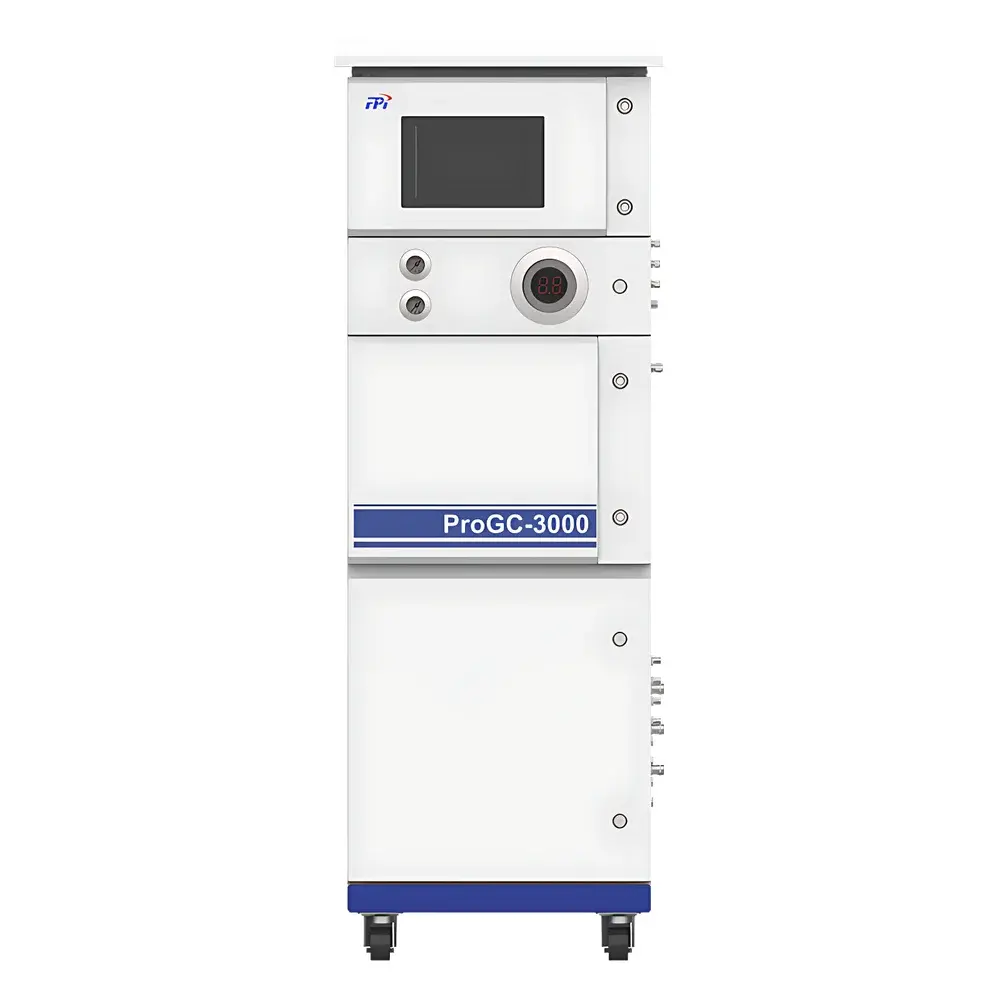
ProGC Series Industrial Online Gas Chromatograph
| Brand | FPI (Fortune Photonics Instrumentation) |
|---|---|
| Origin | Zhejiang, China |
| Manufacturer Type | OEM Manufacturer |
| Country of Origin | China |
| Model | ProGC Series |
| Pricing | Available Upon Request |
Overview
The ProGC Series Industrial Online Gas Chromatograph is a fully automated, process-integrated analytical instrument engineered for real-time, continuous compositional analysis of gaseous and volatile liquid streams in harsh industrial environments. Based on proven gas chromatography (GC) separation principles—utilizing temperature-programmed capillary or packed columns coupled with selective detectors (e.g., TCD, FID, or PID)—the system delivers high-resolution, quantitative determination of hydrocarbons, permanent gases, sulfur compounds, oxygenates, and other volatile organic components. Designed for unattended 24/7 operation, the ProGC integrates sample extraction, conditioning (filtration, pressure regulation, moisture removal), and precise injection into a single ruggedized platform compliant with Class I, Division 1 or Zone 1 hazardous area requirements (ATEX/IECEx certified variants available). Its architecture eliminates dependence on external analyzer shelters, enabling direct mounting at or near process taps to minimize transport line volume and ensure representative, low-lag measurements critical for advanced process control (APC) and safety interlock systems.
Key Features
- Integrated sample handling system featuring automated, programmable sampling valves, heated sample lines (up to 180 °C), and multi-stage conditioning (particulate filtration, coalescing, cryogenic or membrane-based dew point control)
- Explosion-proof enclosure rated to IP66/NEMA 4X and certified for hazardous locations per ATEX Directive 2014/34/EU (II 2G Ex d IIB T4 Gb) and/or IECEx standards
- Modular column oven and detector assembly allowing field-replacement of GC columns in under three hours without recalibration or system purge—reducing maintenance downtime by >85% versus conventional online GCs
- Self-diagnostic firmware continuously monitors operational health of critical subsystems: carrier gas pressure stability, detector baseline noise, valve actuation timing, oven temperature uniformity, and detector filament integrity
- Robust mechanical design optimized for vibration resistance (IEC 60068-2-6 compliant), wide ambient operating range (−20 °C to +55 °C), and long-term drift stability (<0.5% RSD over 30 days)
Sample Compatibility & Compliance
The ProGC Series accommodates a broad spectrum of process streams—including refinery off-gases, FCC unit vapors, hydrogen purity streams, syngas, natural gas blends, and pharmaceutical solvent recovery lines—without requiring pre-dilution or derivatization. Sample inlet pressure tolerance spans 0.1–1.6 MPa(g), with flow rates adjustable from 10–200 mL/min. All wetted materials comply with ASTM A269 TP316L stainless steel specifications; seals meet FDA 21 CFR 177.2600 for incidental food contact where applicable. The system supports compliance with ISO 8573-1 (compressed air purity), ASTM D1945/D1946 (gas analysis), and USP residual solvents testing protocols when configured with appropriate columns and calibration standards. Full audit trail, electronic signatures, and data integrity controls align with FDA 21 CFR Part 11 and EU Annex 11 requirements for regulated manufacturing environments.
Software & Data Management
The embedded Linux-based control software provides intuitive web-HMI access via secure HTTPS, supporting remote configuration, method scheduling, and real-time chromatogram visualization. Data export adheres to OPC UA (IEC 62541) and Modbus TCP protocols for seamless integration into DCS, MES, and PI System platforms. Calibration management includes automated bracketing, multi-point linear/nonlinear fitting, and uncertainty propagation reporting per ISO/IEC 17025 guidelines. Raw chromatographic data (time-stamped peak areas, retention times, baseline corrections) are stored locally on encrypted SSD with optional cloud synchronization (AWS IoT Core or Azure IoT Hub). Software revision history, user login logs, and parameter change tracking satisfy GLP/GMP documentation requirements.
Applications
- Refining: Continuous monitoring of naphtha splitter cuts, LPG composition, and hydrogen sulfide in amine regenerator overheads
- Petrochemicals: Real-time ethylene purity assurance, butadiene assay in C4 streams, and benzene/toluene/xylene (BTX) quantification
- Power Generation: Hydrogen coolant purity verification in turbine generators and trace moisture/oxygen detection in SF₆ switchgear
- Pharmaceutical Manufacturing: Residual solvent verification in API drying ovens and inert gas blanketing validation (N₂/Ar O₂ content)
- Metallurgy: Blast furnace top gas analysis for CO/CO₂/H₂ ratio optimization and sinter plant exhaust emissions monitoring
FAQ
What certifications does the ProGC Series hold for hazardous area installation?
The system is available with ATEX II 2G Ex d IIB T4 Gb and IECEx Ex d IIB T4 Gb certification; non-sparking (Ex nA) variants are offered for Zone 2 applications.
Can the ProGC be integrated into an existing DCS without third-party gateways?
Yes—native support for Modbus TCP and OPC UA enables direct communication with major DCS platforms (Emerson DeltaV, Honeywell Experion, Yokogawa CENTUM VP) without protocol converters.
How often does the system require calibration verification in continuous operation?
Under typical refinery conditions, calibration verification is recommended every 72 hours using certified span gases; automated verification cycles can be scheduled within the onboard software.
Is method transfer possible from laboratory GC systems to the ProGC platform?
Yes—retention time locking (RTL) and standardized column dimensions (e.g., 30 m × 0.32 mm ID fused silica) enable straightforward migration of validated lab methods with minimal re-optimization.
What level of cybersecurity protection is implemented in the embedded controller?
The device implements TLS 1.2 encryption, role-based access control (RBAC), disabled default credentials, and automatic security patching via signed firmware updates—meeting IEC 62443-3-3 SL2 requirements.