
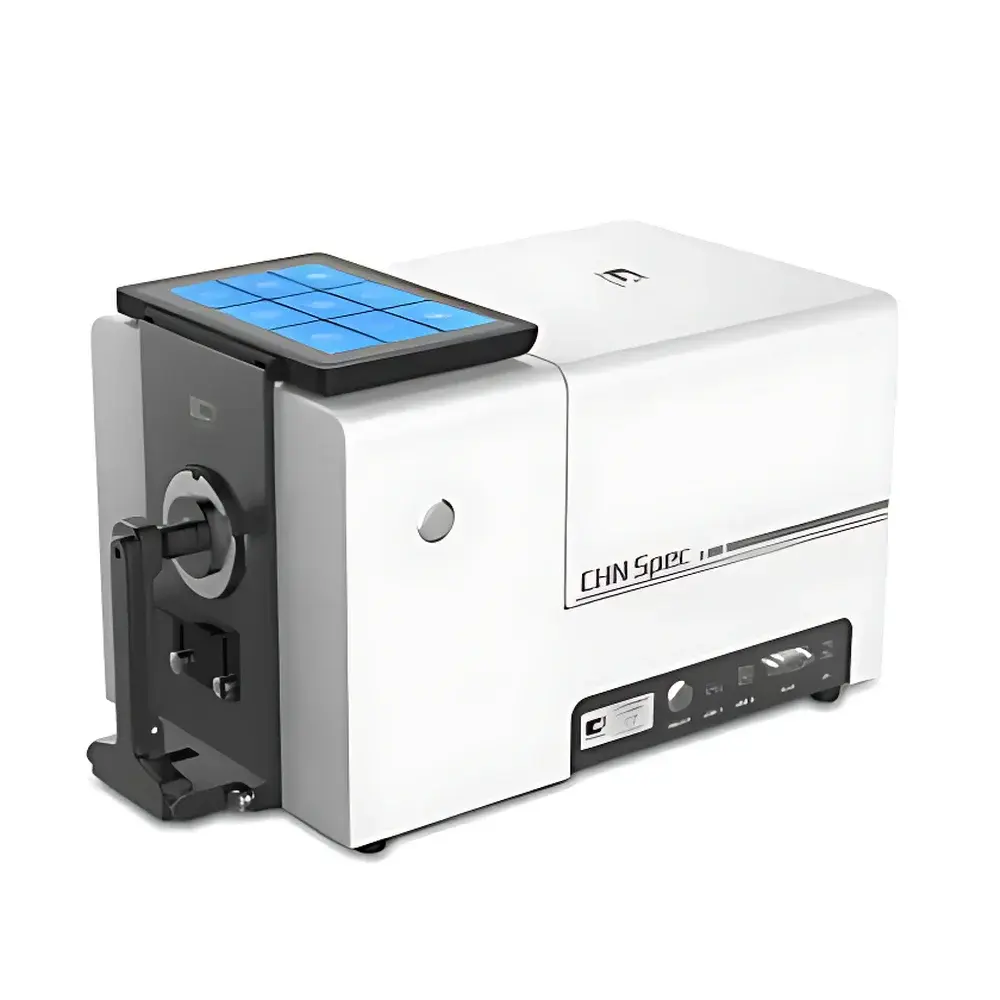
CS-821N High-Stability Desktop Spectrophotometric Colorimeter
| Brand | — |
|---|---|
| Origin | Zhejiang, China |
| Manufacturer Type | Authorized Distributor |
| Regional Classification | Domestic (China) |
| Model | CS-821N |
| Price Range | USD 4,200 – 7,000 |
| Product Category | Spectrophotometric Colorimeter |
| Instrument Type | Desktop |
| Optical Geometry | d/8° Integrating Sphere |
| Illumination Sources | Pulsed Xenon Lamp & LED |
| Repeatability | ΔE*ab ≤ 0.015 |
Overview
The CS-821N High-Stability Desktop Spectrophotometric Colorimeter is engineered for precision color measurement in quality control laboratories, R&D centers, and production environments where long-term measurement consistency is non-negotiable. It operates on the fundamental principle of spectrophotometric analysis—capturing full spectral reflectance (360–780 nm at 10 nm intervals) and transmittance data via a 152 mm diameter integrating sphere with concave grating dispersion and silicon photodiode array detection. Its d/8° optical geometry complies with CIE No. 15, ISO 7724-1, ASTM E1164, and GB/T 3978, enabling both SCI (Specular Component Included) and SCE (Specular Component Excluded) measurements simultaneously—critical for distinguishing surface texture effects from inherent material color. Unlike filter-based tristimulus meters, the CS-821N delivers traceable, physics-based color data suitable for regulatory documentation, inter-laboratory comparison, and spectral reconstruction.
Key Features
- Auto-calibration system with real-time drift compensation—maintains calibration integrity across ambient temperature fluctuations (20°C ±10°C) and humidity shifts without manual intervention.
- Dual illumination architecture: pulsed xenon lamp for high-intensity, UV-inclusive spectral capture and stable LED for rapid, low-heat routine measurements—enabling consistent performance over extended operational cycles.
- Comprehensive standard light source library: 24 CIE- and industry-standard illuminants (including D65, A, F2, TL84, LED-B1–B5, and UV-filtered variants at 400/420/460 nm cutoffs) supporting global color specification requirements.
- Integrated environmental compensation: on-board temperature and relative humidity sensors feed correction algorithms into spectral data processing—reducing measurement variance attributable to lab climate drift.
- 7-inch capacitive touchscreen running Android OS—providing intuitive navigation, multi-language UI (12 languages), and local data management without dependency on external PCs.
- Dual-path spectral acquisition: simultaneous SCI/SCE measurement in <2 seconds eliminates sequential mode errors and accelerates batch verification workflows.
- Modular aperture system: motorized recognition of 8 interchangeable reflective ports (Φ3–Φ30 mm) and 2 transmissive apertures (Φ17/Φ25 mm), with automatic gain adjustment per geometry.
Sample Compatibility & Compliance
The CS-821N accommodates diverse physical forms: opaque solids (e.g., painted panels, plastics, textiles), translucent films, liquids (in standard or micro-volume cuvettes), and powdered samples (using optional fiber test box or powder holder). Transmittance mode supports specimens up to 50 mm thick with unrestricted height—ideal for molded polymer blocks or laminated composites. All optical configurations adhere to ISO/IEC 17025-relevant traceability practices. Measurement protocols align with ASTM D1003 (haze/transparency), ASTM E313 (whiteness/yellowness), ISO 2846 (printing inks), AATCC TM173 (colorfastness), and GB/T 18833 (retroreflective materials). The instrument’s spectral output meets GLP documentation standards, with audit-ready metadata (timestamp, operator ID, environmental conditions, calibration status) embedded in each exported .spc or .csv file.
Software & Data Management
Built-in Android OS hosts a dedicated color management suite supporting spectral data export in CIE-compliant formats (.spc, .cie, .txt), as well as direct integration with third-party QC software via RS-232 or USB virtual COM port. The included PC-side ColorManager Pro software enables advanced functions: spectral difference mapping, metamerism index calculation (MI), whiteness/yellowness trending per ASTM E313-20, APHA/Pt-Co and Gardner scale quantification for liquid clarity, and pass/fail thresholding against master standards. All measurement sessions are time-stamped and logged with full environmental context. While not natively 21 CFR Part 11 compliant, the system supports external validation protocols—including electronic signature integration, user access levels, and immutable audit trails—when deployed within validated laboratory information management systems (LIMS).
Applications
- Pigment and coating formulation labs requiring repeatable ΔE*00 comparisons across raw material batches.
- Automotive OEM suppliers performing interior trim color matching under multiple illuminants (D65, A, F12) per SAE J1545.
- Pharmaceutical packaging QA verifying label ink consistency and blister foil reflectance per USP <1061>.
- Textile mills assessing dye lot uniformity and evaluating metamerism risk between retail lighting (LED-B2) and daylight (D65).
- Plastics processors monitoring yellowness index (YI) drift during thermal aging studies per ASTM D1925.
- Food and beverage labs quantifying liquid color in APHA, Gardner, or Saybolt scales using standardized cuvette holders.
FAQ
Does the CS-821N support FDA 21 CFR Part 11 compliance?
The instrument itself does not include built-in electronic signature or role-based access controls required for Part 11. However, its structured data export and timestamped audit logs enable integration into validated LIMS or ELN platforms that provide full Part 11 functionality.
Can it measure metallic or pearlescent coatings accurately?
Yes—via its dual-angle SCE/SCI mode and 25.4 mm XLAV port, which minimizes spatial averaging artifacts common with effect pigments. For directional appearance assessment, pairing with optional articulating fixtures (e.g., vertical stand or pneumatic sample press) is recommended.
What is the spectral bandwidth and how is it verified?
The effective optical resolution is 1.6 nm (FWHM), determined by the concave grating design and detector pixel pitch. Verification is performed using NIST-traceable holmium oxide and didymium filters during factory calibration.
Is UV calibration included in routine white tile verification?
Standard white ceramic tile calibration validates visible-range response only. UV component accuracy requires separate verification using a certified UV-transmitting standard (e.g., BaSO₄-coated plate with documented UV reflectance curve), available as an optional accessory.
How often must the instrument be recalibrated?
Under stable lab conditions (±2°C, <60% RH), annual factory recalibration is recommended. In dynamic environments, quarterly verification against supplied black cavity and white/gray/green calibration tiles—supported by the auto-compensation algorithm—is sufficient to maintain ΔE*ab ≤ 0.015 repeatability.





