
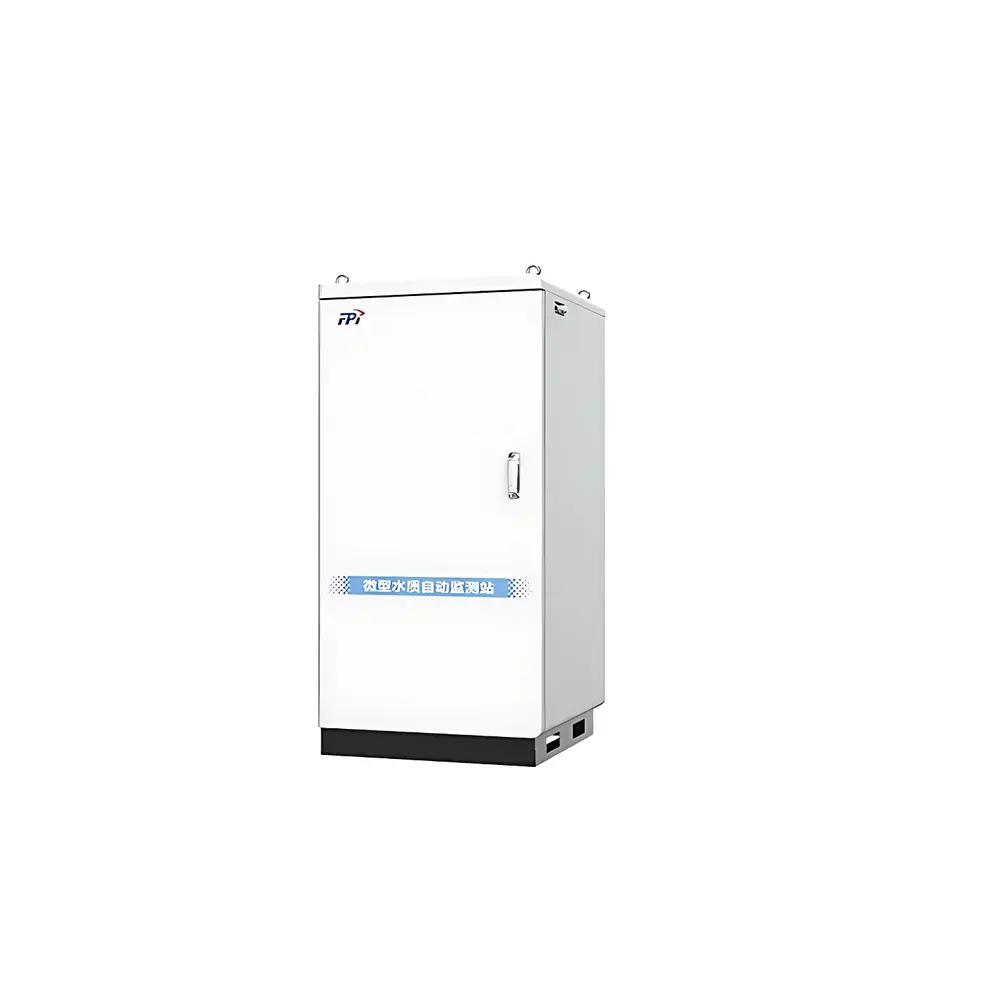
FPI AMSW-1100 Integrated Compact Online Water Quality Monitoring Station (0.5 m² Footprint)
| Brand | FPI |
|---|---|
| Origin | Zhejiang, China |
| Manufacturer Type | OEM/ODM Producer |
| Country of Origin | China |
| Model | AMSW-1100 |
| Pricing | Available Upon Request |
Overview
The FPI AMSW-1100 Integrated Compact Online Water Quality Monitoring Station is an engineered solution for continuous, unattended water quality surveillance in space-constrained and off-grid environments. Designed around Couette-flow-based wet-chemistry analytical modules and multi-parameter electrochemical/optical sensor integration, the system implements standardized wet chemical methods—including dichromate digestion for COD, Nesslerization or salicylate for ammonia nitrogen, molybdenum blue for total phosphorus, and alkaline persulfate UV digestion for total nitrogen—aligned with Chinese National Standards (e.g., HJ 399–2017, HJ 535–2009, HJ 671–2013, HJ 636–2012). Its modular architecture integrates sampling, filtration, pH/temperature compensation, reagent dosing, reaction timing, photometric detection, and waste handling within a single weatherproof enclosure measuring under 0.5 m²—making it suitable for deployment at wastewater lift stations, decentralized rural treatment facilities, combined sewer overflows (CSOs), and surface water intake points where civil infrastructure is minimal or absent.
Key Features
- Compact outdoor-rated cabinet design with footprint ≤ 0.5 m²—enabling installation in utility corridors, pump station kiosks, or roadside cabinets without structural modification.
- Full compliance with GB/T 35217–2017 (Technical Specifications for Online Water Quality Monitoring Systems) and method-specific national standards for all measured parameters (CODCr, NH3-N, TP, TN, pH, turbidity, temperature).
- Integrated environmental safety layer: built-in smoke and temperature sensors with relay-triggered alarm output; optional IP66-rated PTZ camera module with motion-triggered recording and RTSP streaming support.
- Low operational footprint: average power consumption < 80 W (AC mode); solar-ready configuration supports 12 V/24 V DC input with MPPT charge controller and LiFePO₄ battery backup (72 Ah typical).
- Dual-outlet valve manifold enables alternating sampling from two discharge points using a single inlet—reducing hardware redundancy while maintaining temporal resolution across multiple flow paths.
- Modular reagent packs with RFID-tagged cartridges ensure traceable consumables management and automatic low-reagent alerting via embedded PLC logic.
Sample Compatibility & Compliance
The AMSW-1100 accepts raw influent and effluent samples with suspended solids ≤ 50 mg/L (pre-filtered via 80 µm stainless-steel sieve integrated in the intake assembly). It operates reliably across ambient temperatures from −20 °C to +50 °C and relative humidity up to 95% non-condensing. All analytical modules undergo factory calibration verification against NIST-traceable reference standards (e.g., potassium hydrogen phthalate for COD, ammonium chloride for NH3-N). Data integrity meets GLP-aligned requirements: audit trails record calibration events, maintenance logs, reagent lot numbers, and sensor drift corrections. While not certified to IEC 61508 or EN 14181, the system supports third-party validation per ISO/IEC 17025 when operated under documented QA/QC protocols.
Software & Data Management
The station runs FPI’s proprietary EdgeMonitor™ firmware (v4.2+), featuring embedded Modbus TCP, MQTT 3.1.1, and HTTP RESTful API interfaces. Local data storage retains ≥ 90 days of 15-minute interval records on industrial-grade microSD (32 GB). Remote access is enabled via TLS 1.2-secured web interface or FPI CloudLink™ platform—supporting role-based user permissions, configurable alarm thresholds (email/SMS), and automated report generation (PDF/CSV) compliant with China’s Ministry of Ecology and Environment (MEE) reporting templates. Audit logs capture all configuration changes and manual overrides, satisfying basic FDA 21 CFR Part 11 principles for electronic records—though full Part 11 compliance requires on-site validation and procedural controls.
Applications
- Real-time performance verification at decentralized rural wastewater treatment plants (WWTPs), including inflow/outflow nutrient load balancing.
- Early-warning monitoring of urban surface water bodies (rivers, canals, reservoir perimeters) for organic loading spikes or nutrient enrichment events.
- Dynamic characterization of wastewater conveyance networks—detecting infiltration/inflow anomalies, blockage precursors, or illicit discharges via multi-parameter trend analysis.
- Regulatory compliance tracking at combined sewer overflow (CSO) structures, supporting MEE Order No. 15 (2020) requirements for event-driven water quality reporting.
- Supplemental monitoring in industrial park effluent channels where centralized lab access is limited and rapid response to parameter excursions is critical.
FAQ
What power supply options are supported?
The AMSW-1100 operates on 220 VAC ±10%, 50 Hz, or DC 12–24 V input. Solar configurations include a 150 W PV panel, MPPT charge controller, and 24 V/72 Ah LiFePO₄ battery bank with 72-hour autonomy under nominal load.
Can the system be integrated into existing SCADA platforms?
Yes—via native Modbus TCP (holding registers mapped to all real-time parameters and status flags) or MQTT topics structured by parameter ID and timestamp. FPI provides detailed register maps and topic schemas upon request.
How often do reagents need replacement?
Typical reagent cartridge lifespan: 30 days at 15-minute measurement intervals for COD/NH₃-N/TP/TN; pH and turbidity sensors require quarterly verification but no consumables.
Is remote firmware update capability available?
Yes—over-the-air (OTA) updates are supported via HTTPS-initiated package download and atomic firmware swap, preserving configuration and historical data during upgrade.
Does the system support external probe integration (e.g., dissolved oxygen, conductivity)?
The control unit includes four configurable analog inputs (4–20 mA / 0–5 V) and two RS485 ports, enabling connection of third-party sensors with appropriate signal conditioning and protocol translation.







