
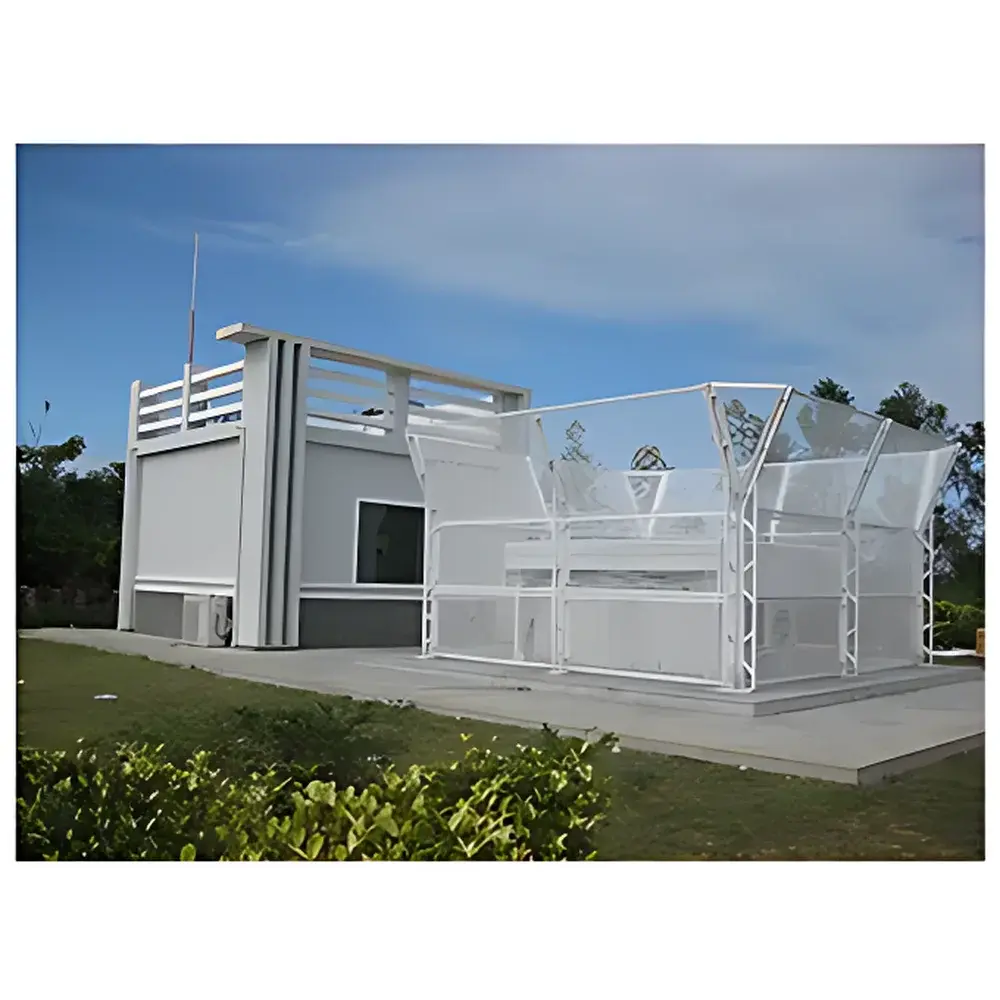
FPI Wind Profiler Radar WPR-Series
| Brand | FPI (Focus Photonics Inc.) |
|---|---|
| Origin | Zhejiang, China |
| Manufacturer Type | Original Equipment Manufacturer (OEM) |
| Country of Origin | China |
| Model | WPR-Series |
| Laser Source | Not applicable (UHF/VHF passive radar principle) |
| Detector | Coherent pulsed Doppler receiver with 16-bit A/D sampling |
| Operating Frequency Band | UHF (915 MHz) or VHF (50 MHz typical, configurable) |
| Maximum Detection Altitude | Up to 12 km (dependent on frequency band and atmospheric conditions) |
| Pulse Repetition Frequency (PRF) | Configurable, typically 100–2,000 Hz |
| Measurement Parameters | Horizontal wind vector (u/v), vertical velocity (w), virtual temperature gradient, refractivity structure parameter (Cn²) |
| Compliance | Designed per MIL-STD-810G environmental ruggedization |
Overview
The FPI Wind Profiler Radar (WPR-Series) is a solid-state, coherent pulsed Doppler radar system engineered for continuous, all-weather, remote sensing of the lower and middle troposphere. Unlike lidar-based systems, it operates in the UHF (e.g., 915 MHz) or VHF (e.g., 50 MHz) radio frequency bands—enabling robust detection of Bragg scattering from turbulent fluctuations in atmospheric refractivity. This physical principle allows quantitative retrieval of horizontal wind components (zonal and meridional), vertical air motion, virtual temperature gradients, and the atmospheric refractivity structure constant (Cn²)—a key turbulence intensity metric. The system employs an active electronically scanned array (AESA) architecture with distributed transmit/receive modules, eliminating mechanical scanning and ensuring high temporal resolution (as low as 30-second vertical profiles) and long-term operational stability. It is not a laser-based instrument; therefore, no optical laser source, wavelength, or photodetector specifications apply. Its design targets boundary-layer meteorology, aviation weather support, and environmental dispersion modeling where persistent, unattended operation under variable climatic conditions is essential.
Key Features
- Active Electronically Scanned Array (AESA) architecture with fully solid-state transmit/receive modules—no moving parts, high MTBF (>15,000 hrs), and immunity to mechanical wear
- Configurable dual-band operation (UHF and VHF variants) optimized for different altitude coverage: UHF for 0.1–6 km AGL (boundary layer focus), VHF for 1–12 km AGL (deep tropospheric profiling)
- 16-bit high-dynamic-range digital receiver with real-time coherent integration—ensuring sensitivity down to −140 dBZ reflectivity-equivalent signal levels
- MIL-STD-810G-compliant environmental hardening: IP66-rated enclosure, -30°C to +55°C operating range, salt fog, dust, and vibration resistance
- Triple-protection design (anti-corrosion, anti-moisture, anti-UV) aligned with military-grade field deployment standards
- Embedded safety interlocks and RF exposure mitigation per ICNIRP/IEEE C95.1 guidelines—compliant with occupational electromagnetic field limits
- Fully integrated timing via GPS-disciplined oscillator (GPSDO) for microsecond-level pulse synchronization and networked multi-radar coherence
Sample Compatibility & Compliance
The WPR-Series does not require physical sample introduction—it performs non-intrusive, volumetric remote sensing of the atmosphere. It complies with international observational standards including WMO Guide to Instruments and Methods of Observation (CIMO Guide, Chapter 11), and its data products are structured to meet BUFR/CREX encoding requirements for global exchange via GTS. Raw IQ data and Level-2 geophysical products (wind vectors, Cn², σw) are generated in netCDF-4/HDF5 format with CF-1.8 metadata conventions. For regulated environments (e.g., airport meteorological offices or national weather services), optional audit-trail-enabled data logging satisfies ICAO Annex 3 and FAA AC 00-6B traceability requirements. System firmware and processing algorithms undergo annual verification against NCAR/NOAA wind profiler validation protocols.
Software & Data Management
- Real-time visualization and control via FPI WindView™ v4.x—a Qt-based GUI supporting multi-radar mosaic display, vertical cross-sections, time-height sections, and automated shear/turbulence alerts
- Automated data ingestion into PostgreSQL/PostGIS databases with RESTful API endpoints for integration with WRF-NMM, HYSPLIT, or EDR forecasting pipelines
- Comprehensive data provenance tracking: every profile includes timestamps (UTC + GPS nanosecond precision), antenna pointing metadata, calibration status flags, and noise-floor diagnostics
- Optional FDA 21 CFR Part 11-compliant mode with electronic signatures, role-based access control (RBAC), and immutable audit logs for GLP/GMP-aligned operational deployments
- Remote firmware updates via secure TLS 1.3 channel; OTA rollback capability ensures system recoverability
Applications
The WPR-Series serves mission-critical roles across civil, defense, and research domains. In aviation meteorology, it delivers high-temporal-resolution vertical wind shear and microburst precursor detection within 20 km of runway thresholds—directly feeding into LLWAS replacement architectures and ATC decision support tools. For environmental monitoring, it quantifies plume rise dynamics and transport pathways during dust storm events, industrial stack emissions, or wildfire smoke dispersion—enabling inverse modeling of source strength using adjoint techniques. In mesoscale research, synchronized networks of WPR units support validation of convection-permitting NWP models (e.g., COSMO, ARW-WRF) at sub-kilometer vertical resolution. It is routinely deployed in DOE ARM Mobile Facilities, NASA CAMP2Ex campaigns, and national hydrometeorological observatories requiring >95% annual data availability.
FAQ
Does this system use laser technology?
No. The WPR-Series is a radio-wave Doppler radar operating in UHF or VHF bands. It relies on Bragg scattering from refractive index irregularities—not optical backscatter—and contains no laser source or photodetector.
What is the maximum altitude coverage?
UHF variant: up to 6 km AGL under standard atmospheric conditions; VHF variant: up to 12 km AGL. Actual height coverage depends on transmitted power, antenna gain, and atmospheric signal-to-noise ratio.
Is the system compliant with aviation weather reporting standards?
Yes. Output formats and metadata structures conform to ICAO Annex 3, WMO BUFR Table D, and FAA AC 00-6B for integration into ASOS/AWOS and TDWR infrastructure.
Can multiple units be synchronized for 3D wind field reconstruction?
Yes. GPS-disciplined timing and configurable PRF allow phase-coherent multi-static operation. FPI provides turnkey network configuration tools and joint retrieval algorithms for volumetric wind tomography.
What maintenance is required for long-term unattended operation?
Annual calibration verification (antenna pattern, receiver linearity, timing offset) is recommended. No routine consumables or optical alignment are needed due to solid-state design and sealed AESA modules.







